
能源储存装置

Search documents
宁德时代股价异动,纳入恒指与业绩稳健成主因
Jing Ji Guan Cha Wang· 2026-02-23 09:46
Group 1 - The core point of the article highlights the stock price movement of CATL, which rose by 3.14% to close at 542.50 HKD on February 23, 2026, influenced by its inclusion in the Hang Seng Index and strong market performance [1] - CATL's Q3 2025 report shows a robust performance with a net profit of 49.034 billion CNY, representing a year-on-year increase of 36.20%. The energy storage business is emerging as a second growth curve with a higher gross margin than power batteries [1] - The company is accelerating its global capacity expansion, with the first phase of its Hungary factory expected to be completed by the end of 2025, while domestic expansions in Shandong and Guangdong are ongoing [1] Group 2 - The stock market sentiment is positive, with technical indicators showing that the stock price is above the 20-day moving average and the MACD histogram is in positive territory [2] - A total of 16 institutions are covering CATL in February 2026, with 94% giving a "buy" or "hold" rating, and the average target price set at 619.99 HKD [2] - The termination of the equity swap transaction with Yongtai Technology is interpreted by the market as a reduction in cooperation uncertainty, contributing to a more favorable funding environment [1]

港股收评:三大指数集体下跌!教育股逆势上涨,贵金属急回调
Ge Long Hui· 2026-01-30 08:48
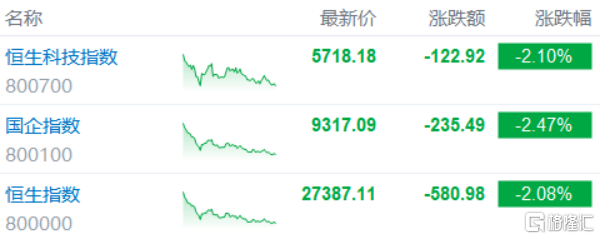
Market Performance - The Hong Kong stock market indices showed weak performance on January 30, with the Hang Seng Index falling by 2.08% to 27,387.11 points, the Hang Seng China Enterprises Index down by 2.47%, and the Hang Seng Tech Index decreasing by 2.1% [1][2] - For the month, the Hang Seng Index recorded a cumulative increase of 6.85%, briefly surpassing 28,000 points, marking a four-year high, while the Hang Seng China Enterprises Index rose by 4.53% and the Hang Seng Tech Index increased by 3.67% [1] Sector Performance - Major technology stocks mostly declined, with Kuaishou and Xiaomi dropping over 3%, and Tencent falling by 2.57% [2][4] - Precious metals experienced a significant sell-off, with gold, aluminum, and copper prices retreating sharply [2] - The application software sector continued to decline, with Kingdee International dropping by 7.7% and Kingsoft falling nearly 4% [2] - Local retail stocks in Hong Kong saw widespread declines, with Chow Tai Fook down by 6.7% [2] - Some education stocks rose against the trend, with China Spring rising over 22% and New Oriental increasing by 5.5% [2][14] Specific Stock Movements - Kingdee International's stock price fell to 12.95 HKD, down 7.7% [5] - Kuaishou's stock price decreased to 80.15 HKD, down 3.38% [5] - Tencent's stock price fell to 606.00 HKD, down 2.57% [5] - Precious metal stocks like Chifeng Jilong Gold and Shandong Gold saw declines of over 14% [7] - Ganfeng Lithium's stock price dropped by 10.90% to 60.50 HKD [9] Educational Sector Insights - New Oriental reported a net revenue of 1.19 billion USD for Q2 of FY2026, a year-on-year increase of 14.7%, with a net profit of 45.45 million USD, up 42.3% [14] - The management expressed confidence in exceeding annual targets, with a profit margin expansion of 300 basis points [14] Capital Flows - Southbound funds recorded a net inflow of 3.218 billion HKD, with 2.036 billion HKD from the Shanghai-Hong Kong Stock Connect and 1.182 billion HKD from the Shenzhen-Hong Kong Stock Connect [20] Market Outlook - According to Everbright Securities, the Hong Kong stock market is expected to trend positively due to earnings recovery, improved liquidity, low valuations, and policy support, with a structural rebound anticipated in Q1 [22]

偏好新经济领域 险资加速掘金港股
Bei Jing Shang Bao· 2025-10-21 15:35
Core Viewpoint - The Hong Kong IPO market has seen significant activity this year, with insurance capital becoming a notable force as cornerstone investors in new listings, reflecting a shift in investment strategy towards stable returns in the context of favorable market conditions [1][2]. Group 1: Insurance Capital Participation - Insurance institutions have participated as cornerstone investors in 7 Hong Kong IPOs this year, with a total subscription amount of approximately 34.4 billion HKD, which is more than three times the total of less than 10 billion HKD from the previous year [1]. - The participation of insurance capital in Hong Kong IPOs is driven by the need for stable investment returns, the relatively low valuations in the market, and supportive regulatory policies encouraging long-term investments [1][2]. Group 2: Active Insurance Institutions - Among the most active insurance institutions in the Hong Kong IPO market are Taikang Life and China Pacific Insurance, with Taikang Life participating in 6 IPOs, while China Pacific Insurance and its subsidiaries have appeared twice as cornerstone investors [3]. - Other participants include Zhongyou Insurance and Dajia Life, each participating in one IPO as cornerstone investors [3]. Group 3: Investment Preferences - Insurance capital shows a preference for sectors such as technology, consumer goods, and new energy, including industries like automotive, home appliances, semiconductors, and energy storage [3]. - This investment strategy aligns with the growth potential of new economy sectors and the national industrial development direction, indicating a focus on high-growth and quality assets [3].

险资加速掘金港股IPO,选股逻辑看重什么?
Bei Jing Shang Bao· 2025-10-21 12:23
Core Insights - The Hong Kong IPO market has seen significant activity this year, with insurance capital becoming a notable force as cornerstone investors in new listings [1][3] - Taikang Life has participated in the IPO of Cambridge Technology, marking a trend where insurance institutions are increasingly involved in Hong Kong IPOs [1][3] Group 1: Investment Trends - Insurance institutions have collectively invested over 34.4 billion HKD in seven Hong Kong IPOs this year, a substantial increase compared to less than 10 billion HKD for the entire previous year [3][5] - The participation of insurance funds as cornerstone investors is driven by the need for stable returns, the relatively low valuations in the Hong Kong market, and supportive policies encouraging long-term investments [3][4] Group 2: Sector Preferences - Insurance capital shows a preference for sectors such as technology, consumer goods, and new energy, including industries like automotive, home appliances, semiconductors, and energy storage [5] - The focus on these sectors aligns with the growth potential and national industrial development directions, indicating a strategic approach to asset allocation [5] Group 3: Regulatory Environment - Recent regulatory policies have encouraged insurance funds to adopt a long-term investment strategy, extending assessment periods to promote stability in investment practices [4]


港股市场能源储存装置概念股拉升,龙蟠科技一度拉升涨近29%,瑞浦兰钧一度拉升涨超23%
Ge Long Hui· 2025-08-11 06:27
Group 1 - The core viewpoint of the article highlights a significant rise in energy storage device concept stocks in the Hong Kong market, with notable increases in specific companies [1] - Longpan Technology (龙蟠科技) experienced a surge, rising nearly 29% at one point [1] - Ruipulan (瑞浦兰) saw an increase of over 23% during the trading session [1]

港股能源储存装置概念股拉升
Jin Rong Jie· 2025-08-11 05:52
Group 1 - The core viewpoint of the article highlights a significant rise in energy storage concept stocks in the Hong Kong stock market, with Longpan Technology experiencing a surge of nearly 29% and Ruipu Lanjun rising over 23% [1]
外资配置AH的审美差异
Changjiang Securities· 2025-07-16 11:30
Group 1: Foreign Capital Flow - In Q2 2025, northbound funds showed a net inflow of approximately 53.74 billion CNY, an increase compared to Q1 2025[2] - Foreign capital in A-shares saw significant net inflows in the financial, industrial, telecommunications, and healthcare sectors, each exceeding 10 billion CNY[6] - In contrast, foreign capital in the Hong Kong stock market experienced a net outflow of about 113.3 billion HKD in Q2 2025 compared to Q1 2025[6] Group 2: Sector Performance - The technology and financial sectors were among the top performers in the Hong Kong market, contributing to significant profit-taking activities in Q2 2025[8] - Specific A-share manufacturing leaders attracted substantial foreign investment during their Hong Kong IPOs, particularly in the energy storage sector[19] - The banking sector saw a divergence in foreign investment, with northbound funds increasing their holdings in A-share banks while foreign intermediaries reduced their holdings in Hong Kong banks[27] Group 3: Investment Trends - The top sectors for foreign capital inflow in the Hong Kong market included information technology, industrials, and essential consumer goods[6] - Notably, the energy storage devices and telecommunications equipment sectors attracted significant foreign investment in Hong Kong[20] - The report highlights a trend where foreign capital is favoring technology and new consumption sectors in Hong Kong, while A-shares are more focused on industrial and financial sectors[22]