
蔬菜种植业

Search documents
屯昌推进8个涉农项目
Hai Nan Ri Bao· 2026-01-27 02:30
Group 1 - The core viewpoint of the article emphasizes the importance of agricultural projects in ensuring food supply and enhancing the quality of life for local communities [2] - The Tunchang County has integrated nearly 200 million yuan in rural revitalization funds since 2025 to accelerate the construction of eight agricultural projects, including a black pig ecological breeding demonstration base [2] - Once operational, the black pig breeding base is expected to generate approximately 9 million yuan in annual revenue for over 60 village collectives [2] Group 2 - The black pig breeding base will have a capacity of over 3,000 breeding sows and is projected to produce 70,000 piglets, 36,000 fattened pigs, and 34,000 piglets annually upon reaching full production [2] - A 1,000-acre emergency supply vegetable base is also under construction, expected to yield produce around the Chinese New Year [2] - Tunchang County is enhancing its agricultural product supply chain through a "direct supply + centralized procurement" model, improving the availability of affordable vegetables and upgrading "reliable grain and oil stores" [2][3] Group 3 - To address the gap in human resource supply and demand, Tunchang authorities are establishing a specialized labor service platform and have signed labor dispatch contracts with nearly 100 units [3] - Over 50 recruitment events have been conducted since 2025, creating 500 new job opportunities in agricultural bases [3] - This initiative effectively connects job seekers with available positions, facilitating employment in the region [3]
双冷青海 鲜销四海
Xin Lang Cai Jing· 2025-12-30 18:06
Group 1: Core Insights - Qinghai is leveraging its unique cool climate and pure glacial meltwater to create industrial miracles, producing cold-weather vegetables and highland salmon for international markets [1][2] - Since the beginning of the 14th Five-Year Plan, Qinghai has exported green organic agricultural and livestock products valued at 55.91 billion yuan, contributing to high-quality development [1][3] Group 2: Cold-weather Vegetables - Cold-weather vegetables thrive in high-altitude, cool climates, with optimal growth temperatures between 17°C and 25°C, making Qinghai's Haidong region ideal for such crops [1] - In the first ten months of this year, Qinghai's Haidong city exported 10,382.7 tons of cold-weather vegetables, surpassing the 10,000-ton mark, with over 20 varieties now available [1] Group 3: Highland Salmon - The Dragon Sheep Gorge salmon is cultivated in an ideal environment with an average water temperature of 12°C, allowing for year-round farming [2] - The salmon is exported to over ten countries and regions, with a market share exceeding 50% in the domestic salmon market [2] Group 4: Organic Agricultural Products - From 2021 to June of this year, Qinghai has exported 3.248 million tons of green organic agricultural and livestock products valued at 55.91 billion yuan [3] - Qinghai has established itself as a major production base for organic livestock and specialty agricultural products, with significant growth in both cold-water fish and cold-weather vegetable sectors [3]
民生消费观察:猪肉价缓慢下降 蔬菜供应充足价格稳定
Yang Shi Wang· 2025-12-10 08:06
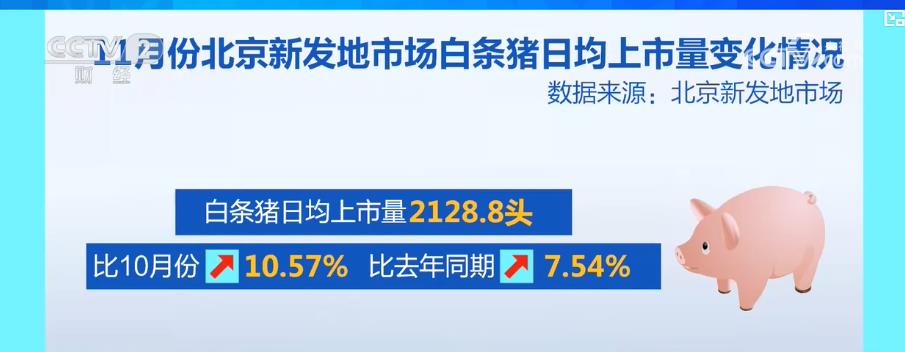
Group 1 - In November, the national pork price was 23.05 yuan per kilogram, a month-on-month decrease of 1.5%, while the national live pig price was 12.55 yuan per kilogram, down 0.2% month-on-month [1][3] - The average daily market supply of white strip pigs in Beijing's Xinfadi market was 2,128.8 heads, an increase of 10.57% compared to October, leading to the highest pork supply level this year and prices at a low point compared to the same period in the last five years [3] - Continuous decline in pork and live pig prices for four consecutive weeks in November indicates a weak demand during the peak season, with southern regions experiencing delayed and scattered consumption [5] Group 2 - As of the end of October, the number of breeding sows nationwide was 39.9 million, a decrease of 1.1% month-on-month and 2.1% year-on-year, marking a significant reduction from the peak last year [7] - The slaughter volume of live pigs in designated enterprises increased by 7.0% month-on-month and 26.2% year-on-year in October, continuing a trend of over 35 million heads for two consecutive months, with November expected to maintain this growth [5]

宁夏农业现代化步履铿锵:“六特”产业激活乡村共富新引擎
Zhong Guo Xin Wen Wang· 2025-11-30 00:21
Core Viewpoint - Ningxia is witnessing a significant agricultural transformation, with the "Six Special" industries driving rural revitalization and economic growth, as evidenced by the increase in primary industry value added from 33.808 billion yuan in 2020 to 45.124 billion yuan in 2024, reflecting an annual growth rate of 5.8%, surpassing the national average by 1.1 percentage points [1] Group 1: Development of "Six Special" Industries - The "Six Special" industries, including cool-season vegetables, Tan sheep, and milk, have become national advantageous industrial clusters, establishing a complete industrial chain from breeding to processing and sales [2] - The cooperative model involving enterprises and universities has led to the development of specialized feed and a stable annual processing and sales volume of 5,000 Tan sheep in a village previously affected by sandstorms [2] Group 2: Digital Transformation in Agriculture - The transition from traditional farming to smart agriculture is highlighted by the use of a digital agriculture platform that enhances irrigation efficiency and crop management, significantly improving productivity [3] - Technologies such as embryo transfer have increased the good breed rate of beef cattle to 85%, and digital management systems for Tan sheep have achieved a survival rate of 96% [3] Group 3: Shared Economic Benefits - The collective income of villages in Ningxia is projected to reach 2.38 billion yuan by the end of 2024, with 85.6% of villages achieving stable operational income, and over 40% of rural residents' disposable income coming from special industries [4] - Training programs for high-quality farmers have reached 450,000 participants, contributing to the modernization of agriculture and enhancing the skill set of the workforce [4]
稻浪千重“慧”种 蔗海万顷“智”理
Guang Xi Ri Bao· 2025-11-11 02:09
Core Insights - The event "Intelligent Gathering in Ba Gui: Academics and Experts' Visit for High-Quality Development of Characteristic Agriculture in Guangxi" aims to enhance the agricultural sector in Guangxi through smart technology and expert guidance [1] - The focus is on achieving food security and improving grain production capacity through smart agriculture, with the first unmanned rice farm in Guangxi demonstrating significant yield [2] - The integration of AI in agriculture is expected to attract younger generations to the sector by addressing labor shortages and improving production efficiency [2] Group 1: Smart Agriculture Initiatives - The first unmanned rice farm in Guangxi achieved a yield of 1,051.89 kg per mu, with the "Wei Liang You 8612" variety consistently exceeding 1,000 kg per mu for two consecutive years [2] - The farm utilizes a range of smart equipment, including unmanned tractors and drones, to manage the entire rice production process digitally [2] - Experts emphasize the importance of smart technology in addressing rural labor shortages and enhancing agricultural productivity [2] Group 2: Aquaculture and Smart Technology - Smart aquaculture is being developed in Guangxi, with real-time monitoring of water quality in modern fish farming facilities [3] - The system alerts farmers when water quality exceeds safe limits, promoting a shift towards ecological farming practices [3] - Collaboration between research teams and local enterprises aims to enhance the entire fish farming process through smart technology [3] Group 3: Sugarcane Production Challenges - The hilly terrain in Guangxi poses challenges for mechanization and smart technology in sugarcane production [3] - Experts recommend improving land suitability for machinery through terrain modification and developing specialized equipment for hilly areas [3] - The promotion of a "step-by-step harvesting" model is being implemented to address harvesting difficulties in small and sloped fields [3] Group 4: Agricultural Technology Exchange - Guangxi is positioned as a potential agricultural technology export hub to ASEAN countries facing similar agricultural challenges [4] - The region can enhance economic cooperation through technology transfer, product exports, and skills training [4] - The integration of traditional breeding methods with modern technology is seen as a way to enhance the competitiveness of local crop varieties [4] Group 5: AI in Breeding and Crop Management - AI technology is being utilized to improve breeding efficiency and shorten breeding cycles for rice and vegetable varieties [5] - Experts suggest focusing on quality improvement in crop varieties, particularly for high-temperature and high-humidity conditions in Guangxi [5] - AI models can also optimize field management by predicting pest and disease outbreaks based on climate data [5] Group 6: Events and Expert Engagement - The event included various activities such as the 2025 Smart Agriculture Expo and the closing ceremony of the Smart Agriculture Innovation Competition, facilitating exchanges between experts and local agricultural representatives [6] - The insights and recommendations from experts are expected to drive the transformation and upgrading of Guangxi's agricultural sector [6]