连锁加盟

Search documents
中国连锁加盟商业发展白皮书2026
Hong Can Chan Ye Yan Jiu Yuan· 2026-01-31 09:42
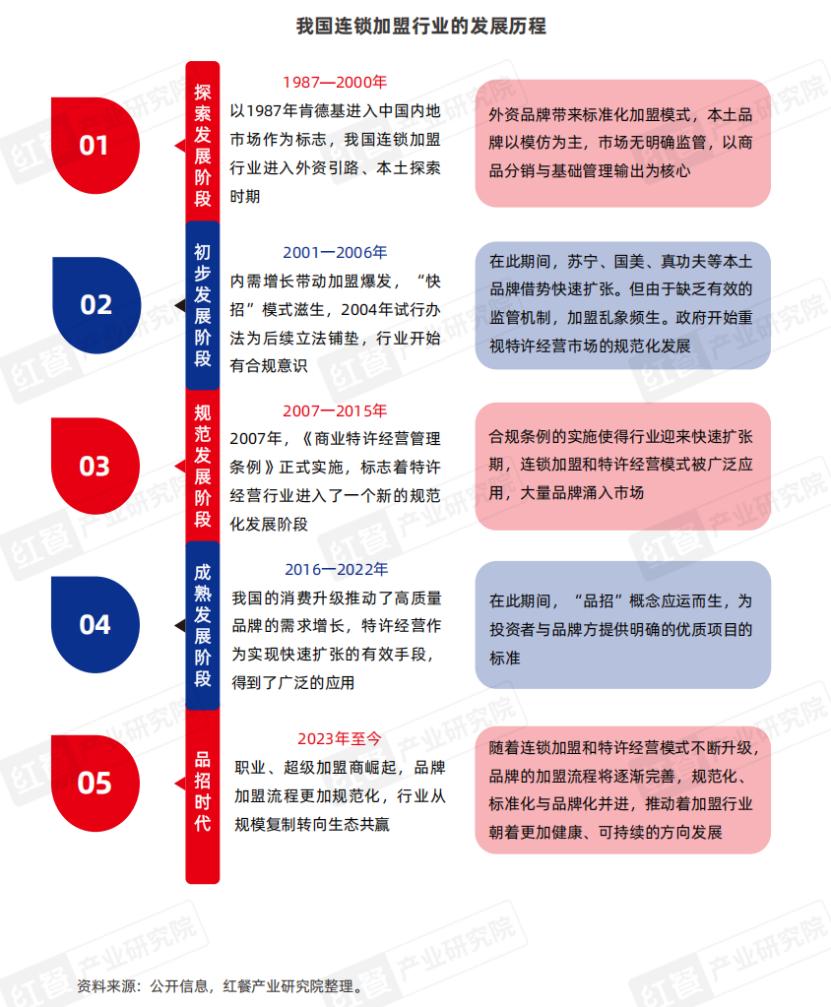
Investment Rating - The report does not explicitly provide an investment rating for the chain franchise industry in China Core Insights - The scale of China's chain franchise industry is approaching 3 trillion yuan, with the "brand invitation" model gradually becoming the mainstream of the industry [7][21] - The industry has undergone five stages of development, transitioning towards compliance, professionalism, and ecological upgrades [8] - The rise of professional and super franchisees is reshaping the market, with a focus on standardized and regulated franchise processes [9][18] - The shift from a "quick franchise" model to a "brand invitation" model emphasizes long-term value and operational quality [33] Summary by Sections 1. Industry Overview - China's chain franchise industry is nearing a scale of 3 trillion yuan, with the brand invitation model becoming the mainstream [7] - The industry has evolved through five stages: exploratory, initial, regulatory, mature, and brand invitation era, reflecting changes in policy, technology, and market demand [8] 2. Current State of Franchise Operations - Franchisees are increasingly focusing on meticulous management, with a trend towards multi-brand strategies [46] - Approximately 90% of market participants operate two or more brands, indicating a diversification strategy [46] - The majority of franchisees (63.1%) focus on a single industry, emphasizing deep exploration of niche markets [48] 3. Characteristics of Franchisee Groups - The report highlights the emergence of professional and super franchisees as the dominant groups in the market [9] - Franchisees prefer to manage their stores independently, with a significant portion of the restaurant industry adopting self-management models [60] 4. Case Analysis - The timing of entry and store models are critical for franchisee success, with a need for multi-dimensional evaluation in popular sectors [44] 5. Franchise Operation Strategies - Key factors for investment effectiveness include product selection, site selection, and operational fit [5] 6. Industry Trends - The industry is witnessing parallel developments in digitalization and refined operations, with supply chain integration and differentiated niche markets becoming new competitive paths [5][18] - The supply chain's maturity is reducing information asymmetry between sectors, leading to intensified competition and shorter franchise store lifecycles [35]
中国连锁加盟商业发展白皮书2026:品招时代,加盟商的投资逻辑正发生“剧变”
3 6 Ke· 2026-01-28 06:33
Core Insights - The Chinese chain franchise industry is experiencing steady expansion, with a market size approaching 3 trillion yuan, and the franchise model is becoming increasingly mainstream [1][7] - The industry is transitioning from a "fast recruitment" model to a "quality recruitment" model, emphasizing brand value and operational quality [15][54] - The franchise market is characterized by a shift towards compliance, professionalism, and ecological upgrades, driven by policy, technology, and market demand [1][54] Industry Overview - The chain franchise market in China is projected to reach approximately 2.77 trillion yuan by 2025, reflecting a year-on-year growth of 4.8% [7] - The retail sector has the highest chain rate at 32%, followed by the hotel industry at 27%, and the restaurant and health service sectors at 25% and 23%, respectively [9] - The restaurant industry accounts for nearly 50% of the franchise market, making it the primary sector, while retail represents 24.2% [11] Development Characteristics - The profit model for brand owners has shifted from collecting franchise fees to gaining profits through supply chain premiums [13] - The industry is witnessing a rapid exit of "fast recruitment" brands due to negative impacts, leading to a more rational market focused on quality [15] - The speed of replication in the franchise industry has increased significantly due to mature supply chains and improved information transparency [18] - The core of brand competition has shifted from advertising to refining store models, with single-store profitability becoming the primary criterion for franchisees [20] Franchisee Behavior - Multi-brand strategies are common, with nearly 90% of franchisees managing two or more brands [23] - A significant 63.1% of franchisees focus on a single industry, indicating a trend towards deep specialization [25] - The survival rate of franchise stores is relatively stable, with only 1.8% of franchisees reporting all their stores closed [27] Investment Preferences - The average payback period varies by industry, with over 50% of beauty industry franchisees recouping their investment within 7 to 12 months, while 71.5% of hotel franchisees require over two years [29] - Franchisees prioritize return on investment, industry growth prospects, and brand image when selecting projects, with respective importance ratings of 84.5%, 80.1%, and 78.3% [44] - Traditional franchise models remain the dominant choice, accounting for over 70% of franchisees, while the preferred investment range is between 410,000 to 600,000 yuan [42] Emerging Trends - The rise of professional and super franchisees is becoming a dominant force in the market, characterized by experience, capability, and financial strength [34] - A notable 77.1% of franchisees view franchising as their primary source of income, indicating a strong commitment to the business [38] - There is a growing interest in the health services sector, with 16.2% of franchisees expressing intent to invest, despite historical investment being only 1.8% [40] Operational Strategies - The franchise operation strategies differ by industry, with a focus on product selection and site evaluation in the restaurant sector [48][50] - A comprehensive decision-making framework is recommended for site selection, ensuring alignment with target demographics and operational viability [50] - The transition from single-store success to scalable growth requires a robust system strategy that balances compliance and operational efficiency [52]

《中国连锁加盟商业发展白皮书2026》发布:品招时代,加盟商的投资逻辑正发生“剧变”
3 6 Ke· 2026-01-27 11:03
Core Insights - The Chinese chain franchise industry is experiencing steady expansion, with a market size approaching 3 trillion yuan, driven by consumer demand for brand and standardized services [2][8] - The industry is transitioning from a "fast recruitment" model to a "quality recruitment" model, emphasizing brand value and operational quality [16][55] Industry Overview - The chain franchise industry in China has evolved through five stages: exploration, initial development, standardized development, mature development, and the current "quality recruitment" era [2] - The market size is projected to reach approximately 2.77 trillion yuan by 2025, with a year-on-year growth of 4.8% [8] Chain Rate and Sector Analysis - The chain rate across various sectors is increasing, with retail at 32%, followed by hotel accommodation at 27%, and food and health services at 25% and 23% respectively [10] - The food and beverage sector accounts for nearly 50% of the franchise market, making it the primary segment, while retail constitutes 24.2% [12] Development Characteristics - The profit model for brand owners is shifting from franchise fees to supply chain premiums, enhancing the connection with franchisees [14] - The industry is witnessing a significant exit of "fast recruitment" brands, with a focus on quality and sustainability [16] - The maturity of supply chains and increased information transparency are accelerating the replication speed within the franchise industry [19] Franchisee Behavior and Trends - Multi-brand strategies are common, with nearly 90% of franchisees managing two or more brands [24] - A significant 63.1% of franchisees focus on a single industry, indicating a trend towards specialization [26] - The overall survival rate of franchise stores is stable, with only 1.8% reporting complete closure [28] Investment Preferences - The average payback period varies by industry, with over 50% of beauty industry franchisees recouping their investment within 7-12 months, while 71.5% of hotel franchisees require over two years [30] - Franchisees prioritize return on investment, industry prospects, and brand image when selecting projects, with respective importance ratings of 84.5%, 80.1%, and 78.3% [45] Emerging Franchisee Profiles - The investor landscape includes novice franchisees, professional franchisees, and super franchisees, with the latter two becoming the dominant groups due to their experience and financial strength [35] - Professional franchisees are primarily aged 31-40, with 40.9% having 3-5 years of investment experience [37] Operational Strategies - Different industries exhibit varied operational strategies, particularly in the food and beverage sector, where selection and location strategies are critical for investment success [49] - A comprehensive decision-making framework is recommended for site selection, focusing on customer flow, competition, and cost [51] Conclusion - The chain franchise industry is in a transformative phase characterized by regulatory compliance, model iteration, and demand upgrades, with future competition focusing on supply chain integration and differentiated market segments [55]
【齐鲁创业嘉年华】2025山东(济南)连锁加盟展览会
Sou Hu Cai Jing· 2025-08-07 02:20
Group 1 - The core viewpoint of the article emphasizes that chain franchising has become a key engine of business innovation in the context of consumption upgrades and digitalization [1][11] - Jinan, as a major economic hub and a node city of the "Belt and Road" initiative, is highlighted for its strategic importance in the expansion of chain brands due to its large population base of 100 million and a retail sales total of 3.8 trillion yuan [1][3] - The upcoming annual event focusing on the chain franchising industry will take place from November 21 to 23, 2025, at the Shandong International Exhibition Center, featuring a significant exhibition area and a large number of participating brands [1][3] Group 2 - The exhibition is strategically scheduled over the weekend to accommodate entrepreneurs, allowing them to engage fully in the event and make informed decisions quickly [3][5] - The event will cover four major industries: catering, retail, education, and services, with an expected attendance of over 50,000 professional visitors [3][5] - The exhibition aims to serve as a comprehensive resource hub for the entire industry chain, facilitating connections between brand owners and potential franchisees [3][5] Group 3 - Participants will have opportunities to enhance brand visibility and market expansion through innovative display activities and direct engagement with investors and agents [5][9] - The event will feature various sectors, including food and beverage, education, and retail, providing a platform for investors to explore potential investment projects [5][9] - The exhibition will also include thematic forums and industry seminars, offering insights into new trends and opportunities in the franchising sector [9][11]