SaaS软件

Search documents
AI 越厉害,麦当劳越值钱
投资界· 2026-03-05 00:44
Core Viewpoint - The article discusses the impact of AI on the capital markets, highlighting a shift from lightweight asset companies to heavy asset companies that are less susceptible to AI disruption. This shift is encapsulated in the term "HALO," which stands for Heavy Assets, Low Obsolescence, indicating a preference for companies that AI cannot easily replace [2][4][5]. Group 1: AI's Impact on Capital Markets - In early 2026, AI developments caused significant declines in various sectors, with companies like IBM losing 13% in a single day, equating to a market cap loss of $310 billion [2]. - The online education platform Duolingo saw its stock price drop over 80% from a high of $544 to below $85 within a year [2]. - Software ETFs experienced a 22% decline year-to-date, with a 30% drop from their peak [2]. Group 2: The HALO Concept - The HALO concept was introduced by Josh Brown, emphasizing investment in companies that cannot be easily replicated by AI [4]. - Examples include Delta Airlines, which increased by 8.3%, versus Expedia, which decreased by 6%, illustrating the difference between heavy asset and light asset companies [4]. - The HALO effect gained traction quickly, with major financial institutions like Goldman Sachs and Morgan Stanley adopting the term and strategy in their recommendations [5]. Group 3: Market Trends and Shifts - From early 2026 to February, the S&P 500's energy sector rose over 23%, while the information technology sector fell nearly 4% [6]. - Major tech companies, including the "Big Seven," faced stagnation, with only two showing gains in 2026, raising concerns about their capital expenditures [6][10]. - The article notes a historical parallel to the 2000 tech bubble, where investors fled tech stocks for more stable sectors, but this time driven by AI's capabilities rather than failures [9]. Group 4: Contrasting Market Reactions - In the U.S., investors are fleeing companies perceived as vulnerable to AI, while in China, there is a focus on companies that can leverage AI for growth [11]. - Chinese companies like Tencent and Alibaba are viewed as beneficiaries of AI, with analysts predicting significant investment themes around AI applications in 2026 [11]. - The article highlights a cultural difference in market sentiment, with the U.S. fearing AI's disruptive potential while China sees it as an opportunity [12]. Group 5: Future Considerations - The article suggests that the current market may be overreacting to AI's potential threats, with heavy asset companies benefiting from this fear [13]. - It emphasizes that true disruption will likely affect companies lacking competitive advantages, rather than established firms that can adapt [14]. - The key question for investors is whether the companies they invest in can utilize AI as a tool for growth rather than viewing it as a threat [14].


“AI 颠覆一切” 席卷股票市场 何处是安全避风港?高盛给出关键词:HALO
Zhi Tong Cai Jing· 2026-02-24 15:57
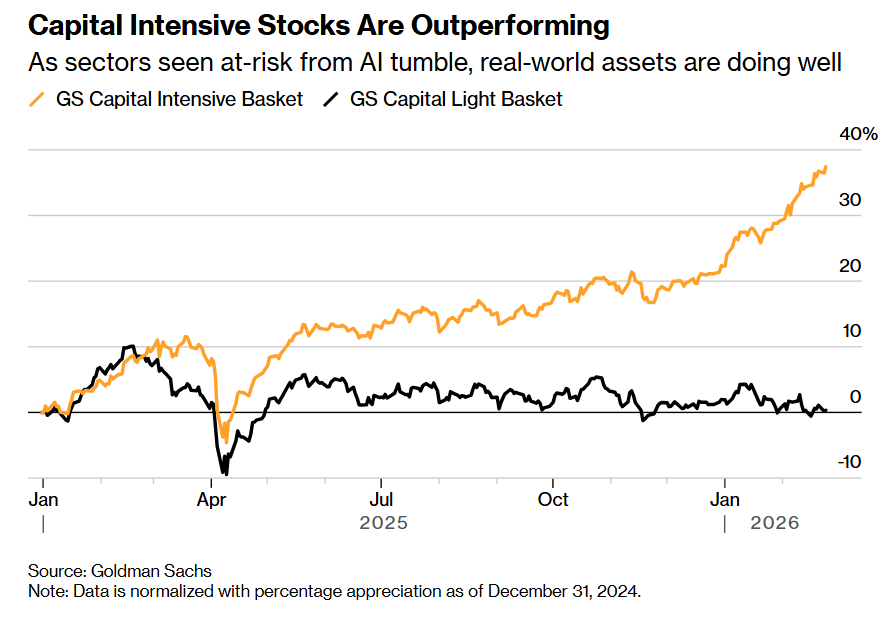
Core Insights - Heavy asset companies are significantly outperforming the global stock market as investors seek safe havens from the "AI disruption" sell-off, focusing on HALO (Heavy Assets, Low Obsolescence) stocks [1][3] - Goldman Sachs reports that its basket of heavy asset stocks has outperformed a lightweight capital stock group by approximately 35% since early 2025 [1][6] Group 1: Characteristics of Heavy Asset Companies - Heavy asset companies are characterized by high barriers to entry in production materials, such as power grids, mining, oil and gas assets, and large utility networks, where AI replication costs are extremely high [2] - These companies also exhibit low technological obsolescence, making it difficult for AI to replace core production capabilities in sectors like semiconductor equipment and advanced packaging [2][3] Group 2: AI Impact on Capital Expenditure - AI is not only disrupting profit structures in lightweight industries but also creating a "super cycle" in capital expenditure, particularly in AI chips and storage [2] - Goldman Sachs estimates that the five largest cloud providers will invest approximately $1.5 trillion in AI infrastructure from 2023 to 2026, shifting them from capital-light to capital-intensive players [2][8] Group 3: Market Trends and Investor Behavior - Investors are increasingly favoring heavy asset stocks due to their perceived stability and lower risk of AI obsolescence, particularly in utilities, basic resources, and semiconductor manufacturing [3][9] - Concerns over AI disrupting traditional business models have led to irrational sell-offs in various sectors, including those not directly impacted by AI, such as logistics [7] Group 4: Performance of Heavy Asset Stocks - Heavy capital-intensive stocks are significantly outperforming the market, especially as light asset sectors face declines due to AI disruption fears [6] - Despite the overall trend, some heavy asset companies are experiencing stock price declines due to skepticism about the returns on massive AI infrastructure investments [8] Group 5: Financial Metrics and Market Shifts - Higher actual yields and geopolitical factors are driving capital towards capital-intensive sectors, with earnings momentum shifting towards heavy asset stocks [9] - Market expectations for stronger earnings per share (EPS) growth and return on equity (ROE) are now significantly higher in capital-intensive companies compared to lightweight capital firms [9]
“看不懂”的跨国报销单:中企出海差旅费控如何破局
Jing Ji Guan Cha Bao· 2025-11-04 04:40
Core Viewpoint - The article discusses the challenges faced by Chinese companies in managing cross-border travel expenses when expanding overseas, particularly in ASEAN countries, highlighting the difficulties in understanding local languages and formats of expense receipts [1][2][3]. Group 1: Challenges in Cross-Border Travel Expense Management - Many Chinese companies struggle with the diverse formats and local languages of travel expense receipts, leading to difficulties in verifying the authenticity and details of these expenses [2][3]. - The proportion of pre-market research and business negotiation costs in overall operational costs for overseas business has exceeded 20%, prompting companies to reassess their investment returns [2]. - Companies are implementing measures to control cross-border travel expenses, focusing on reducing waste and inefficiencies while achieving overseas business expansion goals [2][4]. Group 2: Financial Compliance and Management Issues - The complexity of local financial regulations and compliance requirements poses significant challenges for Chinese companies operating abroad, necessitating substantial effort to understand and adapt to these regulations [6][7]. - Some companies have attempted to assign trusted local employees to manage finances, but this has not always been effective due to potential collusion and misuse of funds [5][6]. - The lack of a culture of employees prepaying travel expenses in certain ASEAN countries forces companies to advance significant funds, complicating overall cash management [7]. Group 3: Solutions and Innovations - The introduction of travel management SaaS solutions has been considered to enhance compliance and efficiency in managing travel expenses, although some solutions have been criticized for their complexity and cost [9][10]. - AI-enabled solutions are emerging as a potential way to improve the identification and verification of diverse travel receipts, allowing financial personnel to manage expenses without needing to understand local languages [10][11]. - Companies are increasingly seeking to integrate multi-currency payment and account management solutions to address operational bottlenecks in cross-border travel expense management [11].
对话群核科技CEO陈航:AI技术+中国制造硬实力,企业出海还有一轮红利期
Mei Ri Jing Ji Xin Wen· 2025-09-28 10:20
Core Insights - The article discusses the application of 3D AI technology in cross-border e-commerce, highlighting its potential to solve efficiency issues faced by businesses in this sector [1][3][4] - The CEO of Qunhe Technology emphasizes the ongoing opportunities for Chinese companies to expand internationally, driven by advancements in AI and digital trade technologies [1][5] Group 1: AI Technology Application - Qunhe Technology has developed a "Cool Home E-commerce Studio" solution using 3D AI, which allows for the rapid generation of marketing materials, significantly improving efficiency compared to traditional methods [1][3] - The company aims to address the high costs and low efficiency associated with offline photo shoots by providing virtual studios and real-time rendering capabilities, enabling designers to create a set of materials in just 15 to 30 minutes [3][4] Group 2: Market Opportunities - The demand for suitable imagery for overseas markets is increasing as Chinese products continue to expand internationally, creating a need for 3D virtualization to effectively showcase products [4][5] - The combination of strong manufacturing capabilities and rapid advancements in digital trade is expected to create a new wave of opportunities for Chinese companies in the global market [5][6] Group 3: SaaS and Commercialization - Qunhe Technology's SaaS product, "Cool Home," has achieved a subscription scale close to 1 billion, indicating a successful business model that can be replicated across different markets [4][5] - The CEO notes that while different countries have varying purchasing power and attitudes towards software tools, the core focus should remain on delivering valuable products and services [4][5]