
HALO效应

Search documents
高盛闭门会-全球策略-HALO效应-人工智能时代重资产-低淘汰风险
Goldman Sachs· 2026-03-04 14:17
Investment Rating - The report indicates a positive outlook for capital-intensive sectors, suggesting a shift in investment preference towards these areas due to macroeconomic factors and structural changes in the market [1][3]. Core Insights - The report highlights a significant revaluation of capital-intensive assets post-pandemic, with a notable increase in their performance compared to light capital sectors, which had previously outperformed from 2010 to 2020 [1][3]. - It predicts a structural turning point in earnings, with capital-intensive sectors expected to see a 14% growth in EPS by 2026, surpassing light capital sectors for the first time in years [1][11]. - The macroeconomic environment is favorable for capital-intensive industries, with improvements in manufacturing and service sector PMI, and a recovery in the global capital expenditure to sales ratio [1][11]. Summary by Sections Investment Rating - The report suggests a favorable investment rating for capital-intensive sectors, particularly utilities, telecommunications, and defense, while cautioning about the light capital sectors due to competitive pressures [1][3]. Market Dynamics - The report discusses the "Halo Effect," where capital-intensive companies are expected to benefit from stable cash flows and lower risk of technological obsolescence, especially in the context of AI's impact on the market [4][5]. - It notes that the valuation gap between capital-intensive and light capital sectors has narrowed significantly, primarily driven by upward adjustments in the valuations of capital-intensive firms [5][6]. Earnings Forecast - Analysts forecast a 14% EPS growth for capital-intensive sectors in 2026, marking a significant shift in earnings expectations compared to light capital sectors [11]. - The report emphasizes that the performance of capital-intensive firms will be driven by earnings realization rather than mere valuation adjustments [11]. Macro Environment - The report identifies a positive macroeconomic backdrop for capital-intensive industries, with rising capital expenditure and a favorable manufacturing environment [12]. - It highlights the importance of monitoring fiscal spending and capital-intensive sectors such as infrastructure and defense for future performance [12]. Sector Analysis - The report categorizes industries based on capital intensity, noting that traditional sectors like utilities and telecommunications exhibit strong capital-intensive characteristics, while software and digital sectors lean towards light capital [5][10]. - It emphasizes the need for a nuanced approach to evaluating light capital sectors, particularly in light of competitive pressures and profit margin uncertainties [10][11].
《赢学》 作者:川普
债券笔记· 2026-02-26 10:04
Group 1 - The recent performance of A-shares is attributed to the appreciation of the RMB, which has accelerated in recent days, leading to increased foreign capital inflow [2] - Shanghai has introduced new housing policies, referred to as "沪七条," which lower the threshold for non-local residents and increase the maximum number of properties that can be purchased [4][5] - The new policies include a reduction in the social security or tax requirement from 2 years to 1 year for non-local residents, and an increase in the public housing fund limit for first-time buyers from 160 million to 240 million [4][5] Group 2 - Trump's proposal to use AI models for pricing key minerals aims to reduce China's influence, although the effectiveness of this approach is questioned [8] - A Goldman Sachs report indicates that investors are increasingly favoring stocks with a "HALO effect," which are heavy asset and low obsolescence stocks, particularly in utilities, basic resources, and energy sectors [8] - Trump's recent State of the Union address emphasized the need for a strong stock market and lower interest rates, while notably omitting any mention of China, suggesting a shift towards negotiation rather than confrontation [9][10][11]


华尔街又有新词!高盛抛出HALO效应:AI越猛,资金越爱“老资产”
Jin Shi Shu Ju· 2026-02-25 10:23
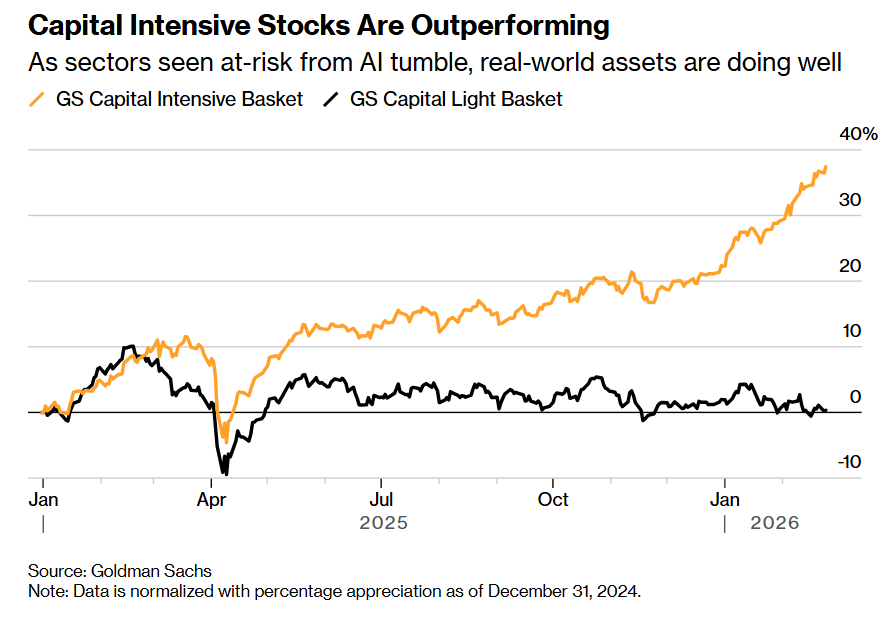
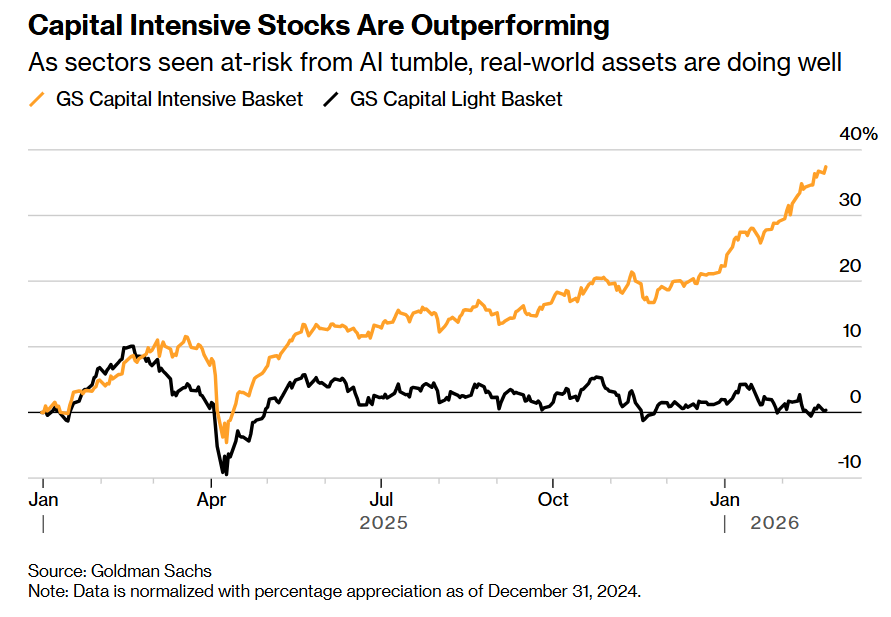
Group 1 - The core viewpoint of the article is that companies with tangible production assets are outperforming the market as investors seek safe havens from AI disruption risks [1] - Goldman Sachs' team reported that since the beginning of 2025, a basket of capital-intensive stocks has outperformed light-asset stocks by approximately 35% [1] - The "HALO effect" refers to the preference for companies with heavy assets and low obsolescence risk, particularly in sectors like utilities, basic resources, and energy [1] Group 2 - The report highlights that the market is rewarding capacity, networks, infrastructure, and engineering complexity, which are harder to replicate and less susceptible to rapid technological obsolescence [2] - In the capital-intensive stock portfolio, Goldman Sachs selected companies such as ASML Holding NV, Safran, LVMH, Air Liquide, and Airbus, while the light-asset portfolio includes L'Oréal, Adyen, DSV, and Siemens Healthineers [2] - Concerns about AI disrupting business models have led to significant declines in stocks previously viewed as stable winners, affecting various industries including logistics [2] Group 3 - Major tech companies, including Amazon, Microsoft, Alphabet, Meta Platforms, and Oracle, are expected to invest approximately $1.5 trillion in AI infrastructure from 2023 to 2026, compared to a cumulative investment of about $600 billion before 2022 [3] - Higher real yields and geopolitical factors supporting fiscal spending and manufacturing are driving capital flows toward capital-intensive industries [3] - Market expectations for earnings growth and return on equity are now more favorable for capital-intensive companies compared to light-asset firms [3]
高盛:HALO效应股票获追捧 美五大科技巨头2023至2026年资本支出将达1.5万亿 重资产组合自2025年以来跑赢轻资产35%
Jin Rong Jie· 2026-02-25 06:52
Group 1 - The core viewpoint of the report is that the current stock market pricing logic is shifting from a "scalable light asset narrative" to "buildable, irreplaceable physical capacity and networks," summarized as "scarcity repricing" [1] - Goldman Sachs defines HALO as a combination of "heavy assets" and "low obsolescence," where heavy assets are based on substantial physical capital with multi-dimensional replication barriers, and low obsolescence refers to assets that maintain economic value across technological cycles [1] - The report highlights that the past decade of zero interest rates and abundant liquidity has led to high valuations for light asset business models, but this balance is now disrupted by the rise of AI, which increases uncertainty in profitability and terminal value for light asset industries [1] Group 2 - Since 2025, Goldman Sachs' heavy asset portfolio has outperformed the light asset portfolio by 35%, indicating that asset intensity has become a core driver of valuation and returns [2] - The valuation gap between heavy and light assets has significantly narrowed, primarily driven by the revaluation of heavy asset companies, reflecting that market funds are willing to pay a premium for the strategic value of physical assets [2]
高盛团队称资产密集型股票表现更佳
Sou Hu Cai Jing· 2026-02-25 04:18
Core Insights - Goldman Sachs strategists highlight that stocks of companies with tangible productive assets are performing better as investors seek safe havens from AI disruption [1] - Since early 2025, the selected capital-intensive stock portfolio has outperformed the light-capital company portfolio by approximately 35% [1] - The team emphasizes a growing investor preference for stocks exhibiting the "HALO effect," characterized by heavy assets and low obsolescence risk, primarily in sectors like utilities, basic resources, and energy [1] Capital-Intensive Stocks - The selected European capital-intensive stock portfolio includes companies such as ASML Holding, Safran, LVMH, Air Liquide, and Airbus [1] Light-Capital Stocks - The light-capital stock portfolio features companies like L'Oréal, Adyen NV, DSV AS, and Siemens Healthineers [1]
高盛:投资者追捧“HALO效应”股票
Ge Long Hui A P P· 2026-02-25 04:04
Group 1 - Goldman Sachs reports that investors are increasingly favoring stocks with a "HALO effect," specifically heavy asset and low obsolescence stocks, primarily in utilities, basic resources, and energy sectors [1] - Since the beginning of 2025, the selected capital-intensive stock portfolio has outperformed the light capital stock portfolio by approximately 35%, indicating a market preference for companies with tangible productive assets [1] - The report highlights that higher actual yields, increased fiscal spending, and geopolitical factors supporting manufacturing are driving funds towards capital-intensive market segments [1] Group 2 - The pursuit of AI leadership has transformed five major companies, previously considered capital-light market winners, into capital-intensive enterprises, with Amazon, Microsoft, Alphabet, Meta Platforms, and Oracle expected to invest around $1.5 trillion in AI infrastructure from 2023 to 2026 [2] - Prior to 2022, these five companies had a cumulative investment of approximately $600 billion throughout their development history [2]
“AI 颠覆一切” 席卷股票市场 何处是安全避风港?高盛给出关键词:HALO
Zhi Tong Cai Jing· 2026-02-24 15:57
Core Insights - Heavy asset companies are significantly outperforming the global stock market as investors seek safe havens from the "AI disruption" sell-off, focusing on HALO (Heavy Assets, Low Obsolescence) stocks [1][3] - Goldman Sachs reports that its basket of heavy asset stocks has outperformed a lightweight capital stock group by approximately 35% since early 2025 [1][6] Group 1: Characteristics of Heavy Asset Companies - Heavy asset companies are characterized by high barriers to entry in production materials, such as power grids, mining, oil and gas assets, and large utility networks, where AI replication costs are extremely high [2] - These companies also exhibit low technological obsolescence, making it difficult for AI to replace core production capabilities in sectors like semiconductor equipment and advanced packaging [2][3] Group 2: AI Impact on Capital Expenditure - AI is not only disrupting profit structures in lightweight industries but also creating a "super cycle" in capital expenditure, particularly in AI chips and storage [2] - Goldman Sachs estimates that the five largest cloud providers will invest approximately $1.5 trillion in AI infrastructure from 2023 to 2026, shifting them from capital-light to capital-intensive players [2][8] Group 3: Market Trends and Investor Behavior - Investors are increasingly favoring heavy asset stocks due to their perceived stability and lower risk of AI obsolescence, particularly in utilities, basic resources, and semiconductor manufacturing [3][9] - Concerns over AI disrupting traditional business models have led to irrational sell-offs in various sectors, including those not directly impacted by AI, such as logistics [7] Group 4: Performance of Heavy Asset Stocks - Heavy capital-intensive stocks are significantly outperforming the market, especially as light asset sectors face declines due to AI disruption fears [6] - Despite the overall trend, some heavy asset companies are experiencing stock price declines due to skepticism about the returns on massive AI infrastructure investments [8] Group 5: Financial Metrics and Market Shifts - Higher actual yields and geopolitical factors are driving capital towards capital-intensive sectors, with earnings momentum shifting towards heavy asset stocks [9] - Market expectations for stronger earnings per share (EPS) growth and return on equity (ROE) are now significantly higher in capital-intensive companies compared to lightweight capital firms [9]
“AI颠覆一切”席卷股票市场 何处是安全避风港? 高盛给出关键词:HALO
Zhi Tong Cai Jing· 2026-02-24 12:14
Core Viewpoint - Heavy asset companies are significantly outperforming the global stock market as investors seek safe havens from the "AI disruption" sell-off, focusing on HALO (Heavy Assets, Low Obsolescence) stocks [1][3] Group 1: Performance of Heavy Asset Stocks - Heavy asset stocks have outperformed a control group of light capital stocks by approximately 35% since the beginning of 2025 [1] - The HALO effect refers to companies with high-value, long-lasting physical assets that are less likely to be quickly replaced by AI, making them attractive during periods of AI-related anxiety [3][6] Group 2: Characteristics of HALO Stocks - HALO stocks are characterized by high barriers to entry in heavy asset production, such as utilities, mining, oil and gas assets, and critical AI infrastructure manufacturers, where AI replication costs are extremely high [2] - These stocks also exhibit low technological obsolescence rates, meaning core production capabilities are difficult to replace with AI in the short term, such as in semiconductor equipment supply chains [2] Group 3: Market Dynamics and Investment Trends - The anxiety surrounding AI's potential to disrupt traditional business models has led to irrational sell-offs across various sectors, including those seemingly unaffected by AI risks [7] - Heavy asset companies are benefiting from increased capital expenditures driven by AI infrastructure investments, with major cloud providers expected to invest around $1.5 trillion from 2023 to 2026 [8] Group 4: Financial Metrics and Investor Sentiment - Higher actual yield rates and geopolitical factors supporting fiscal spending are driving funds toward capital-intensive market segments, with earnings momentum shifting towards heavy asset stocks [9] - Market expectations for stronger earnings per share (EPS) growth and return on equity (ROE) are now significantly higher in capital-intensive companies compared to light capital companies [9]

高盛:AI 重塑市场,“HALO” 概念股成新风尚
Xin Lang Cai Jing· 2026-02-24 06:56
Group 1 - The core viewpoint of the article highlights that investors are favoring stocks with "HALO effect" characteristics, which include heavy assets and low obsolescence rates [1] - Goldman Sachs strategists noted that the market is rewarding assets that possess capacity, networks, infrastructure, and engineering technology barriers, as these assets have high replication costs and are less affected by technological obsolescence [1]