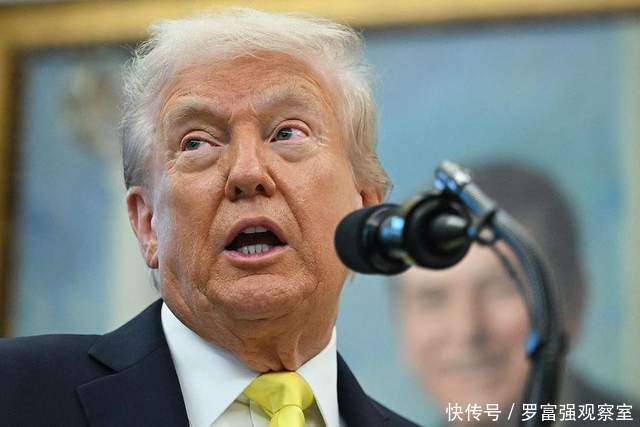
《数字服务法案》

Search documents
美国制裁欧盟前高级官员
Xin Lang Cai Jing· 2025-12-25 03:02
Core Viewpoint - The U.S. government has escalated its confrontation against European regulations by imposing visa sanctions on a former EU official and several anti-misinformation organization staff, citing alleged censorship practices [1] Group 1: U.S. Government Actions - The U.S. State Department has sanctioned individuals leading organizations that pressure American platforms to censor opposing viewpoints and suppress revenue [1] - Among those sanctioned is Thierry Breton, a former European Commission member who spearheaded the Digital Services Act, which mandates large tech platforms to take concrete actions to reduce the spread of illegal and harmful content [1] Group 2: Responses from Sanctioned Individuals - Thierry Breton responded on social media, stating that the alleged censorship is not as the U.S. perceives it [1] Group 3: Targeted Organizations - The sanctions also target activists and non-profit organizations focused on digital hate speech and anti-extremism, including the CEO of the "Center for Countering Digital Hate," which aims to stop the spread of online hate and misinformation through innovative research and advocacy [1] - Another targeted organization is the "Global Misinformation Index," which collaborates with governments, industry, and civil society to make the internet safer [1]
现在,欧洲情绪很不稳定
Sou Hu Cai Jing· 2025-12-25 00:45
Group 1 - The core issue revolves around the United States imposing sanctions on European officials involved in the formulation of the EU's Digital Services Act, which is considered the strictest internet regulation globally [2][4] - The first individual sanctioned is Thierry Breton, the former French finance minister, accused by the US of being a key architect of the Digital Services Act, which holds large social media platforms accountable for illegal content and misinformation [2][4] - The sanctions are a response to claims that these individuals pressured US platforms to censor and suppress dissenting American viewpoints, marking a significant escalation in transatlantic tensions [4][6] Group 2 - The US sanctions also target four other individuals, including members of organizations focused on combating online hate and misinformation, indicating a broader strategy against perceived threats to American digital platforms [3][4] - The US Trade Representative's office has warned that if the EU continues to undermine the competitiveness of American service providers, it will have to take retaliatory measures [6][8] - The sanctions have sparked outrage in Europe, with officials claiming that the US is interfering in European sovereignty and governance, highlighting a growing divide between the two regions [10][11] Group 3 - The sanctions are seen as a reaction to the EU's recent fine of €120 million imposed on Elon Musk's X (formerly Twitter) for violating content regulations, which has further inflamed US-EU relations [6][8] - European leaders, including French President Macron, have condemned the US actions as intimidation against European digital sovereignty, emphasizing the need for a secure digital space for democracy [10][11] - The situation reflects a broader ideological and economic conflict, where the US prioritizes free speech while Europe seeks to enforce stricter regulations on digital platforms [18][20]

牛弹琴:现在,欧洲情绪很不稳定
Xin Lang Cai Jing· 2025-12-24 23:37
Core Viewpoint - The article discusses the escalating tensions between the United States and Europe regarding digital policy, particularly focusing on the U.S. sanctions against European officials involved in the EU's Digital Services Act, which imposes strict regulations on social media platforms [2][30][34]. Group 1: U.S. Sanctions and European Response - The U.S. has imposed sanctions on five individuals, including Thierry Breton, the former French finance minister, for their roles in the EU's Digital Services Act [5][30]. - The sanctions are justified by U.S. officials as a response to these individuals allegedly pressuring American platforms to censor content [6][34]. - European officials, including Breton, have condemned the U.S. actions as political persecution and an infringement on European sovereignty [13][41]. Group 2: Implications of the Digital Services Act - The Digital Services Act is described as the world's strictest internet regulation, holding large social media platforms accountable for illegal content and misinformation, with potential fines of up to 6% of global annual revenue for non-compliance [3][31]. - The act has led to significant financial penalties for companies like X (formerly Twitter), which was fined €120 million for violating content rules [8][36]. Group 3: Broader Context of U.S.-Europe Relations - The article highlights a growing rift between the U.S. and Europe, with the U.S. expressing dissatisfaction over European policies perceived as limiting American companies' competitiveness [9][49]. - The tensions are framed within a larger narrative of ideological differences, with Europe advocating for digital sovereignty while the U.S. emphasizes freedom of speech [22][51]. - The situation reflects a shift in the dynamics of international relations, where former allies may find themselves at odds over regulatory approaches [20][48].
美国以涉嫌实施审查为由,对欧盟前高官实施签证制裁
Huan Qiu Shi Bao· 2025-12-24 22:49
Core Viewpoint - The U.S. government has escalated its confrontation against European regulations by imposing visa sanctions on a former EU official and staff from several anti-misinformation organizations, citing alleged censorship practices [1] Group 1: U.S. Government Actions - The U.S. State Department has sanctioned individuals involved in organizations that allegedly pressure American platforms to censor opposing viewpoints and suppress revenue [1] - Among those sanctioned is Thierry Breton, a former European Commission official who led the advancement of the Digital Services Act, which mandates large tech platforms to take concrete actions to reduce the spread of illegal and harmful content [1] Group 2: Reactions from Sanctioned Individuals - Thierry Breton responded on social media, stating that the alleged censorship is not as the U.S. perceives it [1] - The sanctions also target activists and non-profit organizations focused on combating online hate speech and misinformation, including the CEO of the Center for Countering Digital Hate and the CEO of the Global Misinformation Index [1]
美国制裁法国籍欧盟前官员,马克龙谴责:这等同于是恐吓胁迫
Xin Lang Cai Jing· 2025-12-24 15:44
Group 1 - The U.S. has imposed visa sanctions on a former EU official and four European activists, provoking strong condemnation from France [1][3] - French President Macron criticized the sanctions as an attempt to undermine Europe's digital sovereignty, emphasizing that EU regulations are democratically established and should not be dictated from outside Europe [1][3] - The sanctions target Thierry Breton, a prominent figure in the EU who played a key role in the Digital Services Act, which is considered one of the strictest internet regulations globally [4][5] Group 2 - The Digital Services Act requires large online platforms to take legal responsibility for illegal content and misinformation, with potential fines of up to 6% of global annual revenue for non-compliance [5] - Breton expressed dissatisfaction with the visa restrictions, framing them as a form of political persecution and highlighting the democratic support for the Digital Services Act from the European Parliament and member states [5] - The EU has previously fined Elon Musk's X platform €120 million (approximately 992 million RMB) for violating online content rules, indicating ongoing tensions between the EU and U.S. regarding digital regulation [3]
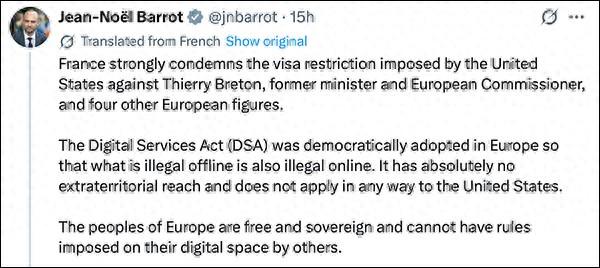
美国禁止欧委会前委员等5人入境 被指“政治迫害”
Zhong Guo Xin Wen Wang· 2025-12-24 08:22
Core Viewpoint - The U.S. government has imposed a visa ban on five individuals, including former EU Commissioner Thierry Breton, accusing them of pressuring tech companies to censor American viewpoints, which is perceived as a form of "political persecution" [1][3]. Group 1: Visa Ban Announcement - The U.S. State Department announced the visa ban on December 23, targeting five individuals for allegedly leading organized actions to pressure U.S. tech platforms into content censorship [1]. - U.S. Secretary of State Rubio stated that the individuals listed had orchestrated actions to suppress opposing American viewpoints and indicated readiness to expand the list if necessary [2]. Group 2: Response from Targeted Individuals - Thierry Breton responded to the visa restrictions by questioning the characterization of their actions and suggesting that it reflects a return to "McCarthy-style political persecution" [3]. Group 3: Context and Implications - The visa ban is viewed as a retaliatory measure against European regulations aimed at combating hate speech and misinformation, particularly the EU's Digital Services Act [4]. - The U.S. government has expressed concerns that such European policies threaten free speech and impose burdens on American tech companies, as highlighted in a recent national security strategy report [4].
【环球财经】谷歌等美企遭欧盟罚款 美国扬言“反制”
Xin Hua She· 2025-12-17 08:51
Core Viewpoint - The U.S. government has threatened retaliation against the EU following high fines imposed on American companies like Google and social media platform X, claiming discriminatory practices against U.S. service providers [1][2] Group 1: U.S. Response - The U.S. Trade Representative's Office stated that if the EU continues its "discriminatory" actions, it will impose countermeasures on European service providers [1] - The U.S. Trade Representative's Office highlighted ongoing lawsuits, taxes, and fines as means to restrict American service providers, naming nine European companies, including Accenture, DHL, and Siemens, as potential targets for retaliation [1] Group 2: EU's Position - The EU Commission spokesperson emphasized that the regulatory framework aims to maintain a "safe, fair, and equal competitive environment," asserting that enforcement actions are not discriminatory [1] - The EU has taken enforcement actions against U.S. tech companies this year under the Digital Services Act and the Digital Markets Act, including a €120 million fine against social media platform X and a €2.95 billion fine against Google for anti-competitive behavior in advertising [1]

火药味上来了!一张罚单炸出欧美裂痕,中国在联合国说出更硬的话
Sou Hu Cai Jing· 2025-12-12 10:05
Group 1 - The core issue revolves around the competition for rule-making authority in the global landscape, highlighted by the EU's €120 million fine against Musk's X platform and the U.S. response threatening tariffs [1][8] - The EU's Digital Services Act aims to establish its own regulatory framework in the digital economy, reducing reliance on U.S. tech companies, while the U.S. seeks to maintain its dominance in the internet sector [7][8] - The conflict over the South China Sea also reflects a struggle over rule-setting, with China asserting its sovereignty based on historical and legal grounds against perceived encroachments by other nations supported by the U.S. [5][8] Group 2 - The U.S. and EU's dispute over the fine illustrates a broader pattern of rule hegemony, where the U.S. insists on compliance with its rules while rejecting those set by other nations [8] - China's firm stance on sovereignty issues indicates a refusal to negotiate on matters of territorial integrity, emphasizing that international rules should not be used to infringe upon its rights [8] - The ongoing tensions signify a shift in global dynamics, where more countries are beginning to assert their voices in the rule-making process, challenging the traditional dominance of stronger nations [8]