
《程婴救孤》

Search documents
戏韵通中外 “戏剧与文化传播”论坛在京举行
Xin Lang Cai Jing· 2025-12-23 13:55
Group 1 - The forum "Drama and Cultural Communication" was held in Beijing, co-hosted by the China Dramatists Association and the China Foreign Languages Publishing Administration, focusing on the importance of cultural confidence in international dissemination of Chinese drama [1] - Chen Yongquan, a key speaker, emphasized that the international spread of Chinese drama must be rooted in cultural confidence and artistic integrity, advocating for "creative transformation and innovative development" to showcase national art on the global stage [1] - Wang Yong, Vice Chairman of the China Dramatists Association, shared that from 2019, the National Peking Opera Company has conducted 176 performances and exchange activities in over 20 countries, reaching an audience of 150,000, highlighting the need for cultural confidence in international outreach [1] Group 2 - Bian Wentong, a professor at the Central Academy of Drama, discussed the need for contemporary perspectives and empathy in the international dissemination of classic works, advocating for creative transformation to rejuvenate traditional art [2] - Zhu Jiejing from the Shanghai Dance Theatre noted that successful dance dramas emerge from distilling traditional culture and innovating expressions, emphasizing the importance of cross-cultural resonance and modern narrative techniques [2] - Various speakers shared insights on the relationship between cultural innovation and international communication, including the success of Huiju Opera at the Sahara International Theatre Festival and new pathways for traditional culture's dissemination through music and new media [2]


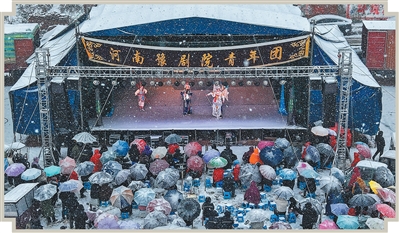
一台戏,“暖”了寒冬(神州看点·古调新声)
Ren Min Ri Bao· 2025-12-17 22:11
Core Viewpoint - The article emphasizes the importance of traditional Chinese opera, particularly Henan Yu Opera, in engaging the younger generation and ensuring the creative transformation and innovative development of Chinese culture in the context of the "14th Five-Year Plan" [1] Group 1: Audience Engagement - Despite harsh weather conditions, audiences are dedicated to attending performances, demonstrating a strong connection between viewers and performers [2] - The interaction between audiences and actors is highlighted, with audiences expressing their commitment to the art form [2][3] - The online presence of performances has garnered significant attention, showcasing the respect for traditional art forms [2] Group 2: Cultural Adaptation and Popularity - Henan Yu Opera has gained popularity beyond its home region, with performances attracting large audiences in various provinces [4] - The adaptability of Yu Opera's themes and performances allows it to resonate with diverse cultural backgrounds [4] - The presence of numerous state-owned and private Yu Opera troupes contributes to the preservation and innovation of the art form [4] Group 3: Innovative Performance Formats - New performance formats, such as immersive experiences, are being developed to attract younger audiences [6] - The collaboration between individual artists and traditional troupes is seen as a new approach to enhance audience engagement and reduce costs [6] - The creative exploration of historical narratives in modern contexts is aimed at resonating with contemporary audiences [7] Group 4: Future Development Initiatives - The government is planning to introduce regulations to protect and promote the development of Yu Opera [7] - Initiatives like "Opera in Schools" and "Stage Arts to the Grassroots" are being implemented to foster innovation within the art form [7]
为传承注入源头活水 让秦腔融入到城市的骨子里
Yang Guang Wang· 2025-12-11 22:36
Core Viewpoint - The Xi'an Yisushe, a century-old theater company, continues to thrive by integrating traditional Qin opera with contemporary narratives, reflecting the cultural essence of Xi'an and promoting the inheritance of Chinese traditional culture [1][2]. Group 1: Historical Significance - Established in 1912, Xi'an Yisushe is closely linked to the cultural heritage of Xi'an, serving as a vital platform for the transmission of Qin opera, which embodies the city's historical and cultural identity [1][2]. - The theater has been a significant witness to the evolution of local culture and has played a crucial role in preserving the artistic legacy of Qin opera over the past century [1]. Group 2: Artistic Development and Education - Li Dongfeng, a prominent actor, emphasizes the importance of understanding the audience's evolving preferences, noting that middle-aged viewers have remained a consistent demographic for Qin opera [3]. - The theater prioritizes the mentorship of young actors, with experienced artists like Li Dongfeng passing on their knowledge and skills to the next generation, ensuring the continuity of artistic traditions [4][5]. - Young actors are encouraged to cultivate a deep understanding of their roles through extensive reading and cultural immersion, which enhances their performance quality [5][11]. Group 3: Youth Engagement and Innovation - The theater has a significant proportion of young actors, constituting two-thirds of the company, which reflects a strategic focus on youth engagement and the future of Qin opera [15]. - Initiatives such as the Youth Support Fund and educational programs are in place to enhance the skills and academic qualifications of young performers, fostering a new generation of artists [15][17]. - The company is actively expanding its outreach by performing in prestigious institutions like Tsinghua University and Peking University, thereby promoting traditional culture to a broader audience [16]. Group 4: Challenges and Future Directions - The aging of veteran performers poses a challenge, making the mentorship of younger actors critical for the preservation of the art form [15]. - The theater is committed to balancing tradition with innovation, as seen in modern adaptations of classic works, which aim to attract younger audiences while maintaining the essence of Qin opera [13][14].
家乡戏
Ren Min Ri Bao· 2025-11-18 23:30
Core Viewpoint - The article reflects on the cultural significance of traditional opera in the author's hometown, highlighting its role in community bonding and personal identity through shared experiences and memories of performances [1][10]. Group 1: Cultural Significance - The hometown of the author, Tanghe County in Henan Province, is rich in various forms of traditional opera, including Han opera, Yu opera, and others, which are deeply embedded in local culture [1][6]. - Traditional opera serves as a vital cultural river that nourishes the spiritual world of the community, with themes of patriotism, morality, and social values being prevalent in the performances [7][8]. Group 2: Community Engagement - The community actively participates in opera, with villagers gathering to watch performances, often preparing food and dressing up for the occasion, indicating the social importance of these events [2][4]. - The article describes the vibrant atmosphere surrounding opera performances, including food stalls and children's activities, which enhance the communal experience [2][5]. Group 3: Personal Connection - The author recounts personal experiences of watching and engaging with traditional opera from a young age, illustrating how these experiences shaped their appreciation for the art form [3][4]. - The influence of local opera is evident in the lives of notable figures from the author's hometown, who have contributed to the field of opera and literature, showcasing the lasting impact of this cultural heritage [8][9].