《西出玉门》

Search documents
《枭起青壤》难调众口,腾讯“尾鱼宇宙”还值得期待吗?
Xin Lang Cai Jing· 2025-12-10 02:19
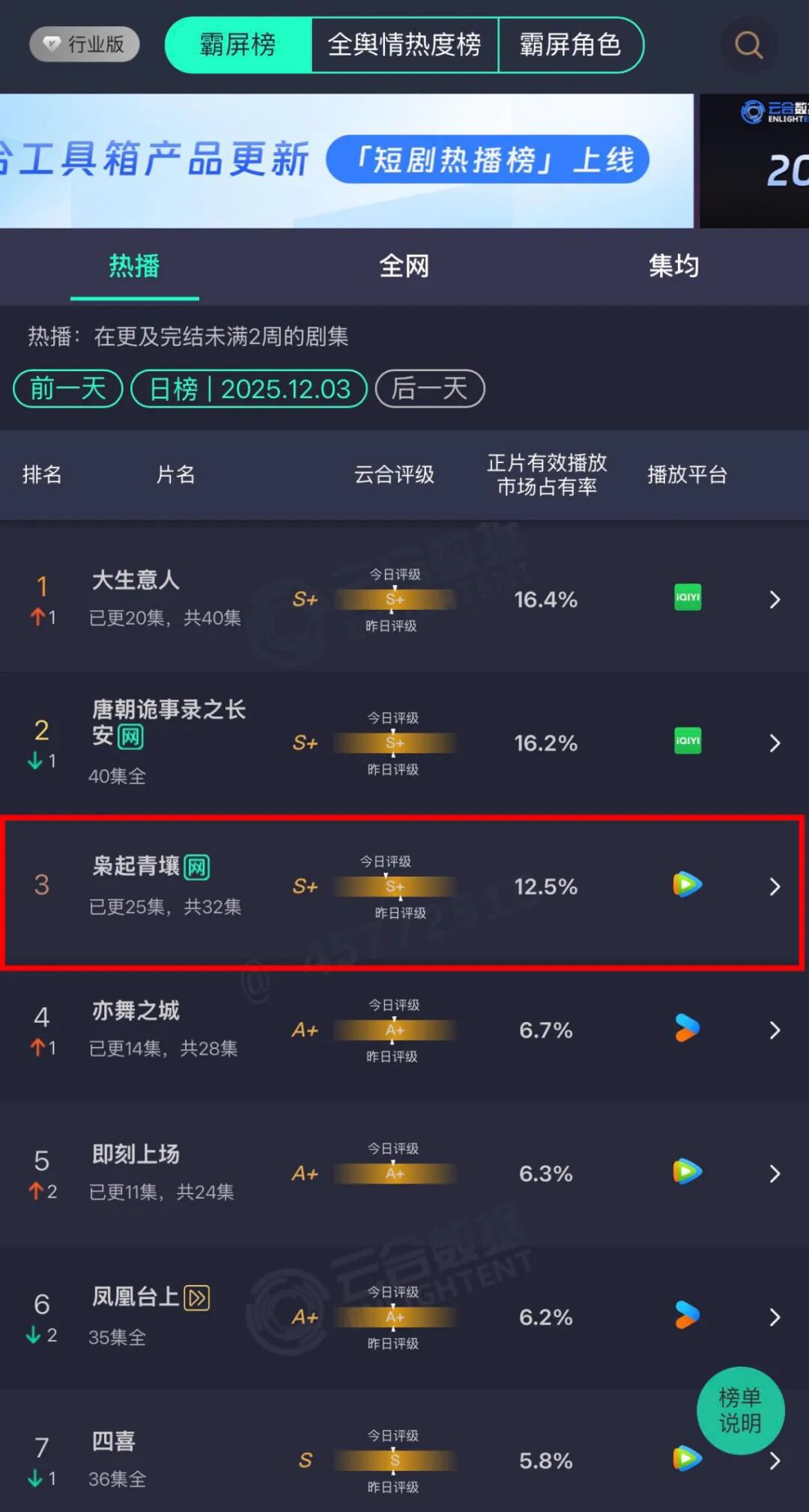
Core Insights - The drama "Xiao Qi Qing Rang" has not yet achieved the expected "Tail Fish Universe" effect despite breaking records for heat value on Tencent Video shortly after its release [1][4] - Tencent Video is under pressure to make "Xiao Qi Qing Rang" a flagship project to demonstrate its capabilities in systematic IP development and to compete with rival platforms like iQIYI [4][5] - The "Tail Fish" IP is recognized as a challenging area in the industry, with mixed audience feedback and difficulties in adaptation [5][9] Performance Metrics - "Xiao Qi Qing Rang" achieved a heat value of 25,000 within 81 minutes of airing, but has since stagnated around 27,000 [1] - The show has a market share of only 13.8% and has been surpassed in rankings by "Da Sheng Yi Ren" [1] - The drama has attracted 14 sponsorships and achieved a total of 1,400 seconds of advertisement exposure, indicating strong commercial potential [12][14] Audience Reception - Audience feedback has been mixed, with criticisms regarding narrative balance and character development, particularly concerning the female lead [11] - The show has implemented a "scaredy-cat mode" to cater to different viewer preferences, reflecting Tencent's commitment to the project [11] Future Prospects - Tencent Video is accelerating its plans for the "Tail Fish Universe," with upcoming projects like "San Xian Mi Hui" and "Long Gu Fen Xiang" already in production [7][17] - The success of "Xiao Qi Qing Rang" has generated interest from brands and overseas platforms, enhancing the visibility of future projects within the IP universe [15] - The original novels for upcoming dramas are noted for their strong narrative and character development, which could contribute to the overall success of the "Tail Fish Universe" [17]


为什么连倪妮热巴刘浩存,都无法拯救尾鱼IP?
3 6 Ke· 2025-12-09 02:19
Core Viewpoint - The adaptation of the novel "Xiao Qi Qing Rang" by author Wei Yu has faced significant criticism, leading to a decline in viewership and engagement, as it fails to meet the expectations set by the original work and its fanbase [1][3]. Group 1: Adaptation Challenges - The adaptation has been criticized for losing the essence of Wei Yu's storytelling, which is rooted in Chinese mythology and complex narratives, resulting in a simplified and less engaging plot [5][10]. - Fans have expressed disappointment over the changes made to key elements of the story, such as the portrayal of the "Di Xiao" (地枭) character, which has been altered from a nuanced being to a mere alien monster, stripping away the cultural and narrative depth [7][8]. - The adaptation has also been accused of prioritizing romantic subplots over the original adventurous and mythical themes, leading to a loss of the story's core appeal [20][24]. Group 2: Industry Trends - The difficulties faced in adapting Wei Yu's work reflect a broader trend in the industry where adaptations of popular literary works often struggle to maintain their original charm and complexity, leading to a diluted final product [26][33]. - The reliance on established IPs (intellectual properties) like Wei Yu's has created a paradox where the desire to retain original elements can hinder creative freedom, resulting in adaptations that fail to resonate with both fans and new audiences [28][30]. - The high costs associated with adapting popular works can limit creative choices, as producers may prioritize financial safety over artistic integrity, leading to adaptations that are perceived as mediocre or formulaic [28][33].
作家“改编运”,几分天注定?
Hu Xiu· 2025-07-08 00:31
Core Viewpoint - The article discusses the varying success rates of authors in adapting their works into films and series, highlighting the concept of "adaptation luck" in the Chinese entertainment industry, particularly in the context of web literature and its transition to screen adaptations [1][4][5]. Group 1: Adaptation Success Stories - The article emphasizes the rise of author Qianshan Chake, whose works have gained significant popularity through successful adaptations, particularly with the web series "Mo Yu Yun Jian" and "Yan Hui Shi," which have achieved high viewership and engagement [6][14][16]. - Qianshan Chake's notable works, such as "Rebirth of the Noble Girl" and "Rebirth of the General's Poisonous Wife," have accumulated millions of views, showcasing her strong presence in the web literature scene [9][10]. - The success of her adaptations is attributed to the compelling female characters and engaging narratives that resonate with contemporary audiences, aligning with current trends in the entertainment industry [18][19][20]. Group 2: Challenges in Adaptation - The article contrasts the success of Qianshan Chake with other authors like Wei Yu, whose adaptations have faced criticism and poor reception, indicating that not all popular web literature translates well to screen [27][30]. - The difficulties faced by authors like Wei Yu stem from the complexity of their narratives, which often do not adapt easily to the visual medium, leading to challenges in maintaining the original story's essence [28][29]. - The article suggests that adaptation success is not solely dependent on the original work's popularity but also on the adaptability of its content and the execution of the adaptation process [30][39]. Group 3: Future of Adaptation - The article posits that authors can enhance their "adaptation luck" by considering the potential for screen adaptation during the writing process, as seen with the author of "Da Feng Da Geng Ren," who tailored his narrative for better compatibility with film and television [31][34]. - It highlights the importance of collaboration between authors and web literature platforms to create works that are more likely to succeed in adaptations, indicating a shift in the industry's approach to content creation [36][37]. - The article concludes with a hopeful outlook for both successful and struggling authors, suggesting that the evolving landscape of the entertainment industry may provide new opportunities for adaptation success in the future [44].