《静夜思》

Search documents
“床前明月光”里的“床”
Xin Lang Cai Jing· 2026-01-13 00:13
Group 1 - The article discusses the widespread popularity of Li Bai's poem "Quiet Night Thoughts," highlighting its emotional depth and connection to nostalgia for one's hometown [1] - The poem consists of four lines and twenty characters, expressing the feelings of a traveler missing home while observing the moonlight [1] - In 2015, UNESCO selected "Quiet Night Thoughts" as the only Chinese poem to be featured on commemorative stamps for World Poetry Day [1] Group 2 - A recent online article argues that Li Bai may have seen the moonlight from a "well railing" rather than from "beside the bed," referencing a long-standing debate about the interpretation of the poem [2] - This interpretation has historical roots, with earlier discussions suggesting that the term "bed" might refer to a "hu bed" or "maza," indicating that ancient homes may not have allowed moonlight to enter [2] - The article critiques this interpretation, emphasizing that regardless of the setting, the essence of the poem remains intact, as it captures the beauty of the moonlight [3]
“天涯共此时——中秋诗会”在联合国总部举行
Xin Hua She· 2025-10-14 14:02
Core Viewpoint - The "Mid-Autumn Poetry Festival" held at the United Nations aims to promote cultural exchange between the East and West, emphasizing themes of reunion, harmony, and harvest associated with the Mid-Autumn Festival [1][2]. Group 1: Event Highlights - The event featured bilingual recitations of classical poems such as "Quiet Night Thoughts" and "Water Melody," showcasing the cultural significance of the Mid-Autumn Festival [1]. - Performances included traditional music and dance, such as "Chasing the Moon" and "Hundred Birds Welcoming the Phoenix," enhancing the poetic experience [1]. - The festival concluded with a solo performance of "May You Live Long," encapsulating the spirit of the celebration [1]. Group 2: Cultural Significance - The event was organized by the Chinese Tourism Office in New York and supported by the US-China Cultural and Arts Foundation, highlighting the collaborative efforts in promoting cultural understanding [2]. - UN representative Peter Dawkins emphasized the power of poetry and art to transcend language barriers, aligning with the UN's mission of peace and understanding [1].
“天涯共此时·中秋诗会暨中国故事讲座”活动在布鲁塞尔中国文化中心举行
人民网-国际频道 原创稿· 2025-10-07 02:30
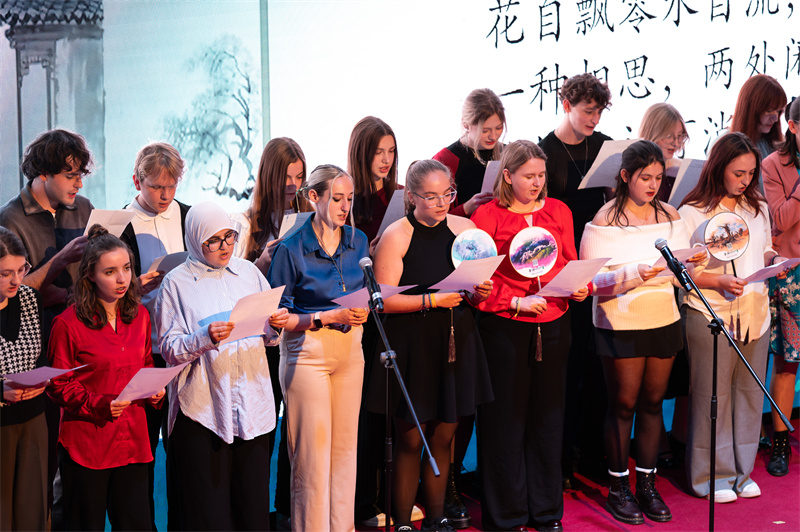
Core Points - The event "Mid-Autumn Poetry Gathering and Chinese Story Lecture" was held at the Brussels Chinese Cultural Center to celebrate its 10th anniversary, bringing together over a hundred participants including students, teachers, and friends of Chinese culture [1][3] - The event featured a variety of activities such as lectures, poetry recitations, artistic performances, interactive Q&A, and calligraphy experiences, emphasizing the cultural richness of the Mid-Autumn Festival [1][3] - The highlight of the event was a collective recitation of Su Shi's famous poem "Water Melody: When Will the Moon Be Clear and Bright," which was accompanied by a discussion on its artistic beauty [3] Summary by Sections Event Overview - The event took place on October 4, marking the 10th anniversary of the Brussels Chinese Cultural Center, and included a diverse audience of students and cultural enthusiasts [1] - Activities included a lecture on "Chinese Stories" and poetry recitations that showcased the cultural significance of the Mid-Autumn Festival [1][2] Cultural Exchange - The event was hosted by students from the Brussels Confucius Institute and Mons University, who introduced the cultural connotations and traditions of the Mid-Autumn Festival in both Chinese and English [2] - Young students recited famous Chinese poems and also performed works by French and American poets, highlighting the universal appeal of poetry [2] Performances and Engagement - Various performances such as flute music, dance, and children's songs were presented, creating a lively atmosphere filled with applause and laughter [3] - The event concluded with participants enjoying mooncakes, symbolizing reunion, while engaging in calligraphy and appreciating the depth of Chinese culture [3]