
万级振子电磁透镜原型机

Search documents
北京亦庄:构筑起引领中国6G走向世界的战略支点
Bei Jing Ri Bao Ke Hu Duan· 2025-11-19 01:05
Core Insights - The 2025 6G Development Conference held in Beijing Economic and Technological Development Zone showcased the leading position of Beijing Yizhuang in building a 6G industrial ecosystem [1][7] - Global experts discussed the future direction of 6G, emphasizing the need for new terminals and application services to support 6G development, particularly through the integration of AI [1][2] - The conference highlighted ten significant advancements from the Beijing 6G Laboratory, marking Beijing's core role in 6G innovation [4][5] Expert Perspectives - Chinese Academy of Engineering academician Wu Hequan emphasized that the consumer market will dominate 6G business, necessitating innovative terminals and services [1] - Zhang Ping from the Chinese Academy of Engineering presented a theoretical framework for 6G, focusing on ComAI and semantic communication, which aims to optimize communication systems [2] - GSMA Greater China President Shi Han stressed the importance of quality spectrum resources and collaborative technical standards for 6G development [2][3] Industry Achievements - The Beijing 6G Laboratory announced ten major advancements, including high-frequency communication and intelligent super-surface technologies, showcasing Beijing's leadership in 6G innovation [4][5] - Notable achievements include the "256TR U6G base station prototype" and a record-setting 30.4 km transmission at 20Gbps by Hongshan Technology [4][5] Yizhuang Practices - Beijing Yizhuang is developing a comprehensive 6G industrial ecosystem, with over 80 companies involved, covering key areas such as chip devices and satellite communication [6] - The region has implemented supportive policies for 6G technology and industry innovation, including funding and platform subsidies [6] - Yizhuang aims to create a seamless service system for 6G, integrating research, production, testing, and application [6][7]

2025中国未来产业前沿进展:量子科技迅猛、脑机接口落地、具身智能蓬勃发展
3 6 Ke· 2025-11-17 04:08
Core Insights - The article emphasizes the importance of future industries driven by cutting-edge technologies, which are in the early stages of development and have significant strategic, leading, disruptive, and uncertain characteristics [1]. Government Initiatives - The Chinese government has issued multiple guiding documents to promote the development of future industries, focusing on six key areas: future manufacturing, future information, future materials, future energy, future space, and future health [2]. - The 2024 and 2025 State Council work reports highlight the need to cultivate emerging and future industries, including quantum technology and life sciences, and to establish growth mechanisms for future industry investments [2]. - The 15th Five-Year Plan emphasizes the exploration of diverse technology routes and typical application scenarios to drive new economic growth points in various future industries [2]. Industry Developments Quantum Technology - Quantum technology integrates principles of quantum mechanics with various scientific fields, aiming to revolutionize information processing and transmission [5]. - Significant advancements include the development of the "Zuchongzhi III" superconducting quantum computing prototype, which set new global records in quantum computing capabilities [6]. - By 2025, China is expected to lead in quantum computing, transitioning from "catching up" to "leading" in the field [7]. Biomanufacturing - Biomanufacturing utilizes biological processes for material processing and conversion, with applications in pharmaceuticals, new materials, and renewable energy [8]. - China has become the largest exporter of key enzyme preparations and gene components, holding a 29% share of the global market [9]. - The industry is characterized by the integration of AI in research and production, accelerating innovation and improving production efficiency [10]. Hydrogen and Nuclear Fusion Energy - Hydrogen energy is recognized as a crucial component of global energy transition, with China being the largest hydrogen producer [11]. - Major projects include the world's largest green hydrogen base and advancements in nuclear fusion technology, with significant milestones achieved in plasma control and fusion energy development [12][13]. Brain-Computer Interfaces - Brain-computer interfaces (BCIs) are emerging as transformative technologies, with successful trials and clinical applications in various fields [14][15]. - The development of both invasive and non-invasive BCIs is progressing rapidly, with applications in medical rehabilitation and research [18]. Embodied Intelligence - The embodied intelligence sector is witnessing rapid growth, particularly in robotics, with advancements in AI and sensor technologies [19][20]. - 2025 is seen as a pivotal year for humanoid robots transitioning from prototypes to mass production, with applications in various industries [21]. Sixth Generation Mobile Communication - The sixth generation (6G) mobile communication technology is expected to enhance performance metrics significantly compared to 5G, with various breakthroughs achieved in key technologies [22][23]. - Standardization efforts for 6G are underway in China, with commercial deployment anticipated around 2030 [23][24].
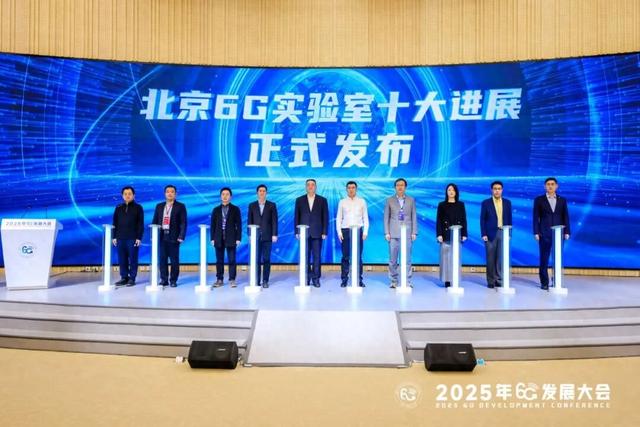
北京首次集中发布 6G实验室十大进展
Bei Jing Shang Bao· 2025-11-16 15:49
Group 1 - The 2025 6G Development Conference in Beijing emphasized the importance of 6G as a strategic direction for digital economy development and future industry cultivation, with a focus on policy support, technology sourcing, and industry ecosystem building [1] - The Beijing 6G Laboratory announced ten major technological advancements, covering key 6G areas such as high-frequency communication, intelligent super surfaces, and integrated sensing and communication [1][2] - The ten advancements include prototypes like the "256TR U6G base station" and innovations in AI wireless technology, which enhance the 6G technology framework and lay the groundwork for practical applications [2] Group 2 - The Beijing Economic-Technological Development Area (BDA) has over 80 upstream and downstream enterprises, forming an initial 6G industry chain, with 50% of the major advancements led or deeply participated in by BDA enterprises [2] - The establishment of a 6G technology overall group and laboratory in Beijing aims to systematically layout technology research, standard studies, and enterprise cultivation, creating a collaborative development framework [3] - China has conducted 6G technology trials for four consecutive years, completing the first phase and accumulating over 300 key technology reserves, with a structured approach to further stages of development [3]
北京6G实验室十大进展发布,一半由亦庄企业主导
Bei Jing Ri Bao Ke Hu Duan· 2025-11-16 08:25
Core Insights - The Beijing 6G Industry Development Forum was held on November 14, focusing on the theme "Intelligently Painting the Future with Beijing's 6G" and highlighting the "Top Ten Advances of the Beijing 6G Laboratory" [1][2] Group 1: Key Developments - The forum announced ten significant advancements in 6G technology, including a 256TR U6G base station prototype and a ten-thousand-level electromagnetic lens prototype [2] - Five of these major advancements were led or deeply participated in by enterprises in Beijing's Yizhuang area, showcasing a 50% contribution rate and emphasizing the area's advantages in 6G research and industrialization [2] - The 256TR U6G base station prototype achieved a peak downlink speed of 20 Gbps under the U6G frequency band, marking a step towards the maturity of advanced broadband solutions for future applications [2] Group 2: Industry Collaboration and Policy Support - Experts from various sectors discussed the application prospects of 6G technology in areas such as autonomous driving and urban governance, emphasizing the collaborative efforts needed for development [3] - Beijing's Economic and Technological Development Area (ETDA) has implemented a 6G special support policy, proposing ten measures to support core product development and innovation ecosystems [3] - The ETDA is establishing a 6G experimental laboratory and has allocated funding and subsidies to support the development of four innovation laboratories focused on 6G technology [3][4] Group 3: Ecosystem Development - The ETDA is actively integrating quality resources and creating application scenarios to promote the deep integration of 6G technology with industries like commercial aerospace and autonomous driving [4] - A new 6G SPACES ecosystem community is being developed, aiming to create a comprehensive industrial service capability covering research, production, testing, and application [4] - Currently, over 80 upstream and downstream enterprises have gathered in the ETDA, covering key areas such as chip devices and satellite communication equipment, forming an initial 6G industrial chain [4]
北京6G实验室十大进展首次集中发布
Xin Hua She· 2025-11-14 15:27
Core Insights - The Beijing 6G Laboratory has released ten significant advancements in 6G technology, covering areas such as high-frequency communication, intelligent super surfaces, and satellite-ground integration [1][2] - Key breakthroughs include a prototype for a 256TR U6G base station, a new long-distance transmission record, and the first low-orbit satellite environment for vehicle networking [1] - The advancements have achieved a peak single-user downlink speed of 20 Gbps in the U6G frequency band and significant improvements in transmission and networking capabilities [1] Group 1 - The ten technological innovations include a cloud-based sensing integrated base station prototype and AI wireless technology prototype verification system [1] - The establishment of a 6G technology overall group and the initiation of the Beijing 6G Laboratory construction work have been announced, forming a collaborative development framework [2] - The current progress includes systematic layout for technology research, standard studies, enterprise cultivation, and application scenarios [2]