三星S26系列

Search documents
iPhone 17e:2026年,苹果AI生态扩张的关键推动力
Canalys· 2026-03-24 04:05
Core Insights - The article discusses how Apple is expanding its AI device ecosystem with the introduction of the iPhone 17e, which serves as a more accessible entry point into Apple's AI ecosystem for consumers and businesses alike [1][2]. Group 1: Product Features and Strategy - The iPhone 17e features 256GB storage and AI capabilities, maintaining a stable price in a cost-pressured component environment, thus enhancing its appeal among price-sensitive users [2][5]. - The device is positioned as a more affordable model within the iPhone 17 series, starting at $599, which balances accessibility and AI integration [2][6]. - The integration of the A19 chip and 8GB DRAM in the iPhone 17e supports Apple's AI development strategy for 2026, reflecting a shift where 51% of smartphone users actively use AI applications [5][6]. Group 2: Competitive Positioning - The iPhone 17e doubles the base storage from 128GB to 256GB while keeping the price unchanged, enhancing its value proposition amidst rising NAND and DRAM costs [6][9]. - Unlike competitors who resort to temporary discounts to manage rising memory costs, Apple strengthens the 17e's competitive positioning by increasing storage capacity without raising prices [6][9]. - The device targets a broader user base, including existing iPhone users, cost-conscious new users, Gen Z, and B2B customers, thereby expanding the penetration of AI-ready devices [9][10]. Group 3: Market Expansion and Distribution - The iPhone 17e is set to launch in 70 markets, up from 59 for its predecessor, with a strategic focus on carrier-led channels to drive upgrades [10]. - The entry price of approximately $599, along with extensive trade-in support and simplified product offerings, makes it suitable for 24-36 month contract promotions [10]. - The reliance on carrier channels is highlighted, with projections indicating that by 2025, 48% of iPhone shipments will come from these channels, emphasizing their importance in driving sales of mid-range iPhones [10].



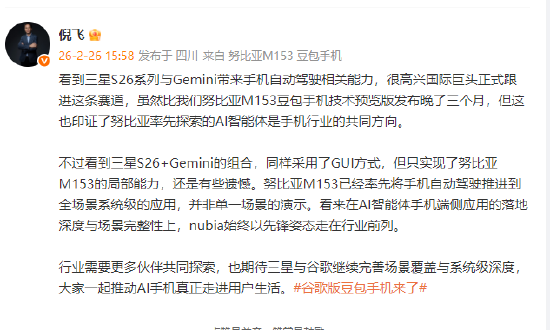
中兴通讯倪飞:三星S26+Gemini的组合,只实现了努比亚M153的局部能力
Xin Lang Cai Jing· 2026-02-26 08:38
Core Viewpoint - Nubia's M153 smartphone has pioneered the integration of AI capabilities in mobile devices, positioning itself ahead of competitors like Samsung, which has recently entered the market with its S26 series and Gemini technology, albeit three months later [1][2]. Group 1 - Nubia's M153 has advanced mobile autonomous driving to a system-level application across all scenarios, rather than just a single demonstration [2]. - The combination of Samsung's S26 and Gemini, while utilizing a GUI approach, only achieves partial capabilities compared to Nubia's M153, indicating a gap in technological depth [2]. - The industry is encouraged to foster collaboration among partners, with hopes that Samsung and Google will enhance scene coverage and system-level depth to bring AI smartphones into everyday user life [2].

三星S26系列将推出三款机型
Jin Rong Jie· 2026-02-25 12:04
Core Viewpoint - Samsung is set to launch the S26 series, including the S26, S26+, and S26 Ultra, at the upcoming Galaxy global product launch event, highlighting the introduction of a hardware-level privacy screen on the S26 Ultra [1] Group 1 - The S26 Ultra will feature Samsung's first hardware-level anti-peeping screen, which can intelligently identify sensitive information areas and automatically apply anti-peeping effects locally [1]
苹果折叠屏手机将装载硅碳负极电池
高工锂电· 2025-03-10 10:52
Core Viewpoint - Silicon-carbon anode batteries are becoming the mainstream choice for new smartphones [1] Group 1: Industry Trends - Apple's first foldable phone will feature a silicon-carbon anode battery supplied exclusively by CATL, with a capacity exceeding 5000mAh [2] - Huawei's Mate XT foldable phone, set to launch in September 2024, will utilize a silicon anode battery with a thickness of only 1.9mm and a capacity of 5600mAh, reducing thickness by over 30% compared to traditional graphite anode batteries [2] - Other brands like Honor, Xiaomi, and Vivo are also adopting silicon-carbon anode technology, with battery capacities generally exceeding 5000mAh [2] - Samsung plans to introduce silicon-carbon battery technology in its S26 series, aiming for a battery capacity of around 6000mAh for the S26 Ultra, while the standard S26 may maintain a capacity of around 5000mAh [2] Group 2: Market Dynamics - The explosion of silicon-carbon anodes is attributed to their theoretical capacity being ten times that of graphite anodes (4200mAh/g), significantly enhancing energy density [3] - The demand for lightweight and long-lasting consumer electronics has made silicon-carbon anodes the first large-scale market for this technology [3] - From early 2024 to March 2025, domestic silicon-carbon anode planned production capacity is expected to exceed 400,000 tons, with total investments surpassing 20 billion yuan [3] - Companies like Shanshan and Silan Microelectronics are accelerating project implementation, with Shanshan's first-phase capacity expected to reach full production by the end of 2024 [3] Group 3: Cost and Production - Companies are integrating upstream raw material production lines to reduce costs, as seen with Zhongning Silicon Industry and Anhui Bond Rui [4] - The cost of porous silicon-carbon preparation has dropped to below 200,000 yuan per ton, which is 30% lower than the silicon-oxygen route [3][4] - Despite the strong foothold of silicon-carbon anodes in consumer electronics, their penetration in power batteries remains low due to issues with cycle life and cost [4] Group 4: Future Outlook - GGII previously predicted that by 2030, China's silicon-based composite material shipments will exceed 300,000 tons [5] - The large-scale application in consumer electronics has opened a market window for silicon-carbon anodes, and as the technology matures, there is potential for significant growth [5]