上海新天地

Search documents
港资守擂、内资突围、区域龙头割据,商业版图谁主沉浮?
Xin Lang Cai Jing· 2026-02-24 05:27
Core Insights - The retail commercial property market in 2025 is undergoing a profound structural adjustment due to macroeconomic headwinds and changing consumer habits, leading to varied survival scenarios among companies with different backgrounds and strategies [3][30] Group 1: Hong Kong Property Companies - Sun Hung Kai Properties remains the "rental king," recording net rental income of HKD 18.392 billion for the fiscal year 2025, demonstrating strong resilience [4][31] - The company maintains a high mall occupancy rate of 95% in Hong Kong by introducing popular mainland brands and optimizing public spaces [4][31] - Swire Properties reported a 20% year-on-year revenue increase in the first half of 2025, with retail sales in mainland China up 70% compared to 2019, but faced significant market differentiation [7][34] - Hang Lung Properties experienced mixed results, with overall income stable but significant city-level disparities, prompting a shift to more refined operational strategies [9][36] - Link REIT adopts a pragmatic approach to stabilize its operations amid structural changes in consumer behavior, enhancing its asset portfolio in Hong Kong and mainland China [11][38] - Kerry Properties shows financial discipline with a 22% drop in net profit but maintains a controlled debt ratio of 40% [13][40] - Shui On Land's resilience heavily relies on its Shanghai projects, which contribute 78% of rental income, highlighting the challenges in its national expansion [16][43] Group 2: Mainland Property Companies - Longfor Properties is focusing on revitalizing older projects, reducing interest-bearing debt by HKD 60 billion over three and a half years, and achieving a historical low financing cost of 3.58% [20][45] - China Resources' commercial segment reported a revenue of CNY 3.267 billion, a 14.6% increase, with a gross margin of 66.1% [21][48] - The average opening rate of new projects in the first half of 2025 exceeded 91%, with significant retail sales growth from third-party managed projects [22][49] Group 3: Regional Leaders - Hisense Plaza in Qingdao has maintained its status as Shandong's top luxury venue for 28 years, achieving annual sales exceeding CNY 6 billion [26][51] - Lihua Group represents a different path in regional commerce with its "department store + supermarket" model, facing challenges in national expansion and declining performance since 2019 [28][53]







浦东三林版“新天地”来了?上海城市更新加快走向多元参与格局
Xin Hua Cai Jing· 2025-11-20 10:51
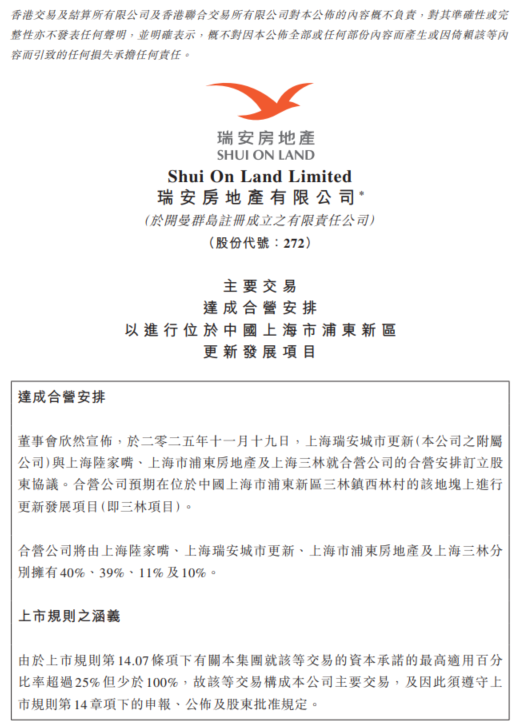
Core Viewpoint - The collaboration between Ruian Real Estate and local state-owned enterprises in Shanghai's urban renewal project is expected to set a new benchmark for urban revitalization, showcasing the importance of diverse participation in enhancing regional vitality and value [1][2][6]. Company Summary - Ruian Real Estate has announced a significant partnership with three state-owned enterprises in Shanghai, forming a joint venture to focus on urban renewal projects [2][5]. - The newly established joint venture has a registered capital of 2.32 billion yuan, with total capital commitments amounting to approximately 9.162 billion yuan, positioning it among the largest urban renewal projects in Shanghai in recent years [6]. - Ruian Real Estate's actual equity in the joint venture is 13.26%, with a capital contribution of 3.573 billion yuan [6]. Industry Summary - The joint venture aims to develop the Sanlin project in the Pudong New Area, which is expected to cover a total construction area of approximately 723,900 square meters, primarily for residential and commercial use [7]. - The Sanlin project is anticipated to become a landmark urban renewal project, following successful examples like the Pandong Tiandi, which has shown significant market potential [8]. - The collaboration reflects a broader trend in Shanghai's urban renewal efforts, where diverse partnerships are increasingly seen as essential for overcoming funding gaps and development challenges [9][10].
地产经纬丨浦东三林版“新天地”来了?上海城市更新加快走向多元参与格局
Xin Hua Cai Jing· 2025-11-20 10:38
Core Viewpoint - The collaboration between Ruian Real Estate and local state-owned enterprises in Shanghai's urban renewal project is expected to set a new benchmark for urban revitalization in the region, highlighting the importance of diverse participation in enhancing regional vitality and value [1][5][9]. Group 1: Project Overview - Ruian Real Estate announced a significant partnership with three state-owned enterprises to establish a joint venture for urban renewal in the Sanlin area of Pudong, Shanghai [2][4]. - The joint venture has a registered capital of 2.32 billion yuan, with a total capital commitment of approximately 9.162 billion yuan, making it one of the largest urban renewal projects in Shanghai in recent years [4][6]. - The project site covers approximately 723,900 square meters, primarily designated for residential and commercial use, and will encompass a full range of real estate development and management services [7][8]. Group 2: Strategic Implications - The partnership is seen as a strong integration of resources, combining Ruian's extensive experience in urban renewal with the local advantages of state-owned enterprises in resource integration and policy alignment [5][9]. - The Sanlin project is anticipated to enhance Ruian's position in the urban renewal sector in Shanghai, contributing positively to its property sales revenue and overall financial health [7][8]. - The project is expected to revitalize the Sanlin area, injecting new commercial vitality and cultural significance, potentially becoming a landmark project following Ruian's previous successes [8][9]. Group 3: Industry Trends - The Sanlin project reflects a broader trend in Shanghai's urban renewal efforts, where collaborative models involving both state and private capital are becoming increasingly common to address funding gaps and development challenges [9][10]. - Experts suggest that sustainable urban renewal requires a combination of government guidance, market mechanisms, and public participation to attract more social capital and enhance project viability [9][10]. - The emergence of projects like Sanlin is indicative of a shift towards a multi-stakeholder approach in urban renewal, moving away from traditional single-developer models [10].

“网红”商场TX淮海操盘人司徒文聪被限制消费
Xin Lang Cai Jing· 2025-05-19 05:17
Core Viewpoint - The article discusses the financial troubles faced by Si Tu Wencong, a prominent figure in the commercial real estate sector, particularly related to his management of various non-standard commercial projects in major cities like Shanghai and Beijing [2][3]. Group 1: Financial Issues - Si Tu Wencong has been subjected to consumption restrictions due to his company, Shanghai Yingzhan Business Management Co., Ltd., failing to fulfill financial obligations, including unpaid rent and penalties totaling nearly 1.5 million yuan since April 2022 [5]. - The financial difficulties of Yingzhan Company are attributed to significant project losses, leading to concerns about potential bankruptcy if obligations are not met [5]. - Other companies under Si Tu Wencong's name are also facing legal disputes, with one company, Beijing Yingtong Xiangye Commercial Management Co., Ltd., involved in cases with execution amounts exceeding 70 million yuan [6]. Group 2: Project Management and Challenges - Si Tu Wencong gained fame for revitalizing commercial properties, but recent projects have not achieved profitability, contributing to his current financial struggles [7]. - His approach to project management involved deep integration with family members, where he leveraged personal connections to secure project opportunities [8]. - The operational model of the non-standard commercial projects he managed has proven challenging, as they require long-term investment and often depend on owner subsidies for sustainability [11]. Group 3: Project Outcomes and Ownership Changes - The TX Huaihai project, once a high-profile venture, has faced scrutiny regarding its operational model, with concerns about whether it is financially viable [12]. - Ownership of TX Huaihai has shifted, with the main operating company being acquired by Bailian Group, indicating a change in management strategy [12]. - Despite the management changes, TX Huaihai has maintained its original branding and positioning, suggesting ongoing support from the project owners [12].