蟠龙天地

Search documents
港资守擂、内资突围、区域龙头割据,商业版图谁主沉浮?
Xin Lang Cai Jing· 2026-02-24 05:27
Core Insights - The retail commercial property market in 2025 is undergoing a profound structural adjustment due to macroeconomic headwinds and changing consumer habits, leading to varied survival scenarios among companies with different backgrounds and strategies [3][30] Group 1: Hong Kong Property Companies - Sun Hung Kai Properties remains the "rental king," recording net rental income of HKD 18.392 billion for the fiscal year 2025, demonstrating strong resilience [4][31] - The company maintains a high mall occupancy rate of 95% in Hong Kong by introducing popular mainland brands and optimizing public spaces [4][31] - Swire Properties reported a 20% year-on-year revenue increase in the first half of 2025, with retail sales in mainland China up 70% compared to 2019, but faced significant market differentiation [7][34] - Hang Lung Properties experienced mixed results, with overall income stable but significant city-level disparities, prompting a shift to more refined operational strategies [9][36] - Link REIT adopts a pragmatic approach to stabilize its operations amid structural changes in consumer behavior, enhancing its asset portfolio in Hong Kong and mainland China [11][38] - Kerry Properties shows financial discipline with a 22% drop in net profit but maintains a controlled debt ratio of 40% [13][40] - Shui On Land's resilience heavily relies on its Shanghai projects, which contribute 78% of rental income, highlighting the challenges in its national expansion [16][43] Group 2: Mainland Property Companies - Longfor Properties is focusing on revitalizing older projects, reducing interest-bearing debt by HKD 60 billion over three and a half years, and achieving a historical low financing cost of 3.58% [20][45] - China Resources' commercial segment reported a revenue of CNY 3.267 billion, a 14.6% increase, with a gross margin of 66.1% [21][48] - The average opening rate of new projects in the first half of 2025 exceeded 91%, with significant retail sales growth from third-party managed projects [22][49] Group 3: Regional Leaders - Hisense Plaza in Qingdao has maintained its status as Shandong's top luxury venue for 28 years, achieving annual sales exceeding CNY 6 billion [26][51] - Lihua Group represents a different path in regional commerce with its "department store + supermarket" model, facing challenges in national expansion and declining performance since 2019 [28][53]







当年抢破头的高分盘,如今还好吗
3 6 Ke· 2026-01-19 03:06
Core Viewpoint - Despite a conservative outlook for the real estate market in 2025, Shanghai has shown resilience, achieving a "tail-end" market performance with second-hand housing transactions reaching a new high of 22,000 units in two consecutive months, while new homes saw 4,088 units launched in December with 2,352 subscriptions [1] Group 1: Market Trends - The rapid cooling of the points system for new homes in Shanghai has exceeded expectations, with only 8% of new projects triggering the points system in 2023, down from 36% in 2022 and 22% in 2023 [2][3] - The supply-demand dynamics have shifted significantly, with an oversupply of new homes leading to a price war and a more cautious buyer sentiment [3][4] - The disappearance of the price gap between new and second-hand homes has diminished the incentive for buyers to rush into the market [3][4] Group 2: Price Dynamics - High-scoring red plate properties have seen significant price increases, with some core area properties experiencing over 50% price appreciation since their launch [5][6] - Conversely, properties in outer districts have faced price declines of around 5%, with some experiencing drops of over 25% due to market cooling [7][8] - The auction market has revealed the true value of properties, with some auctioned homes selling at prices significantly lower than surrounding new developments, indicating a return to realistic pricing [9][10] Group 3: Future Outlook - A total of 33,561 units of previously restricted new homes are expected to be released in 2024, which could significantly impact the second-hand market, particularly in specific areas [11] - The market is likely to see increased competition between new homes and second-hand properties, with new developments offering better layouts and amenities [11][12] - The focus for buyers will shift from high points to the actual quality of the property, emphasizing the importance of practical living needs over speculative investment [13]
浦东三林版“新天地”来了?上海城市更新加快走向多元参与格局
Xin Hua Cai Jing· 2025-11-20 10:51
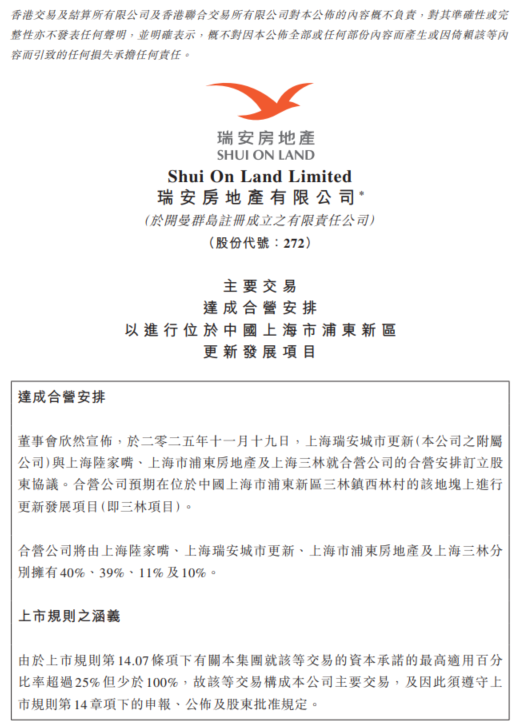
Core Viewpoint - The collaboration between Ruian Real Estate and local state-owned enterprises in Shanghai's urban renewal project is expected to set a new benchmark for urban revitalization, showcasing the importance of diverse participation in enhancing regional vitality and value [1][2][6]. Company Summary - Ruian Real Estate has announced a significant partnership with three state-owned enterprises in Shanghai, forming a joint venture to focus on urban renewal projects [2][5]. - The newly established joint venture has a registered capital of 2.32 billion yuan, with total capital commitments amounting to approximately 9.162 billion yuan, positioning it among the largest urban renewal projects in Shanghai in recent years [6]. - Ruian Real Estate's actual equity in the joint venture is 13.26%, with a capital contribution of 3.573 billion yuan [6]. Industry Summary - The joint venture aims to develop the Sanlin project in the Pudong New Area, which is expected to cover a total construction area of approximately 723,900 square meters, primarily for residential and commercial use [7]. - The Sanlin project is anticipated to become a landmark urban renewal project, following successful examples like the Pandong Tiandi, which has shown significant market potential [8]. - The collaboration reflects a broader trend in Shanghai's urban renewal efforts, where diverse partnerships are increasingly seen as essential for overcoming funding gaps and development challenges [9][10].
地产经纬丨浦东三林版“新天地”来了?上海城市更新加快走向多元参与格局
Xin Hua Cai Jing· 2025-11-20 10:38
Core Viewpoint - The collaboration between Ruian Real Estate and local state-owned enterprises in Shanghai's urban renewal project is expected to set a new benchmark for urban revitalization in the region, highlighting the importance of diverse participation in enhancing regional vitality and value [1][5][9]. Group 1: Project Overview - Ruian Real Estate announced a significant partnership with three state-owned enterprises to establish a joint venture for urban renewal in the Sanlin area of Pudong, Shanghai [2][4]. - The joint venture has a registered capital of 2.32 billion yuan, with a total capital commitment of approximately 9.162 billion yuan, making it one of the largest urban renewal projects in Shanghai in recent years [4][6]. - The project site covers approximately 723,900 square meters, primarily designated for residential and commercial use, and will encompass a full range of real estate development and management services [7][8]. Group 2: Strategic Implications - The partnership is seen as a strong integration of resources, combining Ruian's extensive experience in urban renewal with the local advantages of state-owned enterprises in resource integration and policy alignment [5][9]. - The Sanlin project is anticipated to enhance Ruian's position in the urban renewal sector in Shanghai, contributing positively to its property sales revenue and overall financial health [7][8]. - The project is expected to revitalize the Sanlin area, injecting new commercial vitality and cultural significance, potentially becoming a landmark project following Ruian's previous successes [8][9]. Group 3: Industry Trends - The Sanlin project reflects a broader trend in Shanghai's urban renewal efforts, where collaborative models involving both state and private capital are becoming increasingly common to address funding gaps and development challenges [9][10]. - Experts suggest that sustainable urban renewal requires a combination of government guidance, market mechanisms, and public participation to attract more social capital and enhance project viability [9][10]. - The emergence of projects like Sanlin is indicative of a shift towards a multi-stakeholder approach in urban renewal, moving away from traditional single-developer models [10].

上海与世界|四个“天地”项目与上海城市发展
Xin Lang Cai Jing· 2025-06-23 01:42
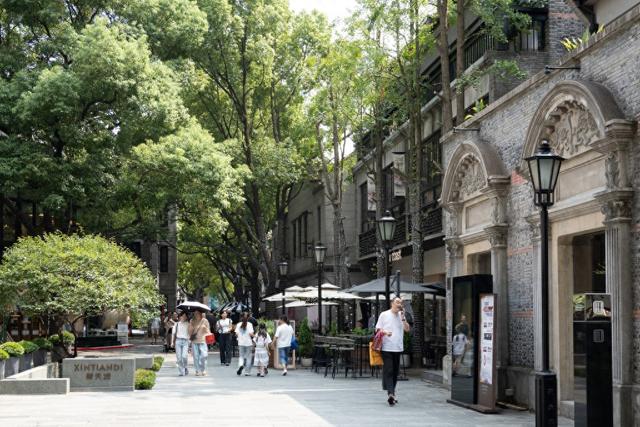
Core Insights - The article discusses the transformative urban development projects led by Hong Kong developer Luo Kangrui in Shanghai, focusing on four key projects: Xintiandi, Chuangzhi Tiandi, Hongqiao Tiandi, and Panlong Tiandi, which have significantly contributed to the city's modernization and cultural preservation [1][3][12]. Group 1: Xintiandi - Xintiandi project (1996-2001) revitalized the Shikumen architecture, transitioning from residential to commercial and leisure spaces, showcasing a successful model of urban renewal [3][5]. - The project gained international recognition during the APEC conference in 2001, establishing itself as a landmark in Shanghai's urban development [3][5]. Group 2: Chuangzhi Tiandi - Chuangzhi Tiandi (2003-2006) was developed as an innovative urban space integrating university campuses, technology parks, and public communities, aimed at fostering creativity and entrepreneurship among youth [5][7]. - The project became a model for open innovation communities, attracting talent and high-tech enterprises to the Yangpu district [7]. Group 3: Hongqiao Tiandi - Hongqiao Tiandi (2005-2015) transformed the economic landscape around the Hongqiao transportation hub, evolving it into a central business district that supports large-scale commerce and cultural activities [10][12]. - The development was strategically aligned with the expansion of the Hongqiao airport and high-speed rail, enhancing its significance in the Yangtze River Delta region [10]. Group 4: Panlong Tiandi - Panlong Tiandi (2014-2023) revitalized a rural ancient town into a leisure center, blending historical preservation with modern amenities to attract urban visitors [12][13]. - The project successfully increased foot traffic and became a popular destination, demonstrating the potential of integrating cultural heritage with contemporary urban life [13][14]. Conclusion - Luo Kangrui's projects illustrate a unique approach to urban development that balances historical preservation with modern needs, contributing to Shanghai's identity as a global city [14].