上银资源精选

Search documents
发起式基金的2025:都在“押注”未来,发展却走向两极
Jing Ji Guan Cha Wang· 2026-01-05 08:45
Group 1 - The A-share market in 2025 exhibited a clear structural bull market, with the Shanghai Composite Index, Shenzhen Component Index, ChiNext Index, and Sci-Tech 50 Index rising by 18.41%, 29.87%, 49.57%, and 35.92% respectively [1] - Nearly 400 initiator funds were established in the market in 2025, which are seen as "seed products" reflecting the confidence of fund managers and market trends [1][2] - The performance of initiator funds varied, with some achieving significant returns while others remained stagnant, indicating a mixed outcome for these investment vehicles [1][4] Group 2 - The year 2025 was characterized by a strong focus on hard technology, with the China Europe Information Technology A fund leading the pack with a return of 102.65% since its inception [2] - The China Europe Resource Selection and Shanghai Silver Resource Selection funds also performed well, achieving returns of 80.46% and 71.69% respectively, highlighting the profitability of core upstream assets [2] - Over 60% of the initiator funds established in 2025 had a scale below 50 million yuan, with many remaining close to the "seed line" of 10 million to 20 million yuan [4][6] Group 3 - The success of initiator funds is closely tied to the overall research and investment capabilities of the fund companies, with a clear strategic focus being essential for effective product deployment [6][7] - Some fund companies adopted a "tool-based positioning" strategy, launching related ETF linked products to capitalize on trends in artificial intelligence and semiconductors, which may lead to future growth [6] - Conversely, smaller fund companies that spread their resources too thin across multiple unrelated themes often faced poor performance and small fund sizes, indicating a lack of strategic focus [6][7]
谁是公募基金中的“偏科王”?“重固收、轻权益”的结构性问题,是市场的选择还是机制束缚下的无奈之举?
Sou Hu Cai Jing· 2025-06-23 12:12
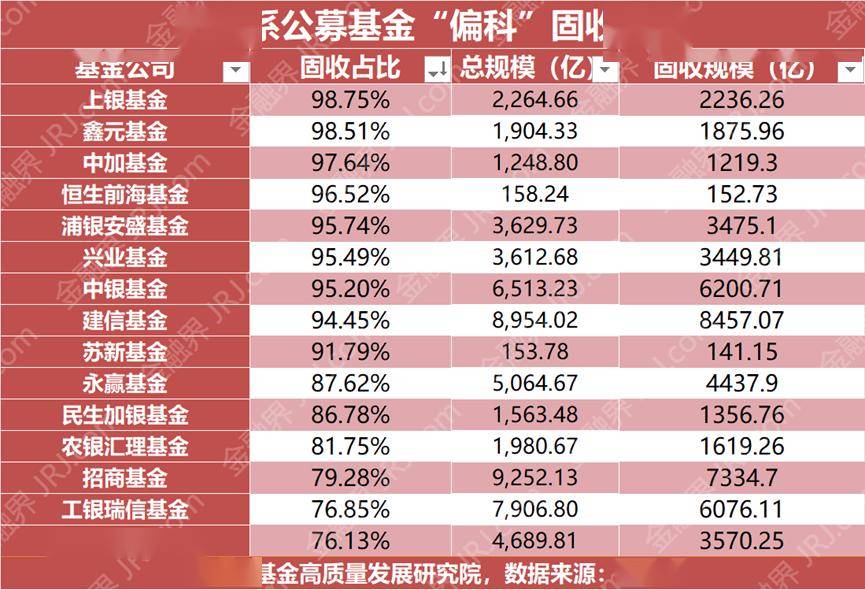
Core Insights - The banking public funds are facing unprecedented transformation pressures despite holding approximately 20% of the total fund market share, indicating a significant reliance on fixed-income products [1][2] - The average scale of fixed-income products among banking public funds is 90%, significantly higher than the industry average of 73%, with 9 out of 15 banking public funds having over 90% in fixed-income allocation [1][2] - The most extreme case is Shangyin Fund, with a fixed-income allocation of 98.75%, while major institutions like Bank of China Fund and Jianxin Fund have less than 5% in equity allocation [1][2] Industry Challenges - The long-term reliance on parent bank channels has led to a "lying win" model, where banking clients prefer conservative fixed-income products, creating a path dependency [2] - Regulatory bodies have emphasized the need to significantly increase the scale and proportion of equity investments in public funds, indicating that the current growth model is unsustainable [2] Emerging Strategies - Some institutions are beginning to adapt, with Shangyin Fund launching equity products like Shangyin Advanced Manufacturing and Shangyin Resource Selection since 2025, indicating a shift in strategy [3] - Puyin Ansheng has achieved a 14% growth in non-cash scale in 2024 by leveraging a digital investment research system, showcasing a successful adaptation to market demands [3] - For banking public funds to truly break through, a "surgical-level" reform is necessary, establishing a dual-driven model of "fixed income for scale, equity for profit" and introducing market-oriented professional managers [3]