中欧信息科技

Search documents
“科技牛”拯救发起式基金!首发与持营不再“窘迫”
Sou Hu Cai Jing· 2026-02-09 09:35
Group 1 - The core viewpoint of the articles highlights the significant growth of initiation funds in the "tech bull" market, where many funds have not only increased their net value but also overcome size challenges, transforming from several million to tens of billions in scale due to investments in sectors like artificial intelligence [1][2] - Several initiation funds, such as the China Europe Information Technology fund, have seen remarkable growth, with the fund's size increasing from 24.4 million to 7.433 billion within nine months, demonstrating the potential for rapid expansion in favorable market conditions [2][3] - The "slow bull" market has alleviated the pressure on fund launches, allowing for larger initial fundraising amounts, such as the Penghua Qihang Quantitative Stock Selection fund, which raised 2.98 billion, compared to previous smaller fund sizes [3][4] Group 2 - Despite the favorable market conditions, some initiation funds have struggled to meet the 200 million threshold, leading to several funds announcing their exit after three years due to insufficient scale [6][7] - The operational costs associated with smaller funds can hinder their growth, making them reliant on institutional investments, which may affect their investment strategies [6] - Some funds have managed to "rescue" themselves by temporarily surpassing the 200 million threshold through increased subscriptions, indicating a dynamic market environment where fund performance can fluctuate significantly [7]
限购,加码!
中国基金报· 2025-11-22 06:16
Core Viewpoint - The recent trend of performance-driven funds implementing purchase limits is primarily aimed at controlling fund size to maintain the effectiveness of investment strategies, reflecting a cautious approach to managing potential market risks and ensuring stable growth for investors [2][10]. Group 1: Fund Purchase Limits - On November 22, China Europe Fund announced that starting November 24, the daily purchase limit for four funds managed by Lan Xiaokang will be reduced to 500,000 yuan [4]. - This year, over 230 active equity funds have announced the suspension of large purchases or general purchases, with many of these funds showing strong performance and reaching new net asset value highs [10]. - The recent limits on fund purchases are a response to the significant structural characteristics observed in the A-share market, which have led to concentrated investor interest in high-performing funds [10]. Group 2: Fund Performance - As of November 20, the one-year performance of several funds managed by Lan Xiaokang, including China Europe Dividend Enjoyment A and China Europe Value Return A, showed returns of 38.93%, 30.24%, and 41.68%, all exceeding their performance benchmarks [6]. - Other high-performing funds, such as China Europe Small Cap Growth A and China Europe Digital Economy A, reported one-year returns of 57.39% and 126.55%, respectively, placing them among the top tier of similar funds [7]. - The trend of limiting purchases among high-performing funds indicates a cautious stance from fund managers regarding the potential for market overheating and valuation bubbles in specific sectors [10]. Group 3: Investment Strategy Insights - Lan Xiaokang emphasizes the need to adjust investment strategies in light of global changes, advocating for a balanced allocation between precious metals and quality Chinese assets over the next 3 to 10 years [6]. - The cautious approach to fund management reflects a broader industry trend where fund managers are increasingly focused on the stability of net asset values and the long-term profitability of their investors [10].


限购,加码!
Zhong Guo Ji Jin Bao· 2025-11-05 09:28
Core Insights - The China Europe Small Cap Growth Mixed Fund has announced a suspension of large subscriptions over 500,000 yuan, marking the second such announcement this year, following a previous limit of 10 million yuan in August [1][2][4] - The fund has demonstrated strong performance, ranking in the top 5% of its peers over the past year and three years, with returns of 67.55% and 62.20% respectively [4] - A total of approximately 220 actively managed equity funds have announced suspensions of large subscriptions or general subscriptions this year, indicating a trend among high-performing funds to limit inflows to maintain investment strategy effectiveness [1][6] Fund Performance - As of the end of Q3, the China Europe Small Cap Growth Mixed Fund had a total size of 1.138 billion yuan [4] - The fund's managers attribute its strong performance to balanced sector and style allocation, with expectations for a continuation of structural market trends in Q4 [4] Market Trends - The trend of high-performing funds announcing subscription suspensions reflects a cautious approach by fund managers in response to the structural characteristics of the A-share market this year [6] - Notable funds, including those managed by well-known investors, have also suspended new subscriptions, indicating a broader industry trend towards managing inflows more conservatively [6]

今年最大的“固收+”黑马
Sou Hu Cai Jing· 2025-10-29 20:35
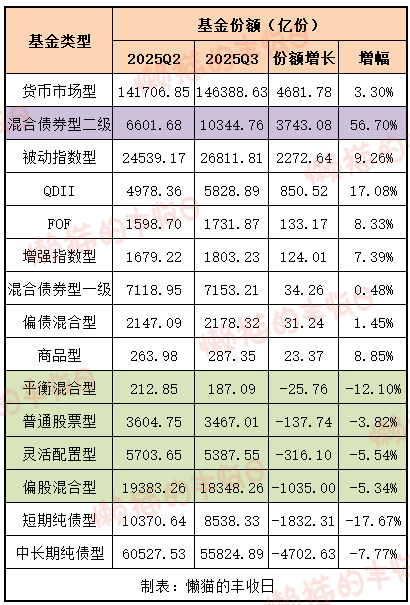
Core Insights - The report highlights a significant shift in fund flows, with active funds experiencing net redemptions while "fixed income plus" funds have gained popularity due to declining bond yields [1][2][20] Fund Type Analysis - Active funds such as ordinary equity, mixed equity, flexible allocation, and balanced mixed funds saw a net decrease in shares, indicating a trend of investors opting for capital preservation amidst a rising market [1] - "Fixed income plus" funds, particularly secondary bond funds, saw a substantial increase of 374.3 billion shares, representing a growth rate of 56.7%, as investors sought higher returns in a low-yield environment [2][3] - The total shares for various fund types in Q3 2025 showed notable changes, with money market funds increasing by 3.3%, secondary mixed bond funds by 56.7%, and passive index funds by 9.26% [3] Company Performance - Top fund companies capitalized on the "fixed income plus" trend, with notable growth in assets under management. For instance, Invesco Great Wall and Fortune Fund doubled their sizes, while E Fund, China Merchants Fund, and GF Fund saw increases exceeding 10 billion [5][6] - China Universal Fund emerged as a surprising player in the "fixed income plus" space, with a growth of 28.8 billion, nearly doubling its size, indicating a shift from its traditional focus on active equity [5][6] - The "China Universal Fengli" fund demonstrated exceptional growth, increasing from 52.77 billion to 314.89 billion in just three quarters, marking a 497% increase, outperforming its peers [8][10] Investment Strategy and Trends - The "China Universal" fund's success is attributed to its diversified asset allocation strategy, which includes a significant allocation to Hong Kong stocks, contributing to its high returns [10] - The report notes a trend of new investors entering the market with a low-risk appetite, primarily investing in "fixed income plus" products, validating the strategy of using these funds as a gateway to the market [20] - The "China Universal" fund's multi-asset investment approach, characterized by a systematic and industrialized process, has led to rapid growth while maintaining performance levels [16][17]
六个月建仓期接近尾声,徐彦新基仍没动静,投资者:我在这基金里躲牛市
Sou Hu Cai Jing· 2025-09-10 20:25
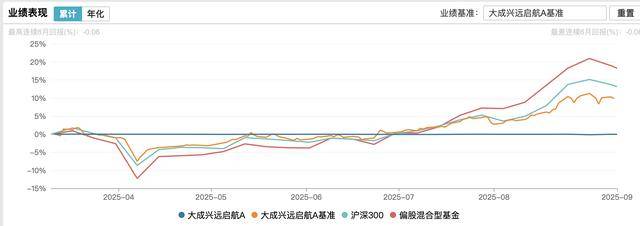
Core Viewpoint - The A-share market has shown unexpected enthusiasm since the beginning of the year, with many active equity funds recovering and achieving significant returns, while the newly established fund, Dachen Xingyuan Qihang, managed by Xu Yan, has remained inactive, leading to widespread controversy and questioning of its strategy [1][2][4]. Fund Performance - Dachen Xingyuan Qihang was established on March 11, 2025, but its net value has barely changed, with A-class shares at 0.9983 and C-class shares at 0.9953 as of September 9, 2025 [2][4]. - The fund has only invested in two stocks, Antu Biology and Meituan, with a stock position of just 0.73% and cash making up 84.95% of its net value [4]. Market Reaction - Since May, market skepticism has grown regarding the fund's "zero allocation" strategy, with investors expressing frustration over missed opportunities in a rising market [4][6]. - Xu Yan acknowledged the lack of systematic investment in the mid-year report, citing significant changes in market conditions and the need for caution due to rational valuation returns [4][5]. Comparison with Peers - In contrast to Dachen Xingyuan Qihang, many newly established active equity funds have quickly completed their allocations and participated in the market rally, with some achieving net value growth exceeding 20% [5][6]. - Funds like Anxin Balanced Growth, established on the same day as Dachen Xingyuan Qihang, have seen net value increases of 20.12% this year, highlighting the stark difference in performance [6]. Industry Trends - The performance of newly established funds this year has shown a clear dichotomy, with some achieving over 50% net value growth while others have recorded losses [7][9]. - The current market environment raises questions about the viability of value investing strategies that prioritize slow and steady approaches, especially in a rapidly changing market [9].
"保成立"到"抢时间"!这类基金上新逻辑生变
券商中国· 2025-03-10 08:53
Core Viewpoint - The logic behind the establishment of initiator funds has shifted from being a "guaranteed establishment" option in a sluggish market to a "quick way" to seize market opportunities as the market heats up [1][5]. Group 1: Initiator Funds Overview - Initiator funds have become a primary focus for many fund companies in 2023, with 41 initiator funds established by March 8, covering various popular sectors [3][4]. - The establishment of initiator funds allows fund companies to successfully launch products even in low market participation periods, with a lower threshold for issuance [4][6]. Group 2: Market Performance and Strategy - Many fund companies are now using initiator funds to quickly establish positions in the market, with some funds achieving significant returns shortly after establishment, such as a 24.86% increase for the China Europe Hang Seng Technology Index fund [5][6]. - The rapid establishment of funds, such as the Kai Stone Yuanxin fund, which had a fundraising period of only two days, reflects the urgency to capitalize on market opportunities [3][5]. Group 3: Challenges and Risks - Despite the advantages, initiator funds face a "wide entry and strict exit" constraint, with many funds failing to meet the scale requirements and subsequently facing liquidation [2][6]. - A significant number of initiator funds established in previous years are at risk of liquidation if they do not reach the required scale of 200 million RMB by the end of their three-year evaluation period [6][7].