中欧磐固

Search documents
2026年公募基金投资策略:均衡配置,顺势而为
Western Securities· 2025-12-10 08:52
Core Conclusions - The public fund market in 2025 saw an increase in both scale and share, with significant changes in structure, as fixed income and active equity funds experienced net redemptions, while fixed income+ and index equity funds were net subscribed [1][3] - Global equity markets strengthened, with domestic stocks outperforming bonds, leading to overall gains in funds, particularly in active funds outperforming passive products, with notable performance in technology and cyclical theme funds [1][2] - For 2026, it is expected that equities will continue to have upward potential, with a recommendation to maintain a balanced allocation between growth and reversal strategies, while flexibly seizing short-term opportunities [1][4] Market Development: Total Growth and Structural Changes - The total scale of public funds surpassed 35 trillion yuan, with stock funds growing by over 1 trillion yuan, indicating a robust market expansion [13] - The number of public funds increased to 13,300, with significant growth in stock and REITs funds, while money market and alternative investment funds saw a decline [13][25] - Active equity funds grew by 21%, with a notable recovery in new fund launches, particularly in technology theme funds, which saw a growth rate exceeding 50% [1][2][29] Performance Analysis: Strong Equity and Weak Bonds - The performance of various asset classes showed that equities outperformed bonds, with gold reaching new highs and equity assets experiencing a broad rally [2][9] - Active funds outperformed passive funds, with specific themes such as TMT, cyclical, and advanced manufacturing showing strong results [9][2] - Fixed income+ funds demonstrated superior performance, particularly those with high allocations to fixed income and convertible bonds [9][20] Investment Strategies: Balanced Allocation and Trend Following - The report suggests a balanced allocation strategy for equity funds, emphasizing the importance of flexibility in capturing phase-specific market opportunities [4][3] - For fixed income funds, the emergence of the fixed income+ era is highlighted, with a focus on asset and strategy characteristics based on risk preferences [5][39] - The report advocates for a global multi-asset allocation approach, emphasizing the value of overseas and commodity funds, with recommendations to follow QDII quotas and focus on mutual recognition funds and southbound ETFs [6][32]
固收+”积极进取不再“佛系
Zhong Guo Zheng Quan Bao· 2025-07-29 22:05
Group 1 - The latest public fund holdings report indicates that many "fixed income +" products increased their equity positions in the second quarter, with sectors like computing power, semiconductors, and biomedicine becoming popular among fund managers [1][4] - Market expectations suggest a further strengthening, with opportunities for rotation across various sectors. After a prolonged adjustment, the value of core A-share assets has become more attractive, and many leading companies' valuations have dropped to lower ranges [1][6] - The increase in equity positions among "fixed income +" funds is notable, with specific funds showing significant rises in their equity ratios compared to the previous quarter [2][3] Group 2 - The investment strategies of "fixed income +" funds have become more diverse, moving beyond traditional large-cap indices to include themes like artificial intelligence, semiconductors, and renewable energy [4][5] - Specific funds, such as Yongying's fund, have shifted their focus from cyclical industries to more elastic sectors, indicating a strategic pivot in asset allocation [4][5] - Fund managers express confidence in the Chinese capital market, highlighting the resilience of the domestic supply chain and the potential for risk assets to perform well in the second half of the year [6][7]
低利率高波动时代,攻守兼备的“固收+”基金将迎新一轮配置机遇
Sou Hu Cai Jing· 2025-06-04 03:29
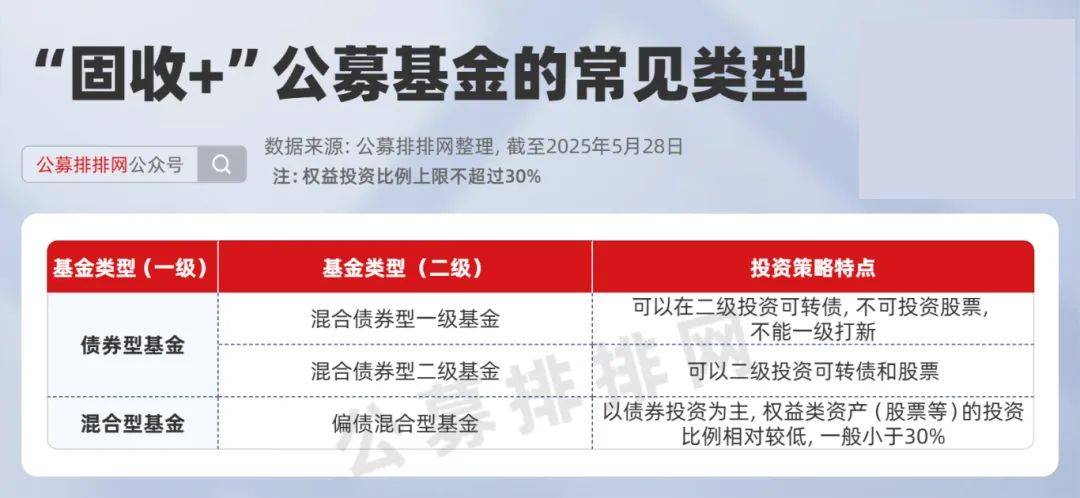
Core Viewpoint - The recent reduction in deposit rates by major banks marks a shift towards a low-interest-rate environment, prompting investors to reconsider traditional savings and explore "fixed income +" strategies in public funds as a viable investment option [1][11]. Group 1: "Fixed Income +" Fund Characteristics - "Fixed Income +" is not an official fund type but a strategy that combines low-volatility fixed income assets with equities and other instruments to enhance returns [1]. - The strategy typically includes mixed bond funds, with equity investments capped at 30% to qualify as "fixed income +" products [2]. - The average annualized return of "fixed income +" funds over the past five years is 16.35%, outperforming both pure bond funds and mixed equity funds [5][6]. Group 2: Performance Metrics - As of May 28, "fixed income +" funds have an average annualized volatility of 4.55% and a maximum drawdown of -8.61%, which is lower than that of mixed equity funds [4]. - Among 1,253 "fixed income +" funds, 64.53% reported positive returns in the first quarter of 2025 [1][5]. Group 3: Growth Phases of "Fixed Income +" Funds - The first rapid growth phase occurred from 2014 to 2016, driven by a favorable market environment and significant liquidity, leading to a doubling of "fixed income +" fund numbers [8]. - The second growth phase from 2019 to 2021 was fueled by regulatory changes and a strong equity market, resulting in a 134.41% increase in the number of "fixed income +" funds [9]. Group 4: Current Market Opportunities - The current market conditions, characterized by low deposit rates and increased volatility, present a favorable environment for "fixed income +" strategies, similar to previous growth phases [11]. - Analysts suggest that the focus on diversified asset allocation within "fixed income +" strategies can enhance return potential amid uncertain economic conditions [11]. Group 5: Recommended "Fixed Income +" Products - A selection of 103 "fixed income +" products with above-average performance metrics has been identified for potential investment, including several mixed bond funds [12][14]. - The top-performing mixed bond funds over the past five years include those managed by Tianhong Fund, Dongfanghong Asset Management, and others, showcasing strong returns and low volatility [14][16].