
中欧资源精选混合基金

Search documents
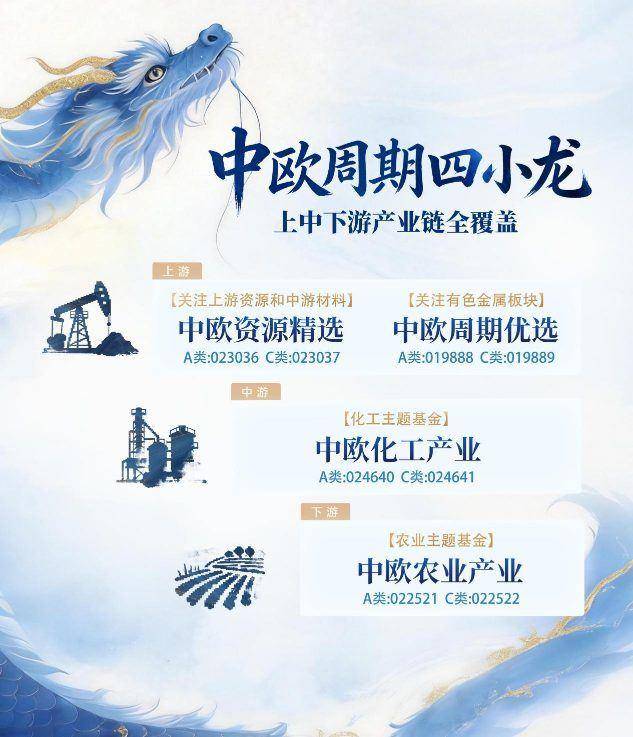
卡位周期全产业链脉络,中欧“四小龙”构建差异化布局
Sou Hu Cai Jing· 2026-02-24 06:17
Core Viewpoint - Recent fluctuations in international gold and silver prices have caused volatility in the A-share cyclical sector, but the fundamental "supply-demand resonance" of the cyclical industry remains unchanged, supported by global power supply constraints, new demand from AI infrastructure and energy storage, and strategic reserve demands driven by national "resource security" policies [1][5] Group 1: Investment Opportunities - The cyclical industry is supported by a complete layout covering upstream resources, midstream chemicals, and downstream agriculture, with four funds from China Europe Fund focusing on the cyclical industry chain [1][3] - The four funds, managed by different fund managers, aim to achieve comprehensive coverage of cyclical investments, with specific focuses on energy metals, industrial metals, natural resources, basic chemicals, and agriculture [3][4] Group 2: Performance Data - As of December 31, 2025, the China Europe Cyclical Preferred Mixed Fund A has achieved a cumulative return of 104.16% since its establishment on November 14, 2023, significantly outperforming its benchmark [4][10] - The China Europe Resource Selection Fund A has a return of 80.46% since its inception, exceeding its performance benchmark by 33.88 percentage points, focusing on core resource varieties like copper and aluminum [4][10] Group 3: Historical Context and Future Outlook - The current third global commodity cycle is characterized by structural adjustments in the global economy, industrial upgrades, and geopolitical changes, with historical cycles providing a reference for understanding the uniqueness and sustainability of this cycle [5][6] - The ongoing global commodity cycle is expected to be prolonged, with major economies emphasizing "resource security," which supports the demand for core commodities like copper and aluminum [6][7] Group 4: 2026 Investment Directions - Fund managers have outlined investment directions for 2026, focusing on commodities such as copper, aluminum, lithium carbonate, gold, and small metals, while also considering opportunities in chemicals and coking coal [8][9] - The cyclical industry is expected to benefit from continued liquidity easing and supply-side constraints, with a focus on price-elastic new energy metals and industries that can increase reserves and production under "resource security" policies [8][9]

洞察资源品超级周期的投资密码——访中欧资源精选混合基金经理叶培培
Shang Hai Zheng Quan Bao· 2025-11-09 15:26
Core Insights - The global commodity market is currently in the third super cycle of the past 60 years, with scarce resource prices expected to remain high for a longer duration compared to previous cycles [1][3] - A comprehensive investment framework is essential, integrating macroeconomic conditions, industry trends, and individual stock analysis [2][3] Investment Framework - The investment framework consists of three components: macroeconomic judgment, industry analysis, and micro-level stock selection [2] - Macroeconomic factors include population changes, technological advancements, and policy directions, which influence consumption demand and labor supply [2] - Industry analysis focuses on inventory levels, investment activities, and competitive landscape, which reflect market supply and demand [2] Resource Classification - Resources are categorized into three types: 1. Financial commodities like gold and silver, influenced more by macroeconomic factors than actual consumption [3] 2. Industrial commodities like copper and aluminum, which are affected by both financial and physical demand [3] 3. Specialty metals in China, driven by industrial policy [3] Market Opportunities - Gold has shown strong performance this year, with increasing institutional and individual investments expected to continue into 2025 [4] - The current weak dollar environment is likely to enhance the financial attributes of dollar-denominated assets, leading to price increases [4] - Industrial metals are influenced by capital expenditure cycles, with potential benefits from China's "anti-involution" policies [5] Specific Investment Opportunities - Aluminum is identified as a significant dividend asset, providing stable cash returns and potential for price appreciation in a recovering economy [5] - Copper is highlighted for its extensive applications in power grids and AI data centers, with a growing demand expected [5] - Lithium and other energy metals are nearing the end of their industrial cycle, with improvements anticipated by mid-next year [5]
中欧基金基金经理叶培培:黄金短期交易拥挤,中长期驱动力未发生根本转变
Zheng Quan Shi Bao Wang· 2025-10-22 07:01
Core Viewpoint - The current gold market is experiencing a crowded trading sentiment, with a potential correction of 10% to 15% expected, similar to the market behavior observed from April to August this year. However, the long-term drivers for gold prices have not fundamentally changed, indicating a high ceiling for gold prices [1] Summary by Relevant Categories Short-term Market Dynamics - The gold market is currently characterized by an overheated trading sentiment, suggesting a potential correction of 10% to 15% [1] - This situation mirrors the market trends seen from April to August of this year [1] Long-term Price Drivers - The fundamental drivers for gold prices remain unchanged, with a high ceiling anticipated for gold prices [1] - The proportion of investable gold market capitalization relative to stock and bond portfolios is significantly lower than it was before the 1980s, indicating room for rebalancing towards dollar assets [1] Key Influencing Factors - The reversal of gold price drivers is closely tied to the weakening of the US dollar's credit [1] - Historical analysis over the past 60 years shows an inverse relationship between gold and US dollar credit [1] - If the US economy achieves a long-term strong recovery and fiscal balance, such as reducing the deficit rate below 4%, it could signal the end of a bull market for gold. Until then, the expectation is for gold to remain in a fluctuating upward trend [1]

中欧基金的基金经理叶培培:黄金短期交易拥挤,中长期驱动力未发生根本转变
Zheng Quan Shi Bao Wang· 2025-10-22 06:35
Core Viewpoint - The current gold market is experiencing a consolidation phase, with a potential 10-15% correction expected due to overheated trading sentiment, similar to the market behavior observed from April to August this year [1] Group 1: Market Analysis - The long-term drivers of gold prices have not fundamentally changed, indicating a high ceiling for gold prices [1] - The proportion of investable gold market capitalization relative to stock and bond portfolios is significantly lower than it was before the 1980s, suggesting room for rebalancing towards dollar assets [1] Group 2: Economic Indicators - The reversal of gold price driving factors is closely tied to the weakening of the US dollar's credit [1] - Historical analysis over the past 60 years shows an inverse relationship between gold and US dollar credit [1] - If the US economy achieves a long-term robust recovery and brings fiscal balance, such as reducing the deficit rate below 4%, the bull market for gold may come to an end [1] Group 3: Price Trend Outlook - Until a significant economic shift occurs, the outlook for gold prices remains within a fluctuating upward channel [1]