
中欧(中亚)班列运输服务

Search documents
阿拉山口铁路口岸通行中欧(中亚)班列突破1000列
Ren Min Ri Bao· 2026-02-20 11:31
Core Viewpoint - The article highlights the significant growth and operational efficiency of the China-Europe (Central Asia) freight trains, particularly through the Alashankou railway port, which has surpassed 1,000 trains earlier than last year, indicating a strong start to the new year and supporting the high-quality development of the Belt and Road Initiative [1][2]. Group 1: Operational Achievements - As of February 14, a freight train loaded with machinery and electronic products departed from the Alashankou port to Poland, marking a milestone in the operational capacity of the China-Europe freight trains [1]. - The Alashankou railway port has maintained an average of over 10,000 trains annually for six consecutive years, with a projected cargo volume of 32.1 million tons by 2025, reflecting a year-on-year growth of 12.1% [1]. - The number of China-Europe freight trains is expected to reach 18,000 by 2025, with a year-on-year increase of 7.4%, accounting for 53% of the total trains operated [1]. Group 2: Efficiency Improvements - The Alashankou station has implemented refined transportation organization, integrated scheduling, and standardized operational processes to enhance the efficiency of freight train operations [2]. - Since 2025, the number of full schedule routes for China-Europe freight trains through Alashankou has increased to 8, with 18 trains operating weekly, achieving a transportation time reduction of over 30% compared to regular trains [2]. - The Alashankou customs has optimized regulatory services and enhanced collaboration with various departments to ensure the smooth operation of the China-Europe (Central Asia) freight trains [2]. Group 3: Connectivity and Trade Support - Currently, the Alashankou railway port has 128 routes for China-Europe (Central Asia) freight trains, reaching 21 countries and cities, including Germany and Poland, with over 200 types of goods transported [2]. - The port serves as a crucial gateway for cross-border trade, reinforcing its role as a bridgehead for China's westward opening and the Asia-Europe golden passage [2].
2025年中哈(连云港)物流合作基地运量突破7.5万标箱
Xin Lang Cai Jing· 2026-01-06 03:50
Core Insights - The article highlights the success of the China-Kazakhstan (Lianyungang) Logistics Cooperation Base, which is the first international economic and trade cooperation project established under the Belt and Road Initiative, achieving a record high in freight volume in 2025 [1] Group 1: Logistics and Trade Performance - In 2025, the base has dispatched a total of 915 trains of the China-Europe (Central Asia) freight service, completing a freight volume exceeding 75,000 TEUs, representing a year-on-year growth of 0.5% [1] - The base has established a stable and efficient two-way logistics channel, continuously operating the China-Europe (Central Asia) freight trains since its inception [1] Group 2: Innovations and Developments - The first photovoltaic special train has been launched, showcasing innovation in logistics services [1] - The implementation of the "one box to the end" model for the transit of Kazakh wheat has been introduced, enhancing the efficiency of cross-border logistics [1] - The "Yunport·Huosutong" platform has been launched, enabling real-time tracking of freight trains across 16 countries in Asia and Europe [1]

中国-中亚边境行:多线布局促中哈物流合作稳步向前
Xin Hua She· 2025-12-09 08:57
Core Insights - The number of China-Europe (Central Asia) freight trains passing through the Alashankou railway port has exceeded 7,000 this year, with 128 routes covering 21 countries including Germany and Poland, transporting over 200 types of goods [2] Group 1 - The construction of the International Transport Corridor across the Caspian Sea is accelerating [2] - The logistics cooperation between China and Kazakhstan is experiencing rapid development, as evidenced by visits to Dostyk and Aktau ports [2]

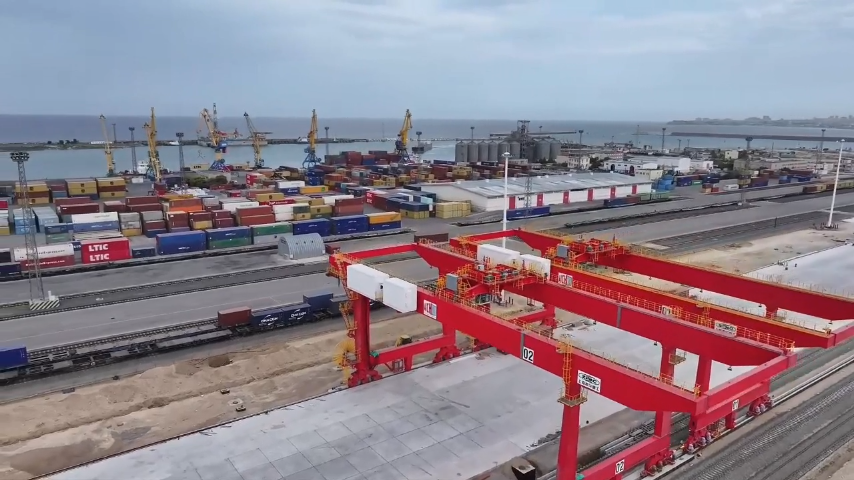
中欧(中亚)班列畅通中国—中亚经济繁荣发展“黄金通道”
Xin Hua Wang· 2025-12-08 09:19
Core Insights - The China-Europe (Central Asia) freight trains are establishing a "golden corridor" for economic cooperation between China and Central Asia, facilitating efficient logistics and trade connections [1][2][3] Group 1: Freight Train Operations - In the first 11 months of this year, the two major ports in Xinjiang handled 16,000 China-Europe (Central Asia) freight trains, marking a 7.6% year-on-year increase, with over 200 types of goods transported [1] - The China-Europe freight trains have three main routes, with the western corridor being a crucial railway transport channel for China-Central Asia trade [1] Group 2: Port Efficiency Improvements - The continuous upgrade of port customs capabilities has led to significant improvements in operational efficiency, with vehicle turnover rates increasing by over 20% at the Horgos port [2] - The implementation of a "fast loading and unloading" model at the Alashankou port allows for same-day customs clearance for arriving trains, reducing costs related to cargo loss and delays [2] Group 3: Economic Impact and Trade Growth - The stable operation of the freight trains has activated regional economies and promoted industrial linkages, with cities like Xi'an regularly operating freight lines to major Central Asian cities [2] - In 2024, Xi'an Aijiu Grain and Oil Industrial Group plans to import 92,000 tons of grain through the China-Europe freight trains, generating sales of 180 million yuan from imported raw materials [2] Group 4: Manufacturing and Export Growth - Companies like Shaanxi Konka Smart Home Appliances are leveraging the logistics advantages of the China-Europe freight trains, with over 60% of their goods being exported via this channel [3] - From January to October this year, the Xi'an China-Europe freight trains operated 5,063 times, a 16.3% increase year-on-year, achieving the highest record for the first ten months in history [3]
阿拉山口铁路口岸通行中欧(中亚)班列突破7000列
Xin Hua She· 2025-11-28 11:32
Core Insights - The Urumqi Railway Bureau has facilitated over 7,000 China-Europe (Central Asia) freight trains through the Alashankou railway port this year, contributing to the high-quality development of the Belt and Road Initiative [1][2] - The railway department in Xinjiang has enhanced the capacity of the port and its back-end channels, with significant upgrades following the opening of the second line of the Lanzhou-Xinjiang Railway [1] - The Alashankou station has increased its container handling capacity to 2,000 TEUs per day, with improvements in standard gauge and broad gauge transport capabilities [1] Capacity Enhancements - The Alashankou station has added one new container operation line and upgraded two existing lines, resulting in a 15% increase in standard gauge transport capacity and a 30% increase in broad gauge transport capacity [1] - The station has integrated freight train operations into its daily schedule, improving communication with Kazakhstan's railway authorities to prioritize the processing of freight train documentation and cargo handling [1] Operational Efficiency - The Alashankou railway port currently has 128 operational lines for China-Europe (Central Asia) freight trains, reaching 21 countries and cities, including Germany and Poland, with over 200 types of goods being transported [2] - The implementation of a "fast loading and unloading" operation model for key goods has improved transportation efficiency, ensuring that trains are ready to depart as soon as cargo is available [2]
新疆双口岸累计通行中欧(中亚)班列突破10万列
Yang Shi Xin Wen Ke Hu Duan· 2025-10-13 13:03
Core Insights - The China-Europe freight train service has surpassed 100,000 trips through the Alashankou and Horgos ports, marking a significant milestone in trade connectivity [1] Group 1: Operational Efficiency - The customs at Alashankou and Horgos have implemented a visual supervision system utilizing big data and IoT technology, enhancing operational efficiency [1] - The transit time for goods via the China-Europe freight trains has been reduced from 2-3 days to under 16 hours, with an average of 2 hours required for the return train to be reloaded [1] - The daily average of inbound and outbound China-Europe freight trains exceeds 27 [1] Group 2: Trade Connectivity - The number of freight train routes through Alashankou and Horgos has reached 127 and 89 respectively, connecting 26 provinces and regions within China and linking to 21 countries in Europe and Asia, including Germany and Hungary [1] - The variety of goods transported has expanded from initial electronic products like computers and mobile phones to over 200 categories, including new energy vehicles, industrial machinery, grains, and alcoholic beverages [1]
新疆阿拉山口铁路口岸今年通行中欧(中亚)班列突破6000列
Zhong Guo Xin Wen Wang· 2025-10-13 12:44
Core Points - The Alashankou railway port has successfully facilitated over 6,000 China-Europe (Central Asia) freight trains this year, enhancing the stability of international supply chains [1][2] - The China-Europe (Central Asia) freight trains have evolved from a simple transportation channel to a comprehensive service platform integrating logistics, trade, and industry [1][2] Group 1: Operational Efficiency - The Alashankou Customs has implemented a series of service measures to ensure the efficient operation of the freight trains, significantly reducing the import goods transit time from 2-3 days to under 16 hours [2] - A dynamic prediction system for freight trains has been established, allowing for real-time updates and automatic completion of manifest reviews, enabling "zero waiting" for inspections upon arrival [2] - The Alashankou station maintains an average daily passage of over 21 freight trains, with a peak of 30 trains in a single day this year [2] Group 2: International Connectivity - The Alashankou railway port currently supports 127 freight train routes, connecting 26 provinces and municipalities in China and linking to 21 countries including Germany, Poland, and Hungary [3] - The range of goods transported includes over 200 categories, such as automobiles, clothing, and electronics [3]
今年霍尔果斯铁路口岸已通行中欧(中亚)班列超7000列
Ren Min Wang· 2025-09-19 00:50
Core Points - A China-Europe freight train loaded with electronic products and daily necessities departed from the Horgos railway port on September 15, marking the 7,000th train this year, which is 44 days earlier than last year [1] - As of September 16, a total of 7,031 China-Europe (Central Asia) freight trains have passed through the Horgos railway port, demonstrating the port's increasing influence in supporting the high-quality development of the Belt and Road Initiative [1] Summary by Category Operational Efficiency - The Horgos port has implemented reforms such as "smart railway port + local rapid customs clearance," reducing the import cargo clearance time from 2-3 days to under 16 hours, a decrease of 70% [1] - The export cargo processing time has been cut from 6 hours to 1 hour, achieving an 80% reduction [1] - Real-time data sharing between customs and railway systems has improved overall clearance efficiency by over 50% [1] Traffic Volume - The average daily number of trains passing through the Horgos port has remained above 27, ensuring efficient customs clearance [1] - Currently, there are 90 train routes operating through the Horgos railway port, covering 18 countries and 46 cities and regions [1] Cargo Variety - The freight trains transport over 200 types of goods, including daily necessities, auto parts, electronic products, and large equipment [1]
今年以来天津口岸中欧(中亚)班列发运超5万标箱
Zhong Guo Xin Wen Wang· 2025-09-18 10:38
Core Points - The Tianjin port has shipped over 50,000 TEUs (Twenty-foot Equivalent Units) of China-Europe (Central Asia) trains this year, highlighting its role as a key hub in the Belt and Road Initiative [1][2] - The port serves as the eastern starting point of the China-Mongolia-Russia Economic Corridor and an important node in the New Eurasian Land Bridge Economic Corridor, achieving full coverage of eastern, central, and western routes for China-Europe and Central Asia trains [1] - The implementation of the "port-to-park" facilitation measures by customs has significantly reduced container turnover time by 1-2 days, enhancing the competitiveness of businesses operating in the region [1] Industry Developments - To ensure smooth and stable operations of the trains, the Tianjin New Port Customs has established a special research group to analyze business conditions and identify bottlenecks, focusing on optimizing customs processes and building information-sharing mechanisms [2] - As of September 15, 2023, the customs has supervised the shipment of 492 China-Europe (Central Asia) trains, totaling 52,890 TEUs, which represents a 15% year-on-year increase in the number of TEUs [2]
今年霍尔果斯铁路口岸已通行中欧(中亚)班列7000列
Zhong Guo Xin Wen Wang· 2025-09-16 09:26
Core Viewpoint - The article highlights the significant increase in the efficiency and volume of cargo transported via the Horgos railway port, marking a milestone with the 7000th China-Europe (Central Asia) freight train this year, which is 44 days ahead of last year's pace [1] Group 1: Operational Efficiency - The Horgos port implemented a "smart railway port + local rapid customs clearance" reform in May, reducing the import cargo clearance time from 2-3 days to under 16 hours, achieving a 70% reduction [1] - The export cargo processing time has been cut from 6 hours to 1 hour, resulting in an 80% decrease [1] - Real-time data sharing between customs and railway systems allows for tracking of logistics and train information, enhancing overall clearance efficiency by over 50% [1] Group 2: Cargo Volume and Routes - The number of freight train routes passing through Horgos has reached 90, covering 18 countries and 46 cities and regions [1] - The types of goods transported include over 200 categories, such as daily necessities, auto parts, electronic products, large equipment, building materials, sports goods, and steel [1]