中证全指红利质量指数

Search documents
金融工程专题:养老定投底仓选择:价值类SmartBeta指数的梳理与对比-20260331
BOHAI SECURITIES· 2026-03-31 07:29
Quantitative Models and Construction Methods 1. Model Name: Dynamic Investment Strategy Based on Valuation (PE Dynamic Investment Model) - **Model Construction Idea**: This model dynamically adjusts investment amounts based on the valuation level of the index, aiming to optimize returns by increasing investment during low valuation periods and reducing it during high valuation periods [54] - **Model Construction Process**: - At the beginning of each month, calculate the five-year historical percentile of the index's current price-to-earnings (PE) ratio - Investment rules: - If PE percentile < 30%, invest 1000 CNY - If PE percentile is between 30% and 70%, invest 500 CNY - If PE percentile > 70%, invest 0 CNY [54] - **Model Evaluation**: The model shows significant improvement in returns for broad-based indices like CSI 300 but has limited incremental benefits for value-based Smart Beta indices due to their already strong performance [55][60] 2. Model Name: Dynamic Investment Strategy Based on Moving Averages (MA Dynamic Investment Model) - **Model Construction Idea**: This model adjusts investment amounts based on the deviation of the index's current price from its 500-day moving average, aiming to capture market trends and optimize returns [54] - **Model Construction Process**: - At the beginning of each month, calculate the deviation: `(Current Index Price - 500-day Moving Average) / 500-day Moving Average` - Investment rules: - If deviation < -50%, invest 1000 CNY - If deviation is between -50% and -35%, invest 800 CNY - If deviation is between -35% and -20%, invest 600 CNY - If deviation is between -20% and 20%, invest 500 CNY - If deviation is between 20% and 35%, invest 400 CNY - If deviation is between 35% and 50%, invest 200 CNY - If deviation > 50%, invest 0 CNY [54] - **Model Evaluation**: Similar to the PE dynamic model, this strategy improves returns for broad-based indices but has limited impact on value-based Smart Beta indices [55][60] --- Model Backtesting Results 1. PE Dynamic Investment Model - **CSI 300 Index**: - 3-year XIRR: Average return improved from -0.06% (normal investment) to 2.16% [56][58] - 5-year XIRR: Average return improved from 0.67% (normal investment) to 3.25% [56][58] - **Value-Based Smart Beta Indices**: - Limited incremental benefits, with average XIRR improvements of less than 0.3% compared to normal investment [56][58] 2. MA Dynamic Investment Model - **CSI 300 Index**: - 3-year XIRR: Average return improved from -0.06% (normal investment) to 0.08% [56][58] - 5-year XIRR: Average return improved from 0.67% (normal investment) to 0.86% [56][58] - **Value-Based Smart Beta Indices**: - Similar to the PE model, incremental benefits were minimal, with average XIRR improvements of less than 0.5% [56][58] --- Quantitative Factors and Construction Methods 1. Factor Name: Dividend Yield - **Factor Construction Idea**: Select stocks with high and stable dividend yields to construct indices with strong income-generating potential [12][21] - **Factor Construction Process**: - Select stocks with at least three consecutive years of cash dividends - Rank stocks by average dividend yield over the past three years - Weight stocks by dividend yield or a combination of dividend yield and other factors (e.g., volatility) [21][23] - **Factor Evaluation**: Provides stable returns and lower volatility, making it suitable for defensive strategies [15][25] 2. Factor Name: Free Cash Flow - **Factor Construction Idea**: Focus on companies with strong free cash flow generation, which indicates financial health and value potential [12][21] - **Factor Construction Process**: - Select stocks with positive free cash flow over the past three to five years - Rank stocks by free cash flow yield - Exclude financial and real estate sectors - Weight stocks by free cash flow yield [21][23] - **Factor Evaluation**: Delivers higher average returns but with greater volatility compared to dividend yield factors [15][25] --- Factor Backtesting Results 1. Dividend Yield Factor - **Indices**: - CSI Dividend Index: 5-year XIRR average return of 9.01% [53] - CSI Dividend Low Volatility 100 Index: 5-year XIRR average return of 10.60% [53] - **Stability**: High stability with 100% profitability over 5-year periods [53] 2. Free Cash Flow Factor - **Indices**: - CSI Free Cash Flow Index: 5-year XIRR average return of 20.88% [53] - **Volatility**: Higher volatility compared to dividend yield indices, with a wider range of returns [53]
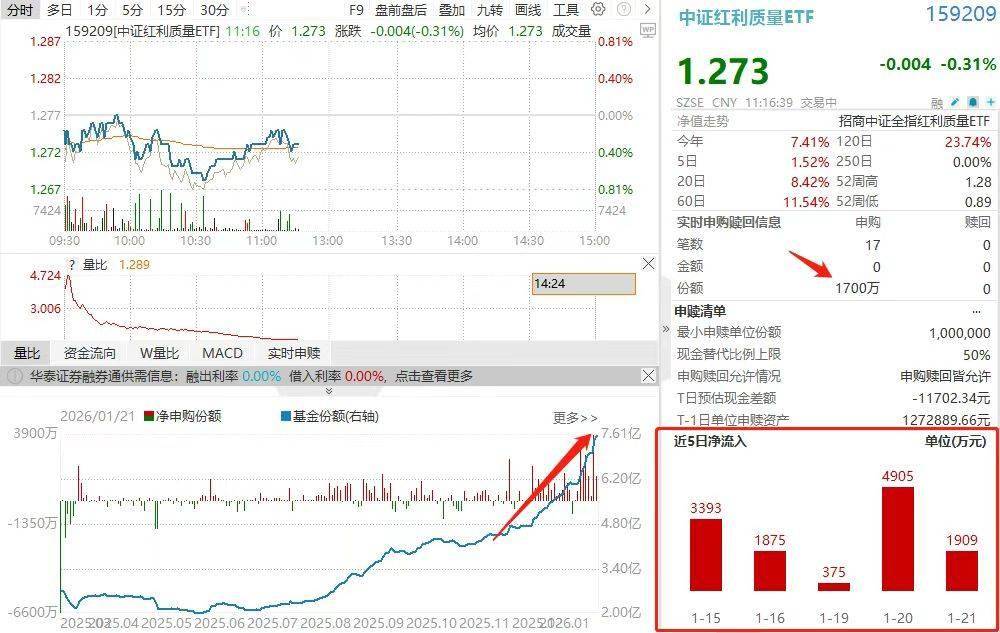
份额加速攀升创新高!“进取型红利”中证红利质量ETF(159209)盘中揽金超2000万,连续第10日净流入
Sou Hu Cai Jing· 2026-01-22 03:43
Group 1 - The core viewpoint of the articles highlights the resilience of high-quality investment strategies amidst market volatility, supported by the scarcity of certain returns and regulatory policies promoting dividend quality [3] - The China Securities Dividend Quality ETF (159209) has seen a continuous net inflow for 10 days, reaching a historical high in shares, indicating strong investor interest [1][3] - The ETF tracks the China Securities All Index Dividend Quality Index, which selects 50 companies with stable dividends and high profitability, reflecting strong dividend and earnings capabilities [3] Group 2 - The ETF employs a "dividend + quality" dual-factor screening mechanism, focusing on undervalued and high-quality companies, aligning with value investment principles similar to those of Warren Buffett [3] - The product design features a low fee structure of "0.15% + 0.05%", providing a cost advantage for long-term holders, and a monthly dividend assessment mechanism to enhance cash flow for investors [3]

【广发金工】AI识图关注化工、非银和卫星
广发金融工程研究· 2026-01-04 08:57
Market Performance - The Sci-Tech 50 Index decreased by 0.59% and the ChiNext Index fell by 0.82% over the last five trading days, while the large-cap value index rose by 0.01% and the large-cap growth index declined by 0.39% [1] - The Shanghai Stock Exchange 50 Index increased by 0.20%, and the small-cap index represented by the CSI 2000 rose by 1.09%, with defense and military, as well as oil and petrochemical sectors performing well, while telecommunications and comprehensive sectors lagged [1] Valuation Levels - As of December 31, 2025, the static PE ratio of the CSI All Share Index is at the 82nd percentile, with the Shanghai 50 and CSI 300 both at 75%, and the ChiNext Index close to 58% [1] - The CSI 500 and CSI 1000 are at 62% and 64% respectively, indicating that the ChiNext Index's valuation is relatively at the historical median level [1] Fund Flows - In the last five trading days, ETF inflows amounted to 25.6 billion yuan, and the margin trading balance increased by approximately 23.8 billion yuan, with an average daily trading volume of 208.23 billion yuan across the two markets [2] Thematic Investment - The latest thematic allocation includes sectors such as chemicals, non-bank financials, and satellite communications, specifically focusing on sub-indices like the CSI Sub-Industry Chemical Index, the National Index for Commercial Satellite Communications, and the CSI 300 Non-Bank Financial Index [2][3] AI and Machine Learning Insights - A convolutional neural network (CNN) model has been utilized to analyze charted price and volume data, mapping learned features to industry thematic sectors, indicating a trend towards AI-driven investment strategies [11]

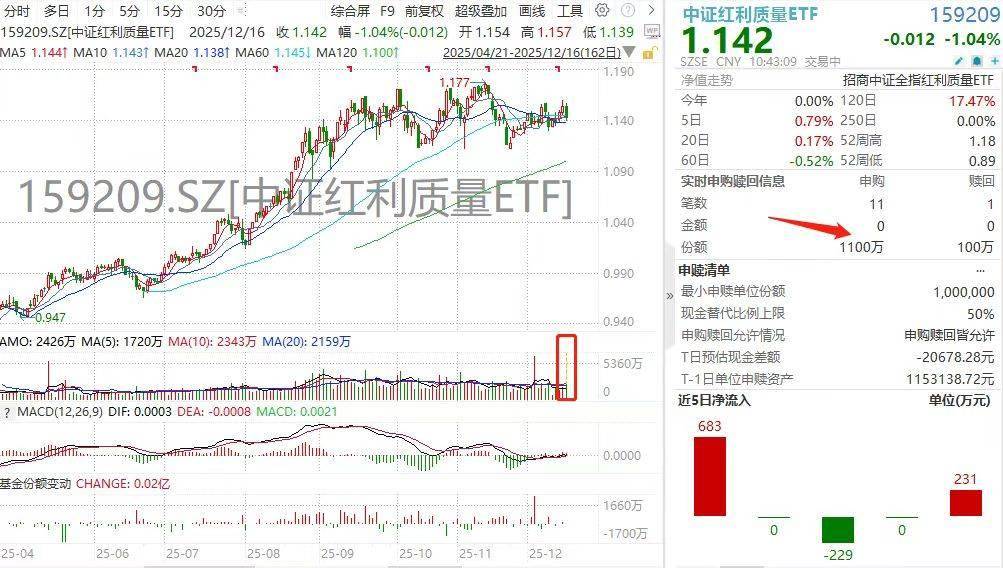
又见机构加仓?中证红利质量ETF(159209)盘中放量揽金超千万,“高质量红利”备受热捧
Sou Hu Cai Jing· 2025-12-16 03:00
Group 1 - The core viewpoint of the news highlights a significant adjustment in the market on December 16, with a renewed interest in dividend assets, particularly the CSI Dividend Quality ETF (159209) [1] - As of 10:42 AM, the CSI Dividend Quality ETF (159209) experienced a decline of 1.13%, but trading activity increased, with a transaction volume of approximately 26 million, representing a 31.34% increase compared to the previous day [1] - There was a net inflow of over 11 million during the trading session, indicating sustained investor interest and market activity [1] Group 2 - The CSI Dividend Quality ETF (159209) tracks the CSI All Share Dividend Quality Index, which selects 50 companies with stable dividends, high dividend yields, and consistent profitability, reflecting the overall performance of companies with strong dividend and profitability characteristics [3] - Unlike traditional high-dividend strategies, the current holdings of the ETF do not include bank stocks, focusing instead on a "dividend + quality" dual-factor selection mechanism that identifies high-quality companies with both "undervalued" and "high-quality" attributes [3] - The product design features a cost structure of "0.15% + 0.05%", which is the lowest in the market, providing a clear cost advantage for long-term holders; it also employs a monthly assessment dividend mechanism to better meet investors' cash flow needs and enhance the holding experience [3]
“不含银行”的中证红利质量ETF(159209)获千万级大幅加仓,净流入9连阳
Sou Hu Cai Jing· 2025-08-22 01:47
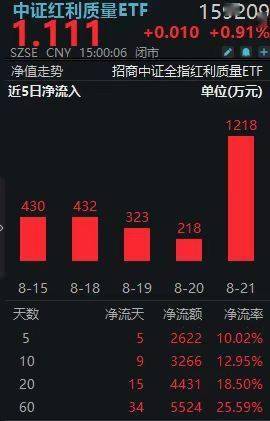
Group 1 - The market enthusiasm has cooled, but the recent performance of fundamental factors has been strong, with the CSI Dividend Quality ETF (159209) seeing over 12 million yuan in net inflows on August 21, reaching new highs in net asset value [1] - High-quality stocks with strong profitability stability, ample cash flow, and reasonable valuations have shown resilience, attracting more capital as market logic shifts towards intrinsic corporate value [1] - The CSI Dividend Quality ETF (159209) tracks the CSI All Share Dividend Quality Index, which selects 50 companies with stable dividends, high dividend yields, and sustainable profitability, reflecting the overall performance of companies with strong dividend and profitability characteristics [1] Group 2 - The ETF employs a "dividend + quality" dual-factor screening mechanism to identify high-quality companies with both "low valuation" and "high quality," aligning with Warren Buffett's value investment philosophy of investing in excellent companies at reasonable prices [1] - The product design features a cost structure of "0.15% + 0.05%", which is the lowest in the market, providing significant cost advantages for long-term holders; it also uses a monthly assessment dividend mechanism to better meet investors' cash flow needs [1]
Slay 全场!中证红利质量ETF(159209)领涨两市红利类ETF,福耀玻璃10CM封板
Sou Hu Cai Jing· 2025-08-21 01:29
Group 1 - The core viewpoint highlights the strong performance of the market, particularly the China Securities Dividend Quality ETF (159209), which has seen continuous net inflows for eight days, totaling approximately 20 million, indicating investor preference for high-quality dividend indices [1] - Fuyao Glass, a leading global automotive glass company, reported better-than-expected financial results for the first half of 2025, with revenue of 21.447 billion, a year-on-year increase of 16.94%, and net profit attributable to shareholders of 4.805 billion, up 37.33% [1] - Among 41 A-share automotive parts companies that have disclosed financial reports, Fuyao Glass ranks second in net profit for the first half of the year, with a growth rate significantly higher than the median growth rate of 18% for the disclosed companies [1] Group 2 - The China Securities Dividend Quality ETF (159209) tracks the CSI All Share Dividend Quality Index, which selects 50 companies with stable dividends, high dividend yields, and strong earnings sustainability, reflecting the overall performance of companies with strong dividend and profitability characteristics [2] - The ETF employs a "dividend + quality" dual-factor screening mechanism to identify high-quality enterprises with both "undervalued" and "high-quality" characteristics, aligning with Warren Buffett's value investment philosophy of investing in excellent companies at reasonable prices [2] - The product design features a cost structure of "0.15% + 0.05%", which is the lowest in the market, providing a significant cost advantage for long-term holders, and a monthly assessment dividend mechanism to better meet investors' cash flow needs [2]