
主权大模型

Search documents
准确度提升400%,印度季风预测模型基于36个气象站点,实现城区尺度精细预报
3 6 Ke· 2025-09-17 07:27
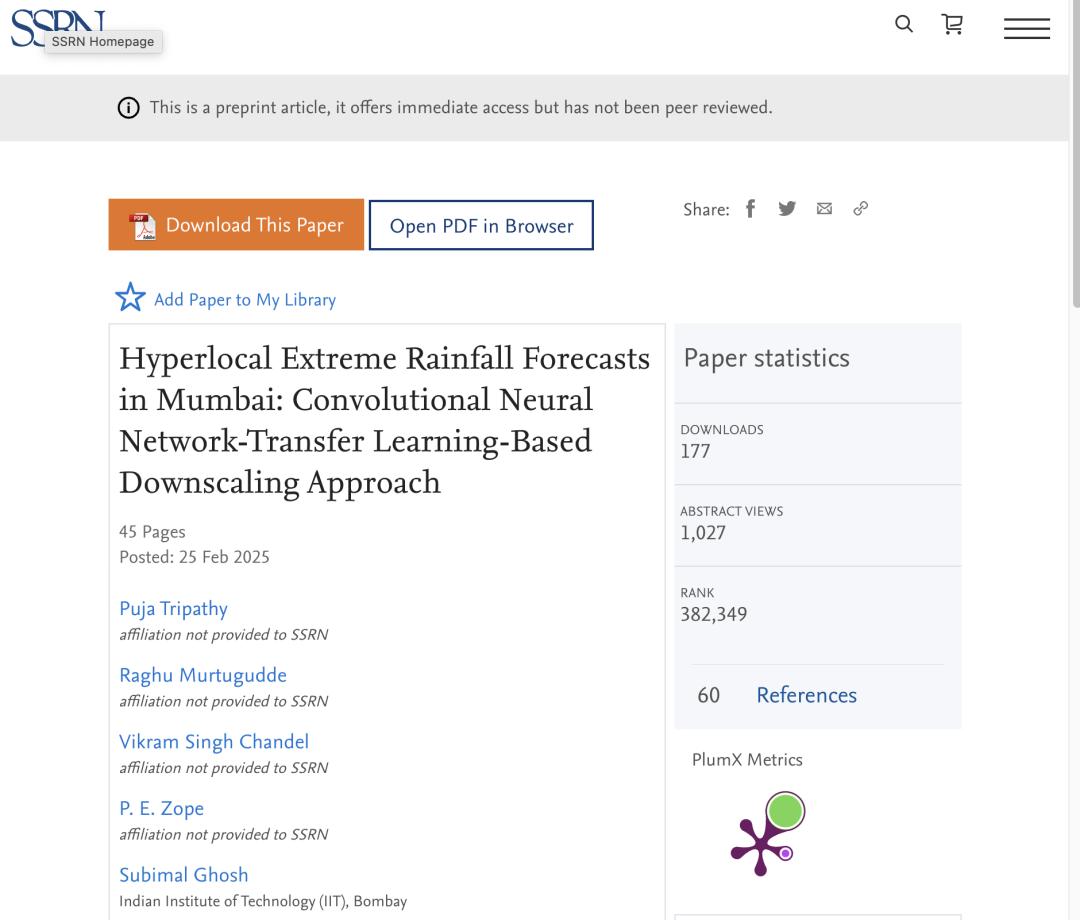
Core Insights - The article discusses the development of a hyperlocal extreme rainfall prediction model for Mumbai, utilizing convolutional neural networks (CNN) and transfer learning to enhance forecasting accuracy [1][2]. Group 1: Model Development - The collaboration between the Indian Institute of Technology Bombay and the University of Maryland led to the creation of a predictive model that can forecast extreme rainfall events several days in advance [1]. - The model addresses the limitations of traditional global forecasting systems, which have a resolution of approximately 25 square kilometers, making them inadequate for capturing local weather phenomena [1][3]. Group 2: Data Utilization - The research utilized two types of datasets: model data from the National Centers for Environmental Prediction (NCEP) and observational data from automatic weather stations in Mumbai, focusing on 36 stations with high data completeness [4][5]. - The model was trained using a comprehensive dataset from 2015 to 2023, ensuring high-quality input data through various preprocessing techniques [4][5]. Group 3: Model Performance - The CNN-based model significantly improved spatial accuracy and reduced root mean square error (RMSE) compared to traditional global forecasting systems [12][13]. - The introduction of transfer learning enhanced the model's ability to identify extreme rainfall events, achieving a prediction accuracy improvement of 60% to 400% for high-intensity rainfall samples [15][18]. Group 4: Practical Application - Mumbai authorities are considering integrating this hyperlocal prediction model into their official warning systems, marking a significant advancement in urban flood forecasting capabilities in South Asia [1][2]. - The model's ability to capture regional rainfall synchronization patterns through event synchronization methods further validates its practical application in urban settings [7][18].

“教育数字化是关乎教育强国建设的大事”——2025全球智慧教育大会开幕
Ke Ji Ri Bao· 2025-08-18 23:55
Core Viewpoint - The "2025 Global Smart Education Conference" emphasizes the integration of artificial intelligence in education, highlighting the need for educational transformation in the digital age [1][2][3]. Group 1: Educational Transformation - The conference focuses on the theme of "Human-Machine Collaboration in Creating a New Educational Ecosystem," indicating a shift towards integrating AI in educational practices [1]. - The Chinese education system is undergoing profound changes due to the deep integration of AI, which is seen as a strategic matter affecting the success of building a strong education nation [2]. - The mission and direction of education remain unchanged despite the evolving educational forms and tools brought about by AI [3]. Group 2: AI's Role in Education - AI technology is enhancing the educational experience for special needs students, improving their engagement and confidence in learning environments [2]. - The relationship between education and AI is reciprocal, where educational scenarios contribute to the iterative development of AI, leading to improved data quality and teaching standards [3]. - The conference aims to foster international collaboration in developing safe and controllable AI models for education, ensuring data sovereignty and cultural value transmission [3].
