乡村振兴保

Search documents
金融机构深耕“三农”提质效
Xin Lang Cai Jing· 2026-02-23 20:40
Group 1 - The core viewpoint of the article emphasizes the significant progress made by the Haixi Regulatory Bureau in enhancing financial services for rural revitalization, focusing on key areas such as agricultural finance and credit support [1][2] - As of the end of 2025, the balance of agricultural loans is projected to reach 31.358 billion yuan, representing a year-on-year growth of 9.47%, with inclusive agricultural loans expected to reach 7.174 billion yuan, growing by 13.37% [1] - The financial institutions are encouraged to innovate products like "Yunong Quick Loan" and "Xingnong Loan" to support key areas of rural revitalization, with a total of 34.17 billion yuan in loans issued under the "Double Base Linkage" model, covering 278 administrative villages [2] Group 2 - The establishment of 240 credit workstations has facilitated the delivery of financial services, effectively addressing the last-mile issue in rural finance [2] - The rural credit system is being strengthened through initiatives like "whole village credit granting," with the Darlinhai Agricultural Commercial Bank evaluating 8,351 credit users and granting a total credit amount of 1.046 billion yuan [2] - Innovative insurance products have been introduced, significantly reducing the insurance costs for farmers, such as lowering the insurance fee for Bactrian camels from 400 yuan to between 12.5 yuan and 25 yuan per camel, providing risk coverage of 51.88 million yuan for 5,372 camels [2]
中国人寿寿险四川省分公司:以金融文化之笔 谱金融为民新篇
Si Chuan Ri Bao· 2026-01-03 22:14
Core Viewpoint - The China Life Insurance Company Sichuan Branch has demonstrated significant growth and commitment to high-quality development over the past five years, positioning itself as a leader in the insurance sector in Sichuan, while also contributing to national and regional development strategies [1][2] Group 1: Company Performance and Development - The total premium income of China Life Insurance Sichuan Branch exceeded 33.5 billion yuan in 2024, marking a historical high [1] - The company has maintained its position as the fifth largest in total premium scale nationally and has consistently led in business and manpower advantages within the Sichuan life insurance market [1] - The company aims for a dual focus on scale and value, achieving a high-quality development trajectory that integrates responsibility and growth [1] Group 2: Leadership and Organizational Structure - The company emphasizes high-quality party building as a core driver for high-quality development, with a focus on implementing the central government's decisions [1] - The new party committee has introduced a work philosophy that prioritizes party leadership in all operations and addresses challenges through party initiatives [1] - The company has established a "dual heart" development philosophy focusing on grassroots and employee welfare, alongside a "five excellence" development goal [1] Group 3: Community and Social Responsibility - The company has launched the "Rural Revitalization Insurance" to support rural communities, addressing insurance accessibility issues for farmers [2] - It has provided coverage for approximately 7.7 million people through inclusive insurance products since 2025, enhancing service quality for rural populations [2] - The company has collaborated with local organizations to donate 15,000 cancer insurance policies, totaling 150 million yuan, to support women's health [2] Group 4: Strategic Contributions and Future Plans - The company integrates its development with national strategies, particularly focusing on the Chengdu-Chongqing economic circle and infrastructure projects [1] - It aims to enhance its product offerings in green transformation and technological innovation, achieving double-digit growth in premiums for related sectors [1] - Looking ahead, the company plans to continue promoting its "five spirits" and actively contribute to the broader development goals of Sichuan [2]

中原南阳担保入选2025金融业(河南)优秀实践案例
Sou Hu Cai Jing· 2025-12-25 07:21
Core Viewpoint - The "2025 Financial Industry (Henan) Excellent Practice Case" collection event highlights the achievements of the financial sector in supporting the high-quality development of the Henan economy, showcasing the vitality and resilience of the financial industry in the region [1]. Group 1: Recognition of Institutions - Zhongyuan Nanyang Guarantee Co., Ltd. was recognized as an excellent institution for serving the real economy in 2025, with its "Rural Revitalization Guarantee" product selected as an outstanding practice case [2]. Group 2: Support for the Real Economy - As a government financing guarantee institution, Zhongyuan Nanyang Guarantee enhances banks' confidence in lending through a risk-sharing mechanism and provides credit enhancement for various market entities, contributing to the robust development of the real economy. By the end of November 2025, the total guarantee amount exceeded 4 billion yuan, serving over 1,800 market entities [2]. Group 3: Rural Revitalization Initiatives - The "Rural Revitalization Guarantee" product was launched in response to national calls for comprehensive rural revitalization, focusing on three key areas: 1. Increasing guarantee support for major grain-producing areas and agricultural product sectors to enhance food security financial guarantees. 2. Providing continuous guarantee support for entities in the research and breeding sectors to promote seed industry revitalization. 3. Including entities involved in the planting and trading of specialty agricultural products in the key service list to encourage support for new business entities driving rural prosperity. - Within three months of its launch, the program provided over 320 million yuan in guarantee funds to various market entities in the rural revitalization sector [3].
撑起农业“保护伞” 托起农牧民“致富梦”——人保财险西藏分公司服务“三农”侧记
Zheng Quan Ri Bao Zhi Sheng· 2025-10-11 13:36
Core Viewpoint - The China People's Property Insurance Company Tibet Branch is actively integrating into national regional development strategies by focusing on rural revitalization, improving livelihoods, and promoting green development, thereby enhancing its role as an economic stabilizer and social stabilizer [1] Group 1: Risk Protection for Agriculture and Livestock - The company has implemented agricultural insurance in Nagqu County, providing risk protection for key livestock such as yaks, which are vital for local income [1][2] - In 2025, the company insured 304,000 yaks, 124,000 sheep, and 11,000 acres of barley, offering a total risk coverage of approximately 1.67 billion yuan [2] - The insurance coverage for Tibetan cattle is 5,000 yuan per head, and for Tibetan sheep, it is 500 yuan per head, with total agricultural insurance payouts increasing from 2.14 million yuan in 2006 to 1.39 billion yuan in 2024 [3] Group 2: Service Network and Community Engagement - The company has established a broad service network in Jiangzi County, covering 19 towns and 155 administrative villages, focusing on agricultural insurance and housing insurance [5] - A "Red Station" initiative has been launched to provide convenience services and financial consultations to the community, enhancing public awareness of insurance [5][6] - The company has implemented a "Police-Insurance Link" model to streamline insurance processes and improve safety measures in high-risk areas [6][7] Group 3: Innovation and Technology in Insurance Services - The company is utilizing a digital agricultural insurance service platform called "Yunzhibao" to enhance service efficiency and accuracy [7] - From 2022 to the present, the company has provided risk coverage of 201.3 billion yuan through its agricultural insurance, benefiting 3.24 million households [7]
中国人寿赋能治理现代化:从“山西实践”到“中国方案”的创新启示
Zhong Guo Chan Ye Jing Ji Xin Xi Wang· 2025-07-30 08:47
Core Viewpoint - The insurance mechanism is becoming a "key variable" in modern social governance, as highlighted by the 20th National Congress of the Communist Party of China, which emphasizes the need to improve the social governance system [1] Group 1: Role of China Life Insurance - China Life Insurance is leveraging its comprehensive financial advantages to enhance social governance effectiveness in areas such as medical security, elderly care, environmental governance, social management, and disaster prevention [1][2] - The company has integrated insurance mechanisms deeply into the national governance system, demonstrating a commitment to serving national development and protecting people's livelihoods [2][3] Group 2: Financial Performance - In 2024, China Life Property & Casualty Insurance's revenue surpassed 100 billion yuan for the first time, marking a significant milestone in its financial performance [2] - The company ranked 36th among the global top 50 property and casualty insurance companies, reflecting its growing competitiveness and influence in the market [2] Group 3: Case Studies in Shanxi - The implementation of the traffic accident social rescue fund in Shanxi has provided timely assistance to over 23,596 individuals affected by traffic accidents, with a total aid amount exceeding 716 million yuan [4] - The "Green Guardian" insurance developed for forest rangers offers 138 billion yuan in risk protection, showcasing the company's commitment to ecological conservation [5] Group 4: Community Engagement - The "Hundred Districts and Hundred Towns" project has established comprehensive financial service stations across 68 counties and 100 towns, providing essential services to local communities and creating over 1,021 job opportunities [6] - These service stations not only offer financial services but also empower rural governance by connecting local residents with insurance and financial products [6] Group 5: Risk Management Innovations - China Life Insurance has implemented a "risk reduction" model that combines insurance with proactive risk management, having identified over 1.5 million safety production hazards across various enterprises [7] - The company has sent over 10 million disaster warning messages, demonstrating its commitment to risk prevention and management [11] Group 6: National Implications - The practices in Shanxi serve as a model for nationwide implementation, illustrating how financial insurance can effectively participate in social governance [8][11] - The integration of insurance into social governance is seen as a crucial element in building a multi-layered social security system, contributing to China's modernization efforts [12]
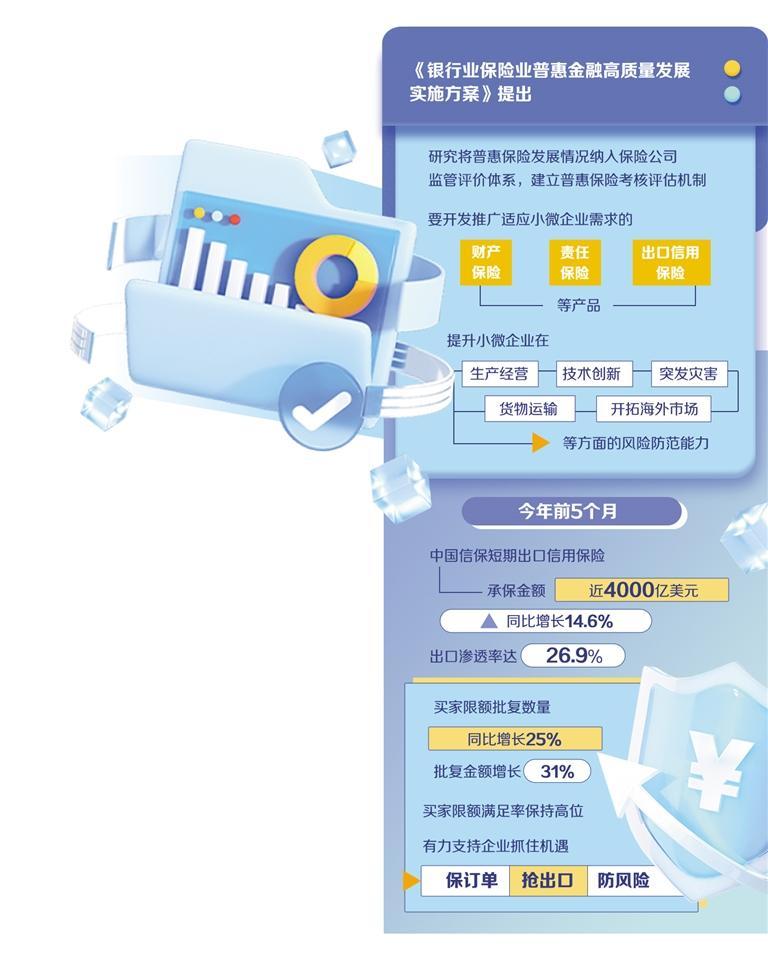
发挥好普惠保险稳定器功能
Jing Ji Ri Bao· 2025-07-13 22:01
Group 1: Core Insights - The implementation plan for high-quality development of inclusive finance in the banking and insurance sectors aims to strengthen the inclusive insurance system, enhance product offerings, and improve service quality over the next five years [2][10] - Recent policies have led to the development of affordable and accessible insurance products tailored for specific groups, addressing the needs of chronic disease patients and new urban residents [3][4] Group 2: Product Development and Innovation - ZhongAn Insurance has improved its medical insurance product to provide long-term medication coverage for chronic disease patients, focusing on their specific needs [3] - Taiping Life launched a targeted accident insurance product for new urban residents, covering high-risk occupations and enhancing the insurance safety net for this demographic [4] Group 3: Support for Small and Micro Enterprises - The implementation plan emphasizes the development of insurance products that cater to the needs of small and micro enterprises, enhancing their risk management capabilities [5] - China Export Credit Insurance Corporation has established a unified insurance platform to support small foreign trade enterprises, facilitating access to financial resources and professional support [6][7] Group 4: Sustainable Development of Inclusive Insurance - The sustainable development of inclusive insurance requires a balance between affordability and quality, with a focus on effective risk measurement and service coverage [9] - Companies are encouraged to optimize pricing models, enhance service offerings, and leverage digital technologies to improve operational efficiency and reduce costs [9] Group 5: Regulatory and Evaluation Mechanisms - The plan includes integrating the development of inclusive insurance into the regulatory evaluation system for insurance companies, establishing assessment mechanisms for inclusive insurance products and services [10] - The importance of setting scientific standards for evaluating inclusive insurance products is highlighted, emphasizing the need for transparency and consumer protection [10]