亚马逊云计算服务

Search documents
英伟达宣布和三星共建AI工厂
Zhong Guo Ji Jin Bao· 2025-11-01 00:50
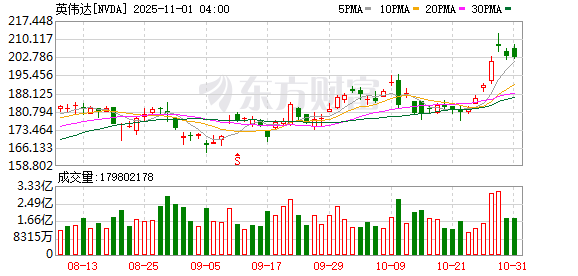
Market Overview - The three major U.S. stock indices recorded gains both this week and this month, with the Dow Jones up 0.75%, S&P 500 up 0.71%, and Nasdaq up 2.24% for the week [3] - For October, the Dow Jones increased by 2.51%, S&P 500 by 2.27%, and Nasdaq by 4.7%, marking six consecutive monthly gains for the Dow and S&P 500, and seven for Nasdaq [3] Federal Reserve Insights - Multiple Federal Reserve officials expressed opposition to the recent interest rate cut decision, emphasizing that a December rate cut is not guaranteed [3][4] - Fed officials highlighted challenges in the labor market and indicated that maintaining some policy restrictions is necessary to reduce inflation [3] - Fed Governor Waller stated that despite the government shutdown, the Fed can still access ample data to guide monetary policy, suggesting a potential rate cut in December based on data [4] Amazon's Performance - Amazon's third-quarter net sales reached $180.169 billion, a 13% year-over-year increase, with net profit rising by 38% to $21.187 billion [6][8] - The company's earnings per share rose to $1.95 from $1.43 a year earlier, exceeding Wall Street expectations, which led to a nearly 10% increase in its stock price [6][8] Nvidia's Developments - Nvidia announced plans to collaborate with Samsung to establish an AI manufacturing facility in South Korea, involving the deployment of up to 260,000 GPUs [8] - The partnership includes significant investments in AI technology, with Samsung set to procure over 50,000 Nvidia GPUs for its AI chip cluster [8] - Nvidia's CEO highlighted the potential of the Chinese market, estimating a $50 billion opportunity this year, which could grow to several hundred billion by the end of the decade [9]


环球市场动态:中美双边关系平稳前行
citic securities· 2025-10-31 02:40
Market Overview - The US stock market faced pressure due to mixed earnings reports from major tech companies and concerns over increased capital expenditures in AI, with the Dow Jones down 0.23% to 47,522 points, S&P 500 down 0.99% to 6,822 points, and Nasdaq down 1.57% to 23,581 points[3][9]. - European markets showed mixed performance, with the Stoxx 600 index slightly down 0.01%, while the UK FTSE 100 rose 0.04%[9]. US-China Relations - The recent meeting between US and Chinese leaders in Busan is expected to ease tensions and positively influence market sentiment, particularly benefiting labor-intensive sectors in China[5]. - The US Senate passed a resolution to terminate Trump's comprehensive tariff policy, indicating a potential shift in trade relations[5]. Earnings Reports - Apple reported Q4 2025 revenue of $102.47 billion, slightly above expectations, with iPhone sales at $49.03 billion, a 6.1% year-on-year increase[7]. - Amazon's Q3 revenue reached $180.17 billion, a 13% increase year-on-year, with net profit up 39% to $1.95 per share, exceeding market expectations[7]. Currency and Commodities - The US dollar index reached a three-month high, while the Japanese yen weakened following the Bank of Japan's decision to maintain its current policy[4][28]. - International oil prices saw a slight increase, with NY crude oil up 0.15% to $60.57 per barrel, and gold prices rebounded after consecutive declines, rising 0.4% to $4,015.9 per ounce[4][28]. Fixed Income Market - US Treasury yields rose, with the 2-year yield at 3.61% and the 10-year yield at 4.10%, reflecting ongoing market adjustments to interest rate expectations[29][32]. - Meta issued $30 billion in bonds, the largest issuance of high-rated corporate bonds this year, indicating strong demand in the corporate debt market[4][32].





从贝索斯零缴税看创业投资的财富密码
Sou Hu Cai Jing· 2025-08-03 05:13
Core Insights - The article highlights the stark contrast between the tax obligations of ultra-wealthy individuals like Jeff Bezos and ordinary workers, emphasizing that Bezos has managed to pay an effective tax rate of approximately 1% on his wealth growth, while average workers face rates between 20% to 30% [2][6]. Group 1: Wealth Accumulation Strategies - Bezos's wealth accumulation strategy is based on the principle of "never selling," allowing him to avoid capital gains taxes by not liquidating his stock holdings, which continue to appreciate in value as Amazon grows [3]. - The article suggests that entrepreneurs should focus on long-term investments in high-growth assets and avoid frequent trading to minimize tax liabilities [3]. Group 2: Financial Leverage - The principle of borrowing rather than earning is discussed, where wealthy individuals use loans against their assets to fund large purchases without incurring tax liabilities, as loans are not considered income [4]. - Entrepreneurs are encouraged to utilize debt financing to optimize their capital structure, ensuring that the return on investment exceeds the cost of borrowing [4]. Group 3: Wealth Transfer and Tax Strategies - The article explains the strategy of leaving wealth to heirs without incurring taxes, as heirs benefit from a step-up in basis, effectively resetting the capital gains tax liability [5]. - Entrepreneurs are advised to consider trust structures and family funds to legally minimize tax burdens during wealth transfer, ensuring the continuity of family wealth [5]. Group 4: Income vs. Capital Gains - A key distinction is made between labor income, which is subject to higher tax rates, and capital income, which can be managed to incur lower tax rates through strategic planning [6]. - Amazon's global effective tax rate is noted to be as low as 1% to 12%, achieved through tax credits and strategic profit allocation to low-tax jurisdictions [6]. Group 5: Tax System Insights - The article concludes that the tax system primarily targets income tax rather than wealth tax, allowing the ultra-wealthy to structure their finances in a way that minimizes taxable income [7]. - Entrepreneurs are urged to study wealth management principles and leverage tax policies and financial instruments to enhance wealth accumulation and protection [7].