人民币债

Search documents
基础设施高效服务一二级债市运行 北金所1月集中簿记系统支持发债超8700亿元
Xin Hua Cai Jing· 2026-02-02 15:06
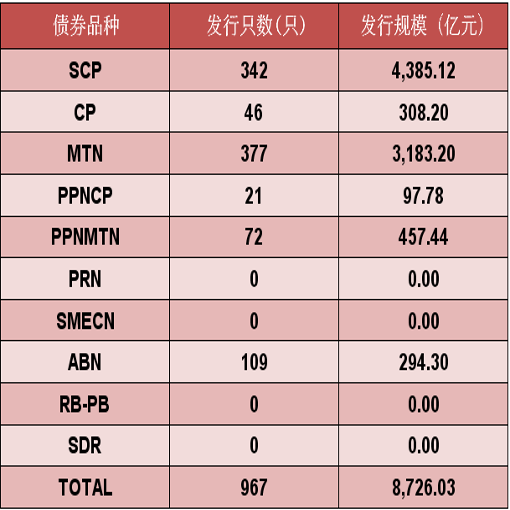
Core Viewpoint - The Beijing Financial Assets Exchange (北金所) has maintained a stable issuance scale in its centralized bookkeeping and filing system in January 2026, with an active bond trading environment indicating continued institutional interest in standardized bond issuance and trading platforms [1]. Issuance Data - In January 2026, the centralized bookkeeping system completed 967 issuances, totaling 8,726.03 billion yuan, providing a smooth channel for corporate debt financing at the beginning of the year [1][2]. - Breakdown of issuance by bond type includes: - SCP: 342 issuances, 4,385.12 billion yuan - CP: 46 issuances, 308.20 billion yuan - MTN: 377 issuances, 3,183.20 billion yuan - PPNCP: 21 issuances, 97.78 billion yuan - PPNMTN: 72 issuances, 457.44 billion yuan - ABN: 109 issuances, 294.30 billion yuan [2]. Trading Activity - In January, there were 21 trading days, with a total of 3,922 quotes made in the bond trading system, averaging about 187 quotes per day, showing an increase compared to December 2025 [3]. - The average yield levels for bonds in January showed a slight decrease compared to December, with specific bonds having notable yields, such as: - Medium-term notes with a buy yield of 1.58% and a sell yield of 2.11% - Short-term financing bonds with a buy yield of 1.31% and a sell yield of 2.22% [4]. Transaction Summary - In January 2026, a total of 15 bond transactions were completed, with cumulative transactions since November 2014 reaching 1,027, totaling 341.36 billion yuan [5]. - The breakdown of transactions includes: - 731 purchases and 296 sales by non-financial institutional qualified investors - 932 different bonds traded, including 15 short-term financing bonds and 569 medium-term notes [5]. - The data reflects a stable willingness among institutions to engage in bond issuance and trading through standardized platforms, with particular interest in certain types of credit assets [5].

中国又悄悄干大事,3月份再抛189亿美元美债,引爆美元信用危机?
Sou Hu Cai Jing· 2025-05-19 15:24
Core Viewpoint - China is significantly reducing its holdings of US Treasury bonds, which raises concerns about potential impacts on the US dollar's creditworthiness and the stability of the US debt market [1][3]. Group 1: China's Actions on US Treasury Bonds - In March, China reduced its US Treasury holdings by nearly $20 billion, marking the first time in a decade that it has ceded its position as the second-largest holder of US debt to the UK [1]. - Currently, China holds over $700 billion in US Treasury bonds, down nearly $300 billion from April 2022 and almost halved from its peak of $1.3 trillion in 2011 [1]. - China is primarily holding short-term US Treasury bonds, which, despite lower yields, offer high liquidity, allowing for quick sales in case of a dollar crisis [1]. Group 2: Market Reactions and Trends - The recent rise in US Treasury yields indicates a significant sell-off in the market, with China being a key contributor to this trend [3]. - Among the top ten foreign holders of US debt, only China and Ireland are currently selling, while other countries, such as the UK, have increased their holdings [3]. - The likelihood of a short-term crisis in the US Treasury market is considered low, although risks are accumulating over time [3]. Group 3: China's Strategy for Currency Internationalization - China is facilitating the replacement of US dollar debt with renminbi debt for countries along the Belt and Road Initiative, thereby promoting the internationalization of the renminbi [4]. - Over the past two years, China has reportedly provided over $100 billion to help these countries repay their US dollar debts, with expectations for this scale to increase [4]. Group 4: Diversification of Investments - China is diversifying its investments to mitigate the risks associated with holding excessive US dollar assets, including increasing its gold reserves [5]. - The People's Bank of China has added 70,000 ounces of gold to its reserves in March, continuing a trend of increasing gold holdings over the past six months [5]. Group 5: Implications for the US Debt Market - China's ongoing sell-off of US Treasury bonds may lead to price volatility in the market, but it is not expected to trigger an immediate crisis [7]. - The US, as the issuer of the dollar, can manage its debt through monetary expansion, although this could undermine the dollar's creditworthiness [7]. - The dynamics of US-China trade and the recent negotiations on tariffs are influencing the US Treasury market, with expectations of increased selling pressure in April [7].