以太网PHY芯片

Search documents
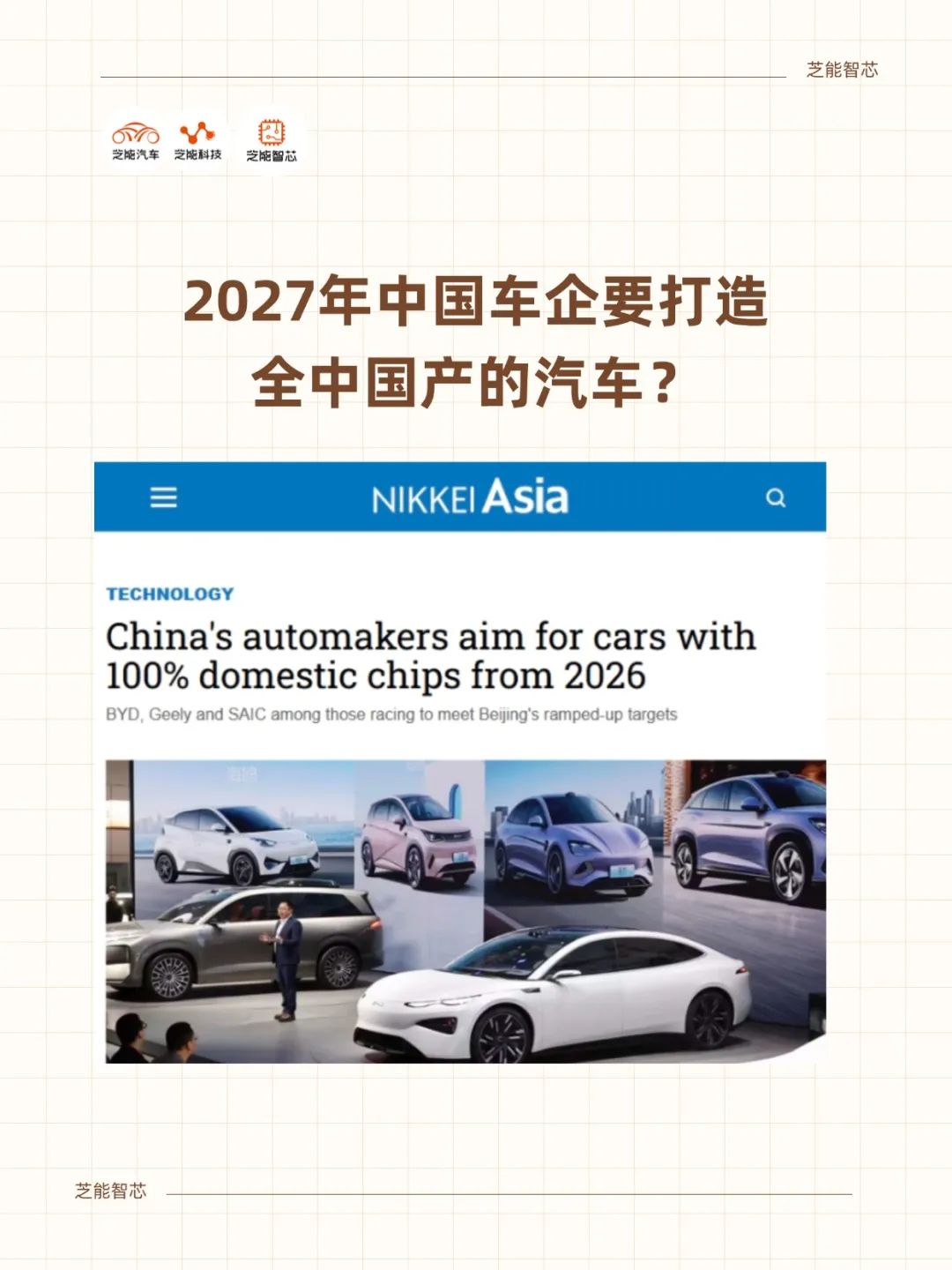
中国车载芯片自主化进程提速,从“25%”到“100%”
Xin Lang Cai Jing· 2025-06-24 07:02
Core Viewpoint - Chinese automotive companies are accelerating the localization of automotive chips, aiming for 100% domestic production by 2027, driven by policy guidance and market awareness, significantly impacting the global chip landscape [1]. Group 1: Chip Classification and Current Status - Automotive chips are essential for the "soft and hard integration" architecture of modern vehicles, with a single vehicle typically requiring hundreds of chips across various functions [5]. - Chips can be categorized into five types: main control (e.g., MCU, SoC), communication (e.g., CAN/LIN/Ethernet transceivers), power (e.g., IGBT drivers), sensor (e.g., millimeter-wave radar front-end), and functional safety chips (e.g., TPM) [6]. - Chinese chip manufacturers have made breakthroughs primarily in main control and communication chip products [6][8]. Group 2: Current Developments in Domestic Chip Production - Companies like Neusoft Carrier, Jiefa Technology, and Huada Semiconductor have launched automotive-grade MCU products that meet AEC-Q100 certification, supporting ISO 26262 safety standards [8]. - In the communication chip sector, companies such as Xingyu Technology and Xinyi Information have achieved small-scale production of domestic CAN and Ethernet PHY chips, with some products entering the vehicle development cycle [8]. - High-performance intelligent driving SoC chips are still dominated by a few companies, with examples like Horizon's Journey series and Huawei's Kirin series, which are being deployed in various vehicle models [9]. Group 3: Trends in Chip Research and Development - Chinese automotive companies are transitioning from being "chip purchasers" to "chip architecture participants" and even "definers," with firms like XPeng leading the way in self-developed AI chip strategies [10]. - The evolution of hardware architecture is moving towards SoC integration platforms that emphasize multi-domain collaboration, requiring chip companies to possess both hardware design capabilities and a complete software SDK stack [12]. - Collaborations between automotive and chip companies are increasing, with examples including Geely's partnership with Hezhima for intelligent driving platforms and BYD's full-stack self-research model for core modules [13][15].

2025年全球与中国以太网PHY芯片市场调查研究及发展趋势预测报告
QYResearch· 2025-06-04 09:57
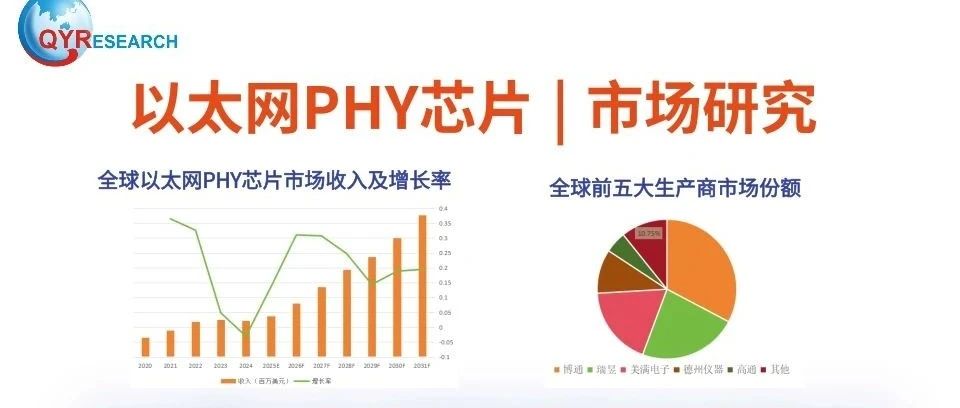
以太网物理层芯片(PHY)也称为收发器,是有线数据通讯和传输中的重要基础芯片之一。以太网PHY芯片工作于网络模型的第一层,是以以太 网有线传输为主要功能的通信芯片,用以实现不同设备之间的连接,广泛应用于数据中心和企业网络、信息通讯、汽车电子、消费电子、工业控 制等市场领域。 0 1 以太网PHY芯片行业规模总体概况 由于下游市场的需求以及国家政策的支持,对以太网PHY芯片行业的发展起到很大的推动作用,未来6年,全球以太网PHY芯片市场将保持这一 增长态势,2024年,全球以太网PHY芯片市场收入达到了24.25亿美元,预计2031年将达到95.55亿美元,年复合增长率(CAGR)为 23.02%(2025-2031)。 2024年,中国以太网PHY芯片市场收入达到了6.57亿美元,预计2031年将达到32.82亿美元,年复合增长率(CAGR)为27.72%(2023-2029)。 全球主要以太网PHY芯片制造商包括博通、美满电子、瑞昱、德州仪器、微芯、高通等。全球领先厂商以出色的产品性能和满意的服务在行业中 享有盛誉。但市场竞争日趋激烈,越来越多的厂商进入以太网PHY芯片市场;中国领先本土制造商,如裕太微电子 ...