
传媒ETF广发

Search documents
策略周报:行业轮动ETF策略周报-20260323
金融街证券· 2026-03-23 07:58
Strategy Overview - The report recommends a strategy focused on industry and thematic ETFs, particularly in the film, liquor, and telecommunications sectors for the week of March 23, 2026[2] - New holdings include Film ETF, Liquor ETF, Telecom ETF from E Fund, Media ETF from Guangfa, and Communication ETF from Southern[2] Performance Metrics - From March 16 to March 20, 2026, the strategy recorded a cumulative net return of approximately -6.60%[3] - The strategy's excess return relative to the CSI 300 ETF was about -4.44% during the same period[3] - Since October 14, 2024, the cumulative return of the strategy is approximately 29.26%, with an excess return of about 8.24% compared to the CSI 300 ETF[3] Risk Indicators - The timing signals for some ETFs and indices provided daily or weekly risk alerts as of last weekend[2] - The report highlights potential rapid style shifts within a week and abnormal increases in the discount rates of certain ETFs[6] ETF Holdings and Changes - The report lists specific ETFs with their market values and weekly performance, indicating adjustments in holdings based on recent performance trends[11][12] - The average return of the ETF portfolio was -6.60%, while the excess return compared to the CSI 300 ETF was -4.44%[12]
超百亿,“跑了”!
Zhong Guo Ji Jin Bao· 2026-02-11 06:17
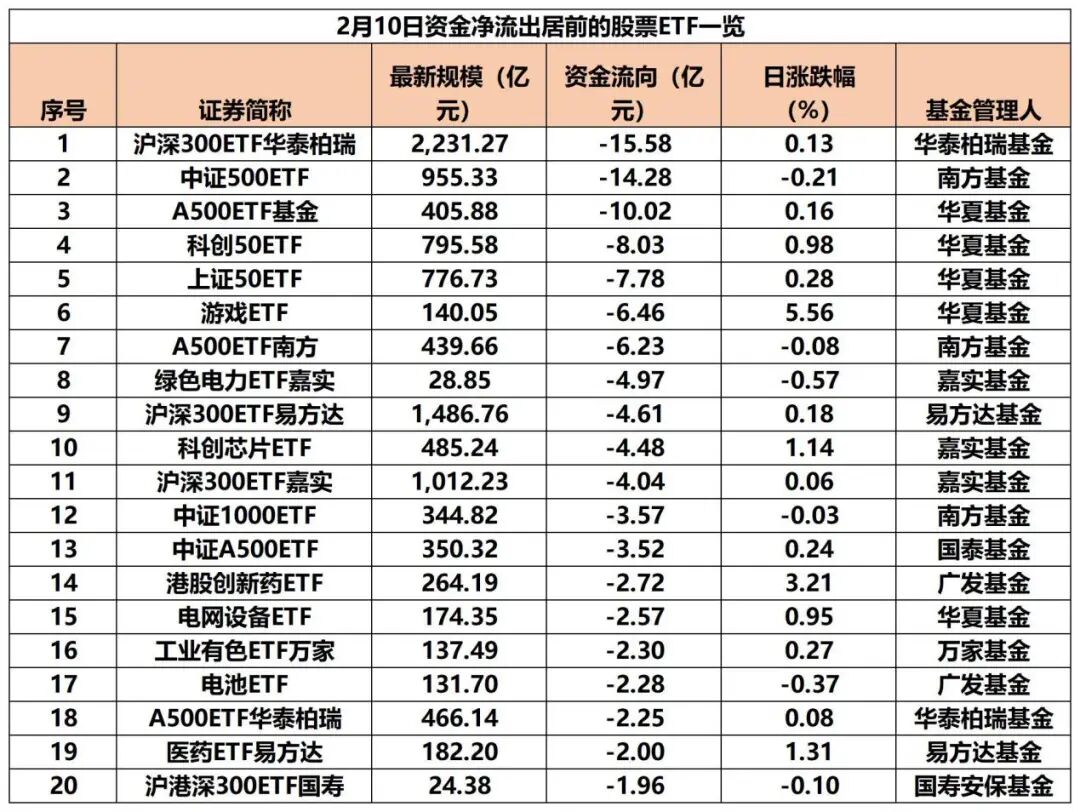
Core Viewpoint - The stock ETF market experienced a net outflow of over 10.26 billion yuan on February 10, with significant movements in various thematic ETFs and broad-based ETFs [2][4][5]. Group 1: Market Overview - On February 10, the three major A-share indices showed mixed results, with the Shanghai Composite Index rising by 0.13%, the Shenzhen Component Index increasing by 0.02%, and the ChiNext Index declining by 0.37% [2]. - The overall market saw a net outflow of 10.26 billion yuan in stock ETFs, including cross-border ETFs [2]. Group 2: ETF Performance - The net inflow for the China Film Index-related ETFs was the highest, reaching 1.339 billion yuan, while the net outflow for the CSI 300 Index-related ETFs was the largest at 2.904 billion yuan [2]. - Over the past five days, the Hang Seng Technology Index-related ETFs saw inflows exceeding 8.5 billion yuan, and the SGE Gold 9999 Index-related ETFs attracted over 6.2 billion yuan [2]. Group 3: Fund Company Insights - E Fund's ETF had a latest scale of 661.58 billion yuan, with an increase of 1.05 billion yuan. The China Internet ETF from E Fund had a scale of 41.921 billion yuan, with a net inflow of 158 million yuan [2]. - Huaxia Fund's Robot ETF and Sci-Tech Semiconductor ETF had significant net inflows of 527 million yuan and 117 million yuan, respectively, with latest scales of 25.818 billion yuan and 8.196 billion yuan [3]. Group 4: Thematic ETF Trends - Popular thematic ETFs such as the Film ETF, Robot ETF, and Satellite ETF saw the highest net inflows, while broad-based ETFs like the CSI 300 ETF and CSI 500 ETF were the biggest losers in terms of net outflows [4][5]. - The Media ETF from GF Fund received the most net inflow, amounting to 460 million yuan, and has seen a year-to-date increase of over 26%, making it one of the top performers in the market [3]. Group 5: Future Market Outlook - The investment focus may shift from January's credit and liquidity performance to macroeconomic and industrial cues as the market enters a relatively quiet period for macro data [6]. - The core assets in the market are currently at historical median valuation levels, suggesting potential for valuation recovery, supported by stable profit expectations and a warming trend in foreign capital inflows [6].

超140亿元!加仓
Zhong Guo Ji Jin Bao· 2026-01-14 06:29
Core Insights - On January 13, the A-share market experienced adjustments, but stock ETFs saw a significant net inflow of 146.46 billion yuan, indicating a reverse trend in funding during market fluctuations [1] Group 1: ETF Performance - The total scale of 1,301 stock ETFs in the market reached 5.06 trillion yuan, with a net inflow of 146.46 billion yuan on January 13 [2] - Industry-themed ETFs and Hong Kong market ETFs attracted the most funds, with net inflows of 175.86 billion yuan and 33.68 billion yuan, respectively [2] - The media sector saw the most significant net inflow, with 45.35 billion yuan on January 13, and over 79 billion yuan in the past five days [2] - The satellite industry also experienced notable inflows of 37.8 billion yuan, with a single product, the Yongying Fund's satellite ETF, seeing a net inflow of 18.86 billion yuan [2] - Other sectors like artificial intelligence, computing, and non-ferrous metals also had substantial inflows, with net inflows of 37.6 billion yuan, 32.6 billion yuan, and 22.4 billion yuan, respectively [2] Group 2: Institutional Insights - The manager of the Rongtong Internet Media Fund anticipates that by 2026, the AI narrative will shift towards commercialization, with the AI application market expected to grow from hundreds of billions to trillions of yuan [3] - EasyOne Fund's AI ETF saw a net inflow of over 7 billion yuan, while other ETFs like software and cloud computing also experienced significant inflows [3] - Huaxia Fund's ETFs, including the electric grid equipment ETF and the Sci-Tech 50 ETF, had notable net inflows of 7.95 billion yuan and 6.26 billion yuan, respectively [3] Group 3: Market Trends - The broad-based ETFs faced significant outflows, totaling 57.65 billion yuan, with the CSI 300 index leading the outflows at 24.7 billion yuan [4] - The market is expected to maintain a stable upward trend in 2026, supported by policy and industrial drivers, with a favorable macro environment anticipated in the first quarter [4] - EasyOne Fund's index investment department believes that the market's rhythm is likely to remain stable and positive in January, with a focus on core growth assets [5]