
恒生科技ETF易方达

Search documents
ETF周报20260323-0327:能源替代或是ETF投资者主要思路-20260330
East Money Securities· 2026-03-30 14:56
Group 1 - The overall market for stock ETFs (excluding cross-border) experienced a net outflow of 12.22 billion, which is a decrease of 5.58 billion compared to the previous week, indicating an expansion of net outflow scale [1][9] - The A-share industry and thematic ETFs saw a net outflow of 15.79 billion, an increase of 8.79 billion from the previous period, showing continued outflow pressure in industry and thematic ETFs [1][11] - The Hong Kong stock ETFs continued to experience net outflows, with the outflow amount increasing to 4.12 billion, including a net outflow of 1.78 billion from cross-border industry and thematic ETFs [1][14] Group 2 - In the broad-based ETF category, there was an overall net outflow of 1.16 billion, while the CSI 300 saw relatively large inflows, with most broad-based ETFs experiencing outflows [2][17] - In the Smart Beta and major industry categories, dividend and cash flow strategies remain relatively high certainty directions in an uncertain environment [2][17] - In the segmented industry, sectors such as non-ferrous metals, chemicals, and oil and petrochemicals continue to face significant outflow pressure, with energy substitution remaining a core strategy (coal replacing oil, secondary energy/new energy replacing fossil energy) [2][21] Group 3 - The top five stock ETFs with net inflows from March 23 to 27 were the Energy Storage Battery ETF (E Fund) (+1.07 billion), CSI 300 ETF (Huatai-PB) (+1.05 billion), Sci-Tech 50 ETF (E Fund) (+0.94 billion), CSI 300 ETF (Hua Xia) (+0.94 billion), and Free Cash Flow ETF (Hua Xia) (+0.92 billion) [3][25] - The top five stock ETFs with net outflows during the same period were A500 ETF (Hua Xia) (-2.65 billion), Non-ferrous Metals ETF (Southern) (-1.68 billion), CSI 1000 ETF (Hua Xia) (-1.23 billion), SSE 50 ETF (Hua Xia) (-1.21 billion), and Non-ferrous Metals ETF (Hua Xia) (-1.16 billion) [3][25] - For cross-border ETFs, the top five with net inflows were the Hang Seng Technology ETF (E Fund), Hang Seng Technology ETF (Tianhong), Hang Seng Technology ETF (Hua Xia), China Concept Internet ETF (E Fund), and Hang Seng Technology ETF (Dacheng) [3][25]
金工ETF点评:行业主题ETF周净流出262.29亿元,钢铁、基础化工拥挤变幅较大
Tai Ping Yang Zheng Quan· 2026-03-27 13:25
Investment Rating - The report indicates a net outflow of 26.229 billion yuan from industry-themed ETFs this week, with significant fluctuations observed in the steel and basic chemical sectors [2][31][36]. Core Insights - As of March 20, 2026, there are a total of 1,456 listed ETFs in mainland China, with a total scale of 5.10 trillion yuan. Among these, stock ETFs account for the largest share, both in number (1,140) and scale (2.95 trillion yuan) [7][8]. - The A-share market saw a decline this week, with the Shanghai Composite Index closing at 3,957.05, reflecting a drop of 3.38%. Notably, the communication and banking sectors experienced gains of 2.10% and 0.36%, respectively, while the non-ferrous and basic chemical sectors faced declines of 11.82% and 10.53% [13][14][21]. - In terms of fund flows, broad-based ETFs saw a net inflow of 9.078 billion yuan, with the top three inflows coming from the CSI 500 ETF Southern (+4.450 billion yuan), the CSI 300 ETF Huatai-PB (+4.333 billion yuan), and the SSE 50 ETF (+3.056 billion yuan). Conversely, industry-themed ETFs experienced a net outflow of 26.229 billion yuan, with the top outflows from the chemical ETF (-4.373 billion yuan) and the non-ferrous metal ETFs [31][32][36]. Summary by Sections ETF Market Overview - As of March 20, 2026, the total number of ETFs is 1,456, with stock ETFs being the most prevalent, comprising 78.30% of the total number and 57.76% of the total scale [7][8][10]. Domestic and International Equity Market Index Performance - The A-share market indices showed a downward trend, with the Shanghai Composite Index down 3.38%. The communication and banking sectors were the only ones to show positive performance this week [13][14][21]. Stock ETF Fund Flows - Broad-based ETFs had a net inflow of 9.078 billion yuan, while industry-themed ETFs saw a significant net outflow of 26.229 billion yuan, indicating a shift in investor sentiment [31][32][36]. Industry Congestion Monitoring - The report highlights that the utility and communication sectors are currently experiencing higher congestion levels, while the automotive and textile sectors are less congested, suggesting potential investment opportunities [34][36].
“落袋为安”?14亿,跑了
Zhong Guo Ji Jin Bao· 2026-02-26 04:17
Group 1 - On February 25, the A-share market saw all three major indices rise, but the stock ETF market experienced a net outflow of approximately 1.4 billion yuan [1] - As of February 25, the total scale of 1,344 stock ETFs in the market reached 4.18 trillion yuan, with a reduction of 503 million fund shares, resulting in a net outflow of about 1.48 billion yuan [2] - The Hong Kong stock market ETFs led in net inflows, totaling 1.881 billion yuan, with the CSI 500 Index ETF seeing the highest inflow of 1.678 billion yuan [2] Group 2 - On February 25, 32 ETFs had net inflows exceeding 100 million yuan, with the CSI 500 ETF leading at 1.424 billion yuan, followed by the Electric Grid Equipment ETF and A500 ETF with inflows of 1.059 billion yuan and 618 million yuan respectively [2] - E Fund's ETFs continued to attract net inflows, with the Hang Seng Technology ETF receiving 270 million yuan, the SSE 50 ETF 229 million yuan, and the Artificial Intelligence ETF 203 million yuan [2] - The Electric Grid Equipment ETF and Hang Seng Internet ETF from Huaxia Fund saw significant net inflows of 1.059 billion yuan and 603 million yuan respectively, with their latest scales at 20.465 billion yuan and 37.213 billion yuan [3] Group 3 - The ChiNext Index ETF experienced the largest net outflow on February 25, amounting to 1.946 billion yuan [4] - ICBC Credit Suisse Fund remains optimistic about the A-share market in the medium term, citing that total demand adjustments are nearing equilibrium and supply-side adjustments will enhance confidence in capital return rates [4]
恒生科技指数大涨,超百亿资金逆势抄底恒生科技指数ETF、恒生科技ETF、恒生科技ETF天弘、恒生科技ETF易方达
Ge Long Hui A P P· 2026-02-23 07:38
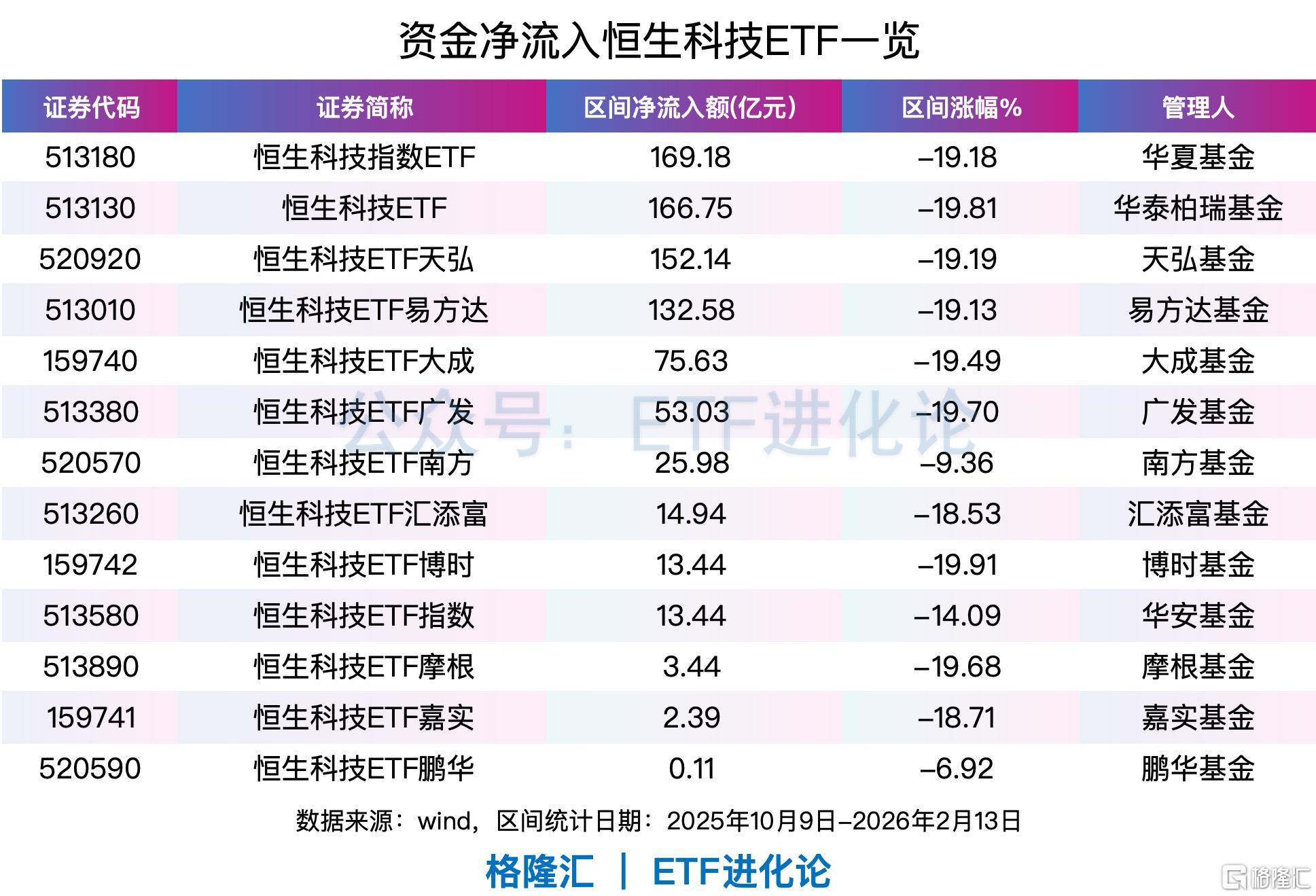
Group 1 - The Hang Seng Technology Index experienced a significant increase of 3.16% on the second trading day after the Spring Festival, following a period of deep adjustment where it fell by 22.02% over 93 trading days from October 3, 2025, to February 20, 2026 [1] - Major companies in the Hong Kong market, including Xiaomi Group, Meituan, and others, have initiated share buybacks, with Xiaomi announcing a buyback of 4.28 million shares for HKD 152 million on February 20, 2026, marking its 24th buyback of the year [1] - The total amount of share buybacks in the Hong Kong market has exceeded HKD 25.4 billion in 2026, with Tencent Holdings leading with a buyback amount of over HKD 6.358 billion [1] Group 2 - From October 9, 2025, to February 13, 2026, ETFs tracking the Hang Seng Technology Index saw a net inflow of over HKD 82.3 billion, with four specific ETFs each receiving over HKD 13 billion in net inflows [2][4] - The current relative valuation of the Hong Kong technology sector is at a historical low, with the Hang Seng Technology Index/A-share dual innovation index premium nearing historical lows, indicating that the sector is significantly undervalued [6] - The Hang Seng Technology Index is characterized by a combination of oversold valuation, counter-cyclical capital inflow, positive fundamentals in AI, and increased buybacks, suggesting a favorable risk-reward ratio for medium to long-term strategic allocation [6]

港股震荡整理,恒生科技ETF易方达(513010)、港股通互联网ETF(513040)等产品受资金关注
Mei Ri Jing Ji Xin Wen· 2026-02-13 05:03
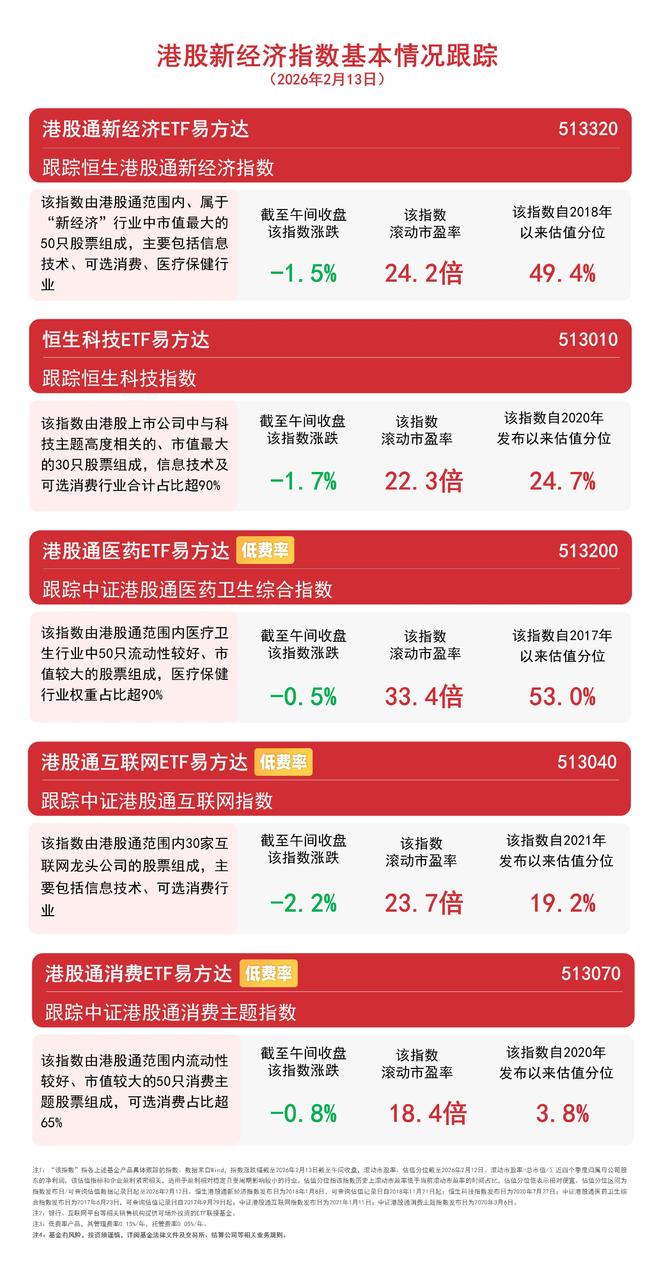
Group 1 - The core viewpoint of the article indicates a decline in various Hong Kong stock indices, with the Hang Seng Technology Index down by 1.7% and the Hang Seng Internet Index down by 2.2% as of midday closing [1] - The China Galaxy Securities report anticipates that macroeconomic policies will remain stable through 2026, with economic growth expected to maintain resilience and inflation likely to recover from low levels [1] - Earnings per share for the Hang Seng Index, Hang Seng Technology Index, and Hang Seng China Enterprises Index are projected to grow by 9.64%, 34.63%, and 9.90% year-on-year respectively by 2026, suggesting investment opportunities in technology innovation, cyclical sectors, and consumption themes [1] Group 2 - The Hong Kong Stock Connect Consumption ETF by E Fund has a low fee rate and tracks the China Securities Hong Kong Stock Connect Consumption Theme Index, which consists of 50 major consumer stocks with a significant portion in discretionary consumption [4] - The Consumption Theme Index has seen a decline of 0.8% as of midday closing, with a rolling price-to-earnings ratio of 18.4 times [4] - The index's performance since its inception shows a valuation percentile of 3.8%, indicating a relatively favorable valuation compared to historical data [4]
超百亿,“跑了”!
Zhong Guo Ji Jin Bao· 2026-02-11 06:17
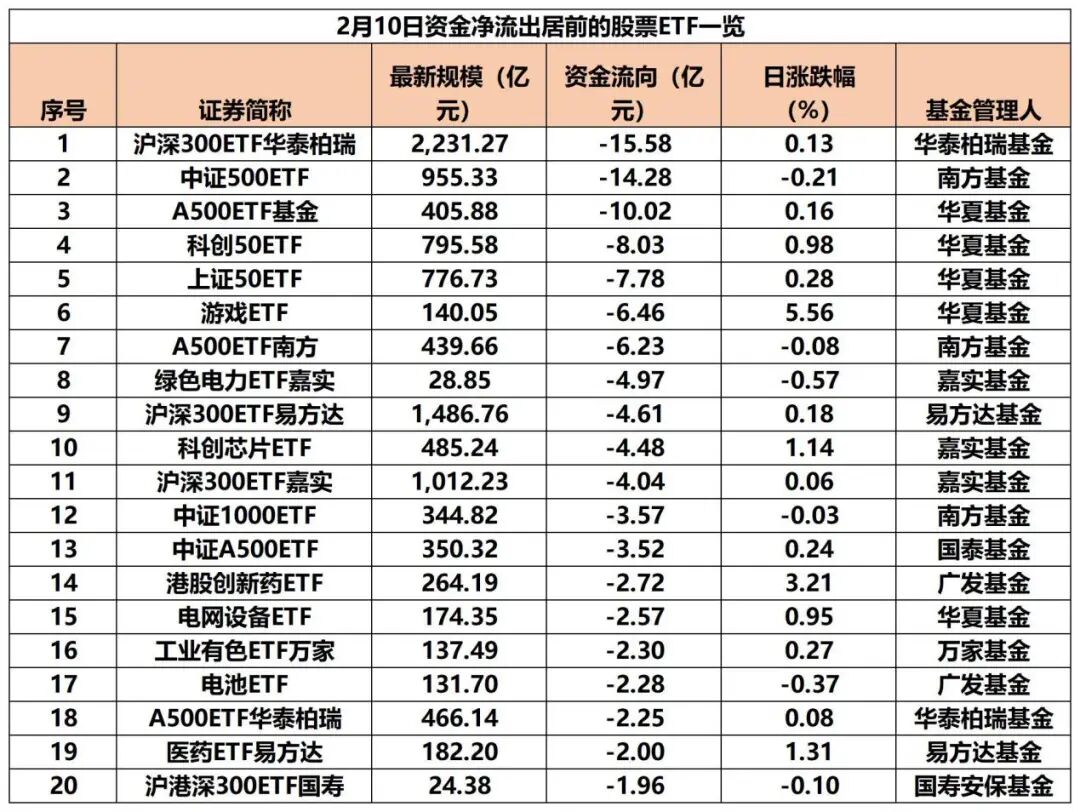
Core Viewpoint - The stock ETF market experienced a net outflow of over 10.26 billion yuan on February 10, with significant movements in various thematic ETFs and broad-based ETFs [2][4][5]. Group 1: Market Overview - On February 10, the three major A-share indices showed mixed results, with the Shanghai Composite Index rising by 0.13%, the Shenzhen Component Index increasing by 0.02%, and the ChiNext Index declining by 0.37% [2]. - The overall market saw a net outflow of 10.26 billion yuan in stock ETFs, including cross-border ETFs [2]. Group 2: ETF Performance - The net inflow for the China Film Index-related ETFs was the highest, reaching 1.339 billion yuan, while the net outflow for the CSI 300 Index-related ETFs was the largest at 2.904 billion yuan [2]. - Over the past five days, the Hang Seng Technology Index-related ETFs saw inflows exceeding 8.5 billion yuan, and the SGE Gold 9999 Index-related ETFs attracted over 6.2 billion yuan [2]. Group 3: Fund Company Insights - E Fund's ETF had a latest scale of 661.58 billion yuan, with an increase of 1.05 billion yuan. The China Internet ETF from E Fund had a scale of 41.921 billion yuan, with a net inflow of 158 million yuan [2]. - Huaxia Fund's Robot ETF and Sci-Tech Semiconductor ETF had significant net inflows of 527 million yuan and 117 million yuan, respectively, with latest scales of 25.818 billion yuan and 8.196 billion yuan [3]. Group 4: Thematic ETF Trends - Popular thematic ETFs such as the Film ETF, Robot ETF, and Satellite ETF saw the highest net inflows, while broad-based ETFs like the CSI 300 ETF and CSI 500 ETF were the biggest losers in terms of net outflows [4][5]. - The Media ETF from GF Fund received the most net inflow, amounting to 460 million yuan, and has seen a year-to-date increase of over 26%, making it one of the top performers in the market [3]. Group 5: Future Market Outlook - The investment focus may shift from January's credit and liquidity performance to macroeconomic and industrial cues as the market enters a relatively quiet period for macro data [6]. - The core assets in the market are currently at historical median valuation levels, suggesting potential for valuation recovery, supported by stable profit expectations and a warming trend in foreign capital inflows [6].
港股科技板块高开高走,恒生科技ETF易方达(513010)等产品助力布局港股“春节行情”
Mei Ri Jing Ji Xin Wen· 2026-02-11 05:59
Group 1 - The core viewpoint of the article highlights a strong performance in Hong Kong's AI applications, smart driving, and robotics stocks, with the Hang Seng Tech Index rising by 1.1% and the CSI Hong Kong Internet Index increasing by 1.3% as of 13:25 on February 11 [1] - Notable stocks within these indices include Bilibili-W, which rose by 6.2%, Xiaomi Group-W, which increased by 4.7%, and SenseTime-W, which saw a rise of 4.1%. Additionally, southbound funds recorded a net purchase exceeding 3 billion HKD during the session [1] - Market analysis indicates that from 2015 to 2025, the Hang Seng Tech Index exhibits significant seasonal characteristics during the Chinese New Year period, with strong performance typically observed in the last three trading days before the holiday and a continuation of this trend in the ten trading days following the holiday [1] Group 2 - The Hang Seng Tech Index comprises the 30 largest stocks listed in Hong Kong that are highly related to technology themes, balancing both "hard tech" and "soft tech." The CSI Hong Kong Internet Index focuses on internet platform companies in Hong Kong, gathering core Chinese AI enterprises [1] - Both indices have rolling price-to-earnings ratios below 25, positioned at the 27.0% and 22.3% percentiles since their inception, indicating potential valuation attractiveness [1] - Investment products such as the E Fund Hang Seng Tech ETF (513010) and the E Fund Hong Kong Internet ETF (513040) are available for investors to conveniently access the Hong Kong tech sector, with the Hang Seng Tech ETF experiencing a net inflow of 2.3 billion HKD over seven consecutive trading days, bringing its total size to over 30 billion HKD [2]
加仓!资金大幅涌入这些方向
Zhong Guo Zheng Quan Bao· 2026-02-08 23:07
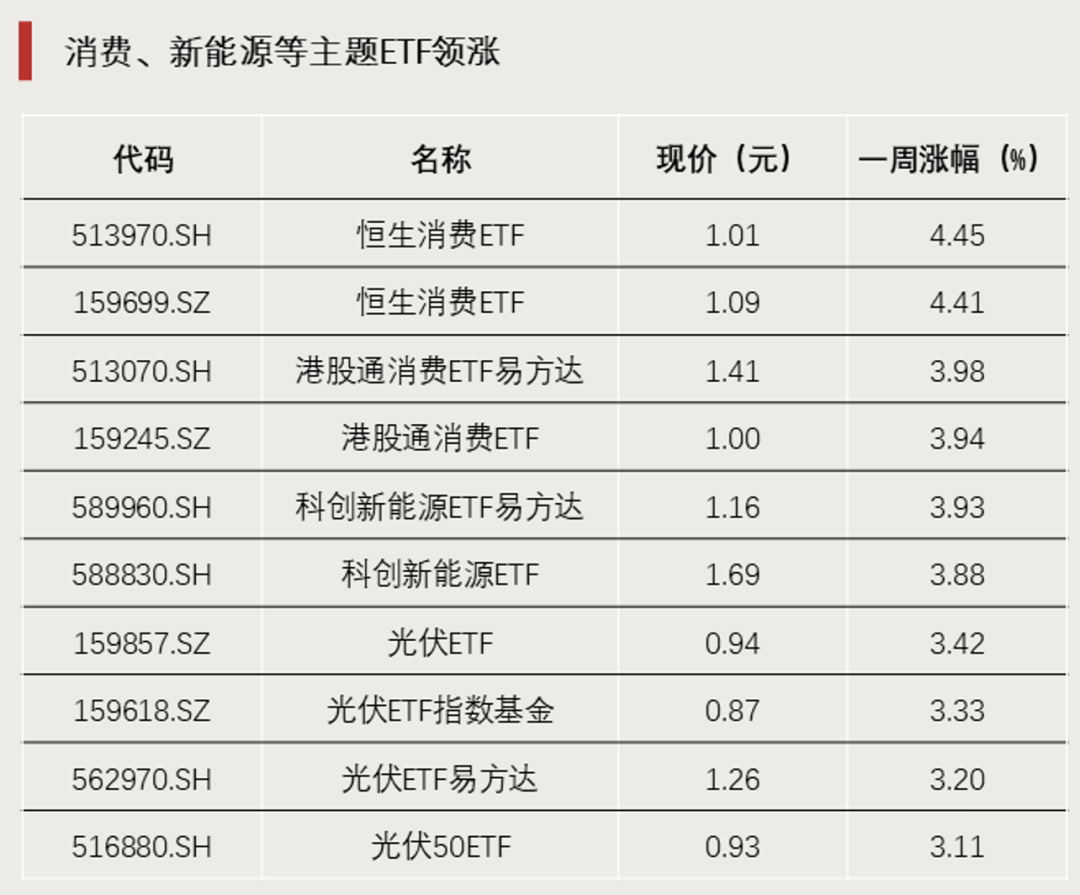
Group 1: Market Performance - The consumption and photovoltaic sectors saw significant gains last week, with several related ETFs, such as the E Fund Consumption ETF (513070) and E Fund New Energy ETF (589960), recording over 3% weekly increases [1][4] - Conversely, gold and artificial intelligence sectors experienced notable adjustments, with multiple related ETFs declining over 9% [1][6] Group 2: Trading Activity - The A-share market saw active trading in broad-based products, with the A500 ETF (159361) and others tracking the CSI A500 index achieving a total trading volume exceeding 254.8 billion yuan [2][8] - The Hang Seng Technology sector attracted significant capital inflow, with ETFs like the E Fund Hang Seng Technology ETF (513010) seeing substantial net inflows [3][10] Group 3: Sector Highlights - The Hang Seng Consumption ETF (513070) tracked the CSI Hong Kong Consumption Index, which rose over 4%, while the E Fund New Energy ETF (589960) and E Fund Photovoltaic ETF (562970) tracked indices that increased over 3% [4][5] - The gold sector showed weakness, with all 14 commodity gold ETFs declining over 5%, and some gold stock ETFs dropping more than 13% [6][7] Group 4: Future Outlook - Industry experts express optimism for the Hong Kong consumption sector in 2026, focusing on high-dividend consumer stocks, resilient domestic demand sectors like education, and timing strategies for new consumption sectors [5] - The market is expected to shift focus towards macroeconomic and industrial cues post-holiday, with a clearer framework for high-quality development and new-old kinetic energy conversion [12]
近90亿!抄底资金来了
Zhong Guo Ji Jin Bao· 2026-02-06 06:37
Core Viewpoint - The stock ETF market has shown significant resilience amid recent market volatility, with a net inflow of nearly 90 billion yuan on February 5, indicating strong investor interest despite broader market declines [1][2]. Group 1: Market Performance - On February 5, the A-share market opened lower due to declines in overseas technology stocks and precious metals, but the stock ETF market experienced a net inflow of 88.99 billion yuan [2]. - The total scale of all stock ETFs (including cross-border ETFs) reached 3.9 trillion yuan as of February 5 [2]. - The net inflow for A-share stock ETFs specifically was 34.95 billion yuan [1]. Group 2: ETF Inflows and Outflows - The leading inflows were observed in Hong Kong stock ETFs and thematic industry ETFs, with net inflows of 53.2 billion yuan and 19.47 billion yuan, respectively [2]. - Conversely, bond ETFs experienced a net outflow of 1.87 billion yuan [2]. - Notably, ETFs tracking the Hang Seng Technology Index saw a net inflow of 29.72 billion yuan, while those tracking the CSI 500 Index had a net outflow of 31.39 billion yuan [2]. Group 3: Fund Company Performance - Major fund companies such as Huaxia, Huatai-PB, and E Fund saw net inflows of 31.8 billion yuan, 28.5 billion yuan, and 28.2 billion yuan, respectively [2]. - In contrast, Southern and Jiashi funds experienced net outflows of 28.5 billion yuan and 3.8 billion yuan [2]. Group 4: Specific ETF Performance - E Fund's ETFs reached a total scale of 651.95 billion yuan, with significant inflows in various ETFs, including 9.2 billion yuan for the China Internet ETF and 3.6 billion yuan for the Hang Seng Technology ETF [3]. - Huaxia Fund's A500 ETF and Hang Seng Technology Index ETF also saw substantial inflows of 11.99 billion yuan and 6.5 billion yuan, respectively [3]. Group 5: Market Outlook - The market is expected to continue its oscillating pattern, with risks that have been accelerating in the short term, particularly in cyclical sectors like metals [5]. - Despite recent adjustments in the technology sector, the overall fundamental outlook remains robust, suggesting limited downside potential [5]. - Consumer sectors may present opportunities for recovery, especially with upcoming events like the Spring Festival and the National People's Congress [5].
恒生科技ETF易方达(513010)规模突破300亿元,关注港股科技产业链阶段性配置价值
Mei Ri Jing Ji Xin Wen· 2026-01-29 02:15
Group 1 - The core viewpoint of the news highlights the resilience of the Hong Kong technology sector, which showed a rebound after a significant drop, with the Hang Seng Technology Index down by 0.7% as of 9:47 AM on January 29 [1] - Recent data indicates a recovery in overall trading volume in the Hong Kong market, with both the amount and proportion of southbound capital increasing, suggesting a rise in market participation [1] - Foreign active funds have turned to net inflows for two consecutive weeks, indicating a positive change in the funding structure of the Hong Kong technology sector, which supports market recovery [1] Group 2 - The current earnings season for U.S. tech stocks is a focal point, with AI, cloud computing, and commercialization of applications being key areas of market interest [1] - If the performance and future guidance of overseas tech leaders exceed expectations, it could catalyze trends in related industries, positively impacting the Hong Kong technology sector through valuation and risk appetite transmission [1] - The Hang Seng Technology Index consists of the 30 largest stocks related to technology themes listed in Hong Kong, focusing on sectors such as semiconductors, robotics, software, internet, and smart driving, with major weights including Tencent Holdings, Alibaba, and SMIC [1] Group 3 - The Hang Seng Technology ETF managed by E Fund has seen a cumulative net inflow of over 1.5 billion yuan since January, with its latest scale surpassing 30 billion yuan, marking a new high since its inception [2] - The ETF offers good liquidity and supports T+0 trading, which can help investors seize opportunities in the Hong Kong technology industry chain amid the convergence of capital inflow and industry catalysts [2]


