大盘成长核心资产

Search documents
节前资金“加仓过年”,创业板、卫星产业ETF成“香饽饽”
Zhong Guo Jing Ji Wang· 2026-02-12 08:45
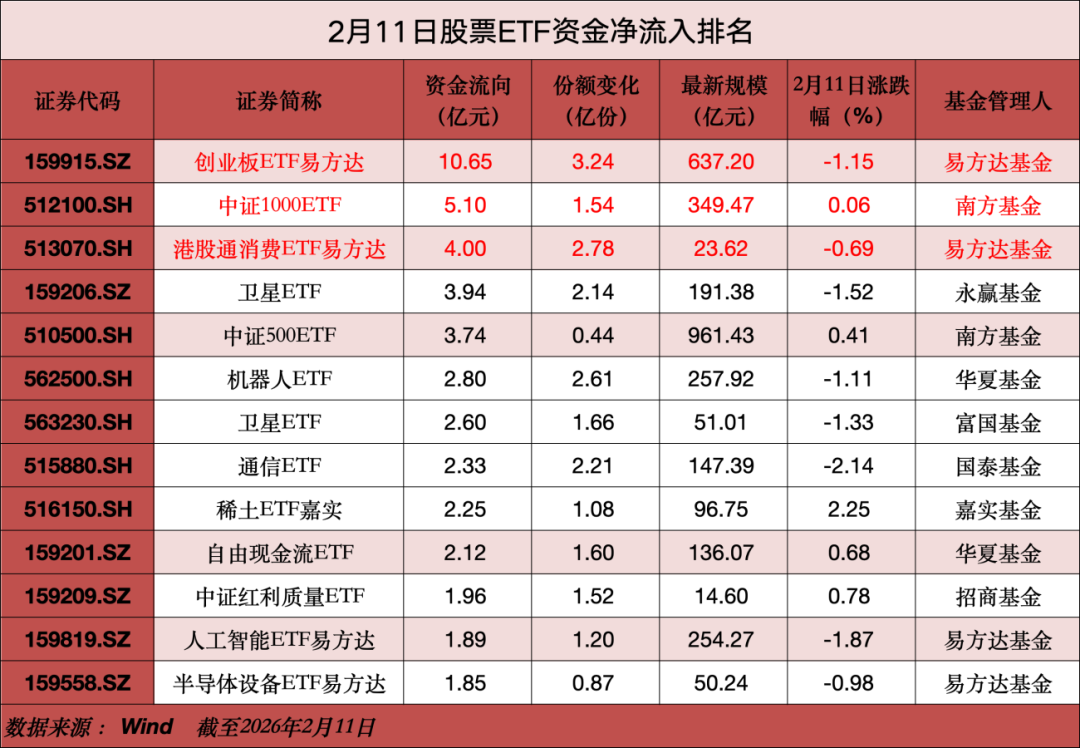
Group 1 - The A-share market showed mixed performance on February 11, with the three major indices fluctuating, and a slight net outflow of 236 million yuan from stock ETFs [1][2] - The ChiNext index saw significant net inflow of 1.14 billion yuan, while the CSI A500 index experienced net outflow [1][2] - The satellite industry and robotics sectors attracted notable capital inflows, while the new energy and dividend sectors faced outflows [1][2] Group 2 - As of February 11, the total scale of stock ETFs in the market reached 4.19 trillion yuan, with an overall net outflow of 236 million yuan for the day [2] - The ChiNext ETF led the inflows with a net inflow of 1.14 billion yuan, primarily driven by E Fund's ChiNext ETF, which saw inflows of 1.065 billion yuan [2][4] - The satellite industry also showed strong inflows, with a net inflow of 890 million yuan, including 394 million yuan into E Fund's satellite ETF [2][4] Group 3 - Over the past five days, the Hang Seng Technology Index ETF received over 6 billion yuan in inflows, while the SGE Gold 9999 Index ETF saw inflows exceeding 4.2 billion yuan [3] - The wide-based ETFs experienced a net outflow of 755 million yuan, with the CSI A500 ETF leading the outflows at 1.605 billion yuan [6][8] - The new energy sector had the highest outflow among thematic sectors, with a net outflow of 820 million yuan [7] Group 4 - The latest scale of E Fund's ETFs reached 661.02 billion yuan, with a total net inflow of 1.53 billion yuan on the previous trading day [4][5] - The robotics ETF and free cash flow ETF from Huaxia Fund saw significant inflows of 280 million yuan and 212 million yuan, respectively [5] - The market outlook suggests a focus on core growth assets, with stable earnings expectations and a potential return of foreign capital, indicating strong allocation properties in a volatile environment [9]


超百亿“跑了”!这些宽基ETF成为“失血”大户
Zhong Guo Jing Ji Wang· 2026-02-11 07:26
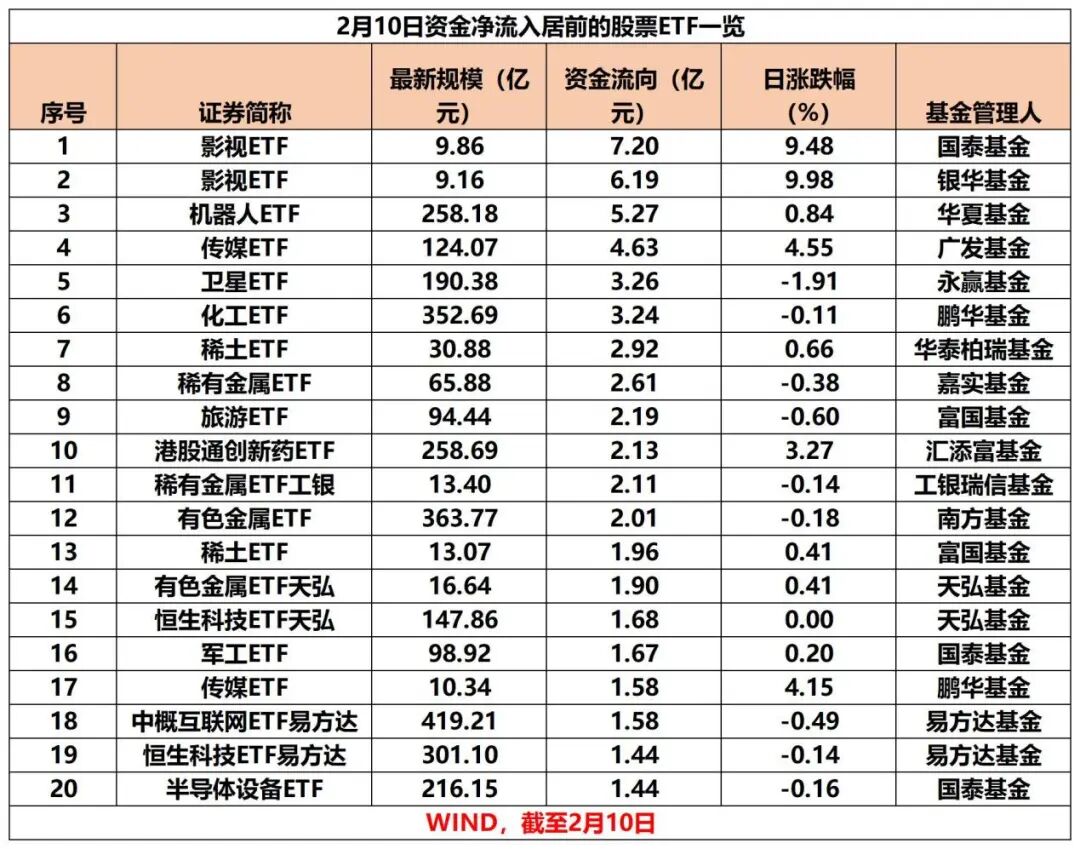
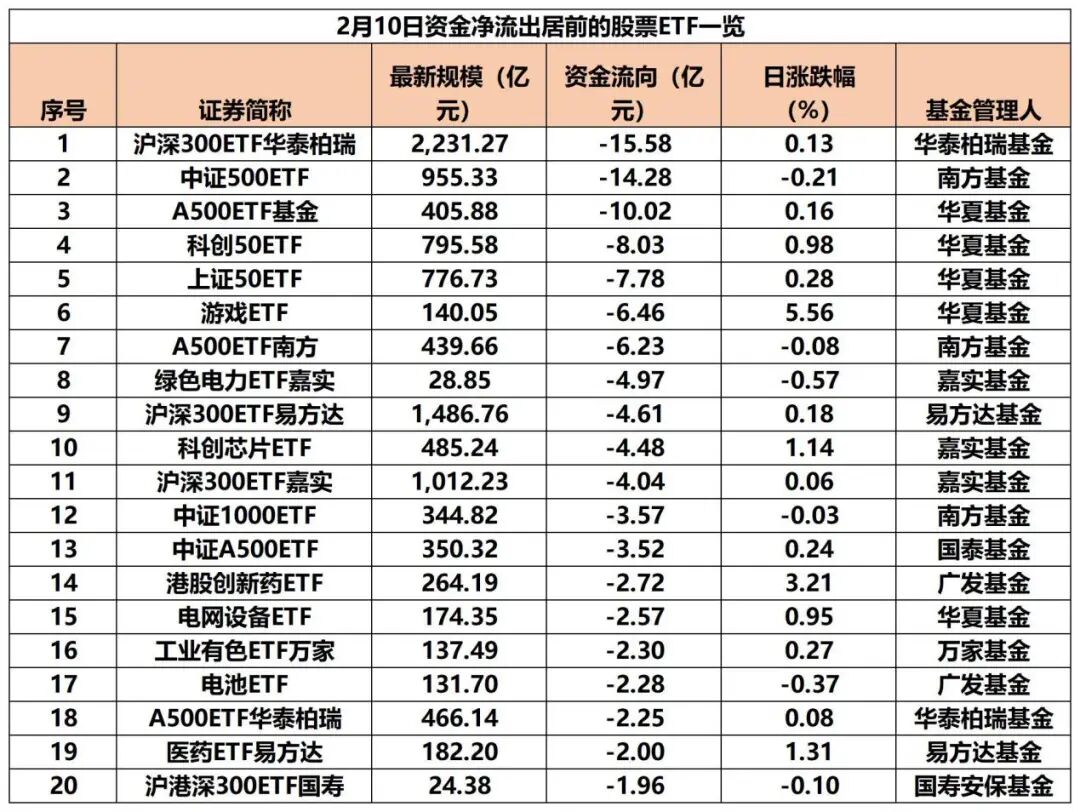
Core Viewpoint - The stock market experienced narrow fluctuations on February 10, with active performance in media and humanoid robot sectors, while stock ETFs saw a net outflow exceeding 10.26 billion yuan [1][2]. ETF Fund Flows - On February 10, the total net outflow from stock ETFs (including cross-border ETFs) reached 10.259 billion yuan, with the CSI 300 index-related ETFs experiencing a net outflow of 2.904 billion yuan, while the CSI Film Index-related ETFs saw a net inflow of 1.339 billion yuan [2][4]. - Over the past five days, the Hang Seng Technology Index-related ETFs attracted over 8.5 billion yuan, and the SGE Gold 9999 Index-related ETFs received over 6.2 billion yuan [2]. Fund Company Performance - E Fund's ETF scale reached 661.58 billion yuan, with a net inflow of 1.05 billion yuan. The China concept internet ETF saw a net inflow of 158 million yuan, while the Hang Seng Technology ETF had a net inflow of 144 million yuan [2]. - Huaxia Fund's robot ETF and sci-tech semiconductor ETF had significant net inflows of 527 million yuan and 117 million yuan, respectively, with their latest scales at 25.818 billion yuan and 8.196 billion yuan [3]. - GF Fund's media ETF received the highest net inflow of 460 million yuan, with a year-to-date increase of over 26%, making it one of the top three ETFs in the market [3]. Market Trends and Insights - The market is expected to shift focus from January's credit and liquidity performance to subsequent macroeconomic and industrial clues, as indicated by E Fund's index investment department [5]. - The manager from GF Fund highlighted the importance of vertical multi-modal AI application opportunities by 2026, emphasizing the deep penetration of AI technology in the production processes of games and films, which could enhance content innovation efficiency [5].
股票ETF资金净流出超百亿元
Zhong Guo Ji Jin Bao· 2026-02-11 06:26
Core Viewpoint - The A-share market experienced a narrow fluctuation on February 10, with significant capital outflows from stock ETFs exceeding 10.26 billion yuan, while sectors like media and humanoid robots showed active performance [1][2]. Group 1: Market Performance - On February 10, the three major A-share indices showed mixed results: the Shanghai Composite Index rose by 0.13%, the Shenzhen Component Index increased by 0.02%, while the ChiNext Index fell by 0.37% [2]. - The overall market saw a net outflow of 102.59 billion yuan from stock ETFs, including cross-border ETFs [2]. Group 2: ETF Capital Flows - The net inflow for the media-related ETFs was significant, with the film and television index-related ETFs seeing a net inflow of 13.39 billion yuan, while the CSI 300 index-related ETFs experienced a net outflow of 29.04 billion yuan [2]. - Over the past five days, the Hang Seng Technology Index-related ETFs attracted over 8.5 billion yuan, and the SGE Gold 9999 Index-related ETFs saw inflows exceeding 6.2 billion yuan [2]. Group 3: Fund Company Insights - E Fund's ETF had a latest scale of 661.58 billion yuan, with a net inflow of 1.05 billion yuan. The China concept internet ETF saw a net inflow of 158 million yuan, while the Hang Seng Technology ETF had a net inflow of 144 million yuan [2]. - Huaxia Fund's robot ETF and sci-tech semiconductor ETF had notable net inflows of 527 million yuan and 117 million yuan, respectively, with their latest scales reaching 25.818 billion yuan and 8.196 billion yuan [3]. Group 4: Notable ETFs - The top ETFs by net inflow on February 10 included the film and television ETF with a net inflow of 720 million yuan, and the robot ETF with a net inflow of 527 million yuan [4]. - Conversely, the top ETFs by net outflow included the CSI 300 ETF with a net outflow of 1.558 billion yuan and the CSI 500 ETF with a net outflow of 1.428 billion yuan [5]. Group 5: Future Market Outlook - The investment focus may shift from January's credit and liquidity performance to macroeconomic and industrial clues as the market enters a relatively data-vacuum period post-Spring Festival [6]. - The media sector is expected to benefit from AI applications, particularly in gaming and film production, which could enhance content creation efficiency and reduce costs [6].
超百亿,“跑了”!
Zhong Guo Ji Jin Bao· 2026-02-11 06:17
Core Viewpoint - The stock ETF market experienced a net outflow of over 10.26 billion yuan on February 10, with significant movements in various thematic ETFs and broad-based ETFs [2][4][5]. Group 1: Market Overview - On February 10, the three major A-share indices showed mixed results, with the Shanghai Composite Index rising by 0.13%, the Shenzhen Component Index increasing by 0.02%, and the ChiNext Index declining by 0.37% [2]. - The overall market saw a net outflow of 10.26 billion yuan in stock ETFs, including cross-border ETFs [2]. Group 2: ETF Performance - The net inflow for the China Film Index-related ETFs was the highest, reaching 1.339 billion yuan, while the net outflow for the CSI 300 Index-related ETFs was the largest at 2.904 billion yuan [2]. - Over the past five days, the Hang Seng Technology Index-related ETFs saw inflows exceeding 8.5 billion yuan, and the SGE Gold 9999 Index-related ETFs attracted over 6.2 billion yuan [2]. Group 3: Fund Company Insights - E Fund's ETF had a latest scale of 661.58 billion yuan, with an increase of 1.05 billion yuan. The China Internet ETF from E Fund had a scale of 41.921 billion yuan, with a net inflow of 158 million yuan [2]. - Huaxia Fund's Robot ETF and Sci-Tech Semiconductor ETF had significant net inflows of 527 million yuan and 117 million yuan, respectively, with latest scales of 25.818 billion yuan and 8.196 billion yuan [3]. Group 4: Thematic ETF Trends - Popular thematic ETFs such as the Film ETF, Robot ETF, and Satellite ETF saw the highest net inflows, while broad-based ETFs like the CSI 300 ETF and CSI 500 ETF were the biggest losers in terms of net outflows [4][5]. - The Media ETF from GF Fund received the most net inflow, amounting to 460 million yuan, and has seen a year-to-date increase of over 26%, making it one of the top performers in the market [3]. Group 5: Future Market Outlook - The investment focus may shift from January's credit and liquidity performance to macroeconomic and industrial cues as the market enters a relatively quiet period for macro data [6]. - The core assets in the market are currently at historical median valuation levels, suggesting potential for valuation recovery, supported by stable profit expectations and a warming trend in foreign capital inflows [6].
加仓!资金大幅涌入这些方向
Zhong Guo Zheng Quan Bao· 2026-02-08 23:07
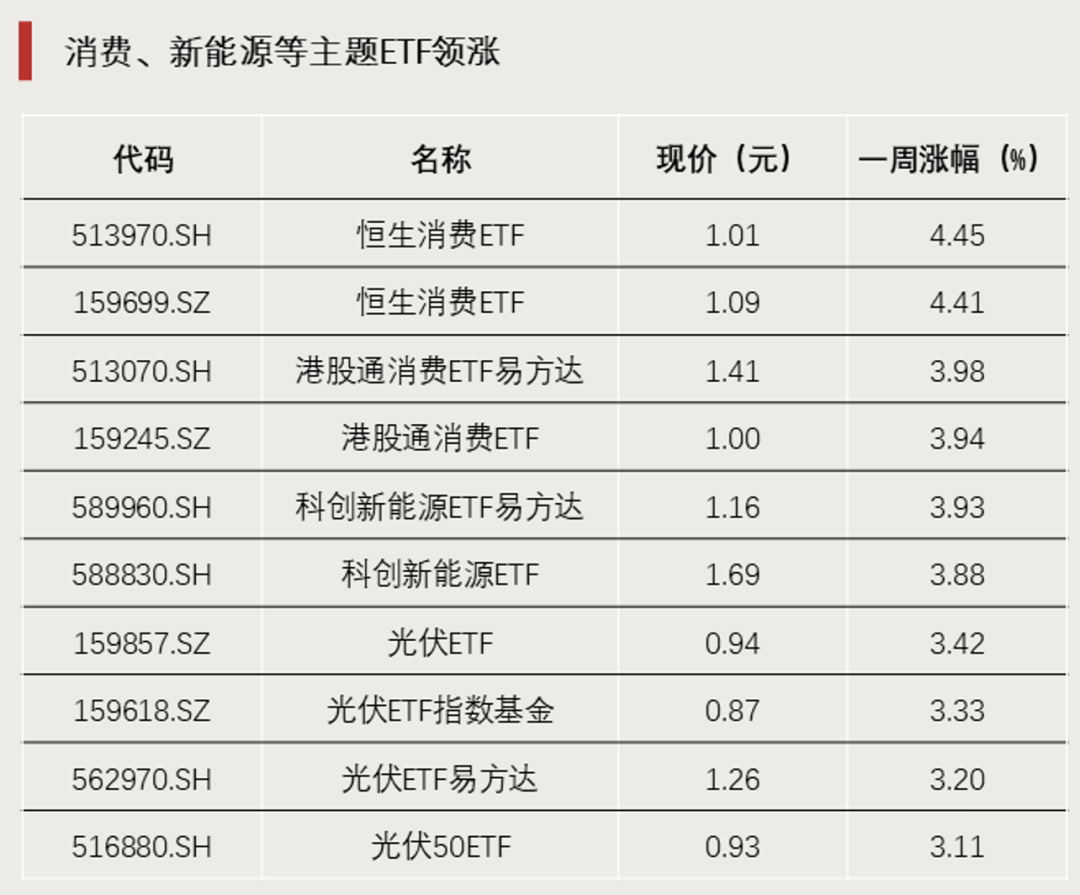
Group 1: Market Performance - The consumption and photovoltaic sectors saw significant gains last week, with several related ETFs, such as the E Fund Consumption ETF (513070) and E Fund New Energy ETF (589960), recording over 3% weekly increases [1][4] - Conversely, gold and artificial intelligence sectors experienced notable adjustments, with multiple related ETFs declining over 9% [1][6] Group 2: Trading Activity - The A-share market saw active trading in broad-based products, with the A500 ETF (159361) and others tracking the CSI A500 index achieving a total trading volume exceeding 254.8 billion yuan [2][8] - The Hang Seng Technology sector attracted significant capital inflow, with ETFs like the E Fund Hang Seng Technology ETF (513010) seeing substantial net inflows [3][10] Group 3: Sector Highlights - The Hang Seng Consumption ETF (513070) tracked the CSI Hong Kong Consumption Index, which rose over 4%, while the E Fund New Energy ETF (589960) and E Fund Photovoltaic ETF (562970) tracked indices that increased over 3% [4][5] - The gold sector showed weakness, with all 14 commodity gold ETFs declining over 5%, and some gold stock ETFs dropping more than 13% [6][7] Group 4: Future Outlook - Industry experts express optimism for the Hong Kong consumption sector in 2026, focusing on high-dividend consumer stocks, resilient domestic demand sectors like education, and timing strategies for new consumption sectors [5] - The market is expected to shift focus towards macroeconomic and industrial cues post-holiday, with a clearer framework for high-quality development and new-old kinetic energy conversion [12]
资金加仓恒生科技等赛道 宽基核心资产受关注
Zhong Guo Zheng Quan Bao· 2026-02-08 21:55
Group 1 - The consumer and photovoltaic sectors saw significant gains last week, with several related ETFs rising over 3% [1][2] - The A-share market's broad-based products experienced active trading, with ETFs tracking the CSI A500 index exceeding a total transaction volume of 250 billion yuan [1][2] - The market outlook for February suggests a continuation of the upward trend, driven by concentrated earnings forecasts and the recovery of leading companies' performance [1][4] Group 2 - The Hong Kong consumer sector performed strongly, with ETFs such as the Hang Seng Consumer ETF leading the gains [2] - Gold-related ETFs faced a downturn, with an average decline of over 5% across 14 commodity gold ETFs, and some gold stock ETFs dropping more than 13% [2] - The technology sector attracted significant capital inflow, with the Huatai-PineBridge Hang Seng Technology ETF seeing a net inflow of over 3.8 billion yuan last week [3] Group 3 - Several asset management institutions have released macro outlooks for China's equity market in 2026, highlighting diverse growth paths driven by the 14th Five-Year Plan [4][5] - Key investment areas identified include technology, manufacturing, renewable energy, healthcare, and emerging consumer sectors [4][5] - The market is expected to maintain a structural trend in February, with a focus on core growth assets that are currently at historical median valuation levels [5]
资金加仓恒生科技等赛道宽基核心资产受关注
Zhong Guo Zheng Quan Bao· 2026-02-08 20:22
Group 1 - The consumer and photovoltaic sectors saw significant gains, with several related ETFs rising over 3% last week, while gold and artificial intelligence sectors experienced declines, with some ETFs dropping over 9% [1][2] - A-shares market showed active trading in broad-based products, with ETFs tracking the CSI 500 index exceeding a total trading volume of 250 billion yuan, and those tracking the Sci-Tech 50 index surpassing 30 billion yuan [1][2] - The market outlook for February suggests a continuation of the upward trend, driven by concentrated earnings forecasts and the recovery of leading companies' performance, benefiting core assets [1][4] Group 2 - The Hong Kong consumer sector performed strongly, with ETFs such as the Hang Seng Consumer ETF leading the gains, while the photovoltaic sector also showed positive performance [1] - The gold sector underperformed, with commodity gold ETFs declining over 5%, and gold stock ETFs experiencing even greater declines, with some dropping over 13% [2] - The technology sector attracted significant capital inflow, with the Hang Seng Technology ETFs seeing substantial net inflows, particularly the Huatai-PineBridge Hang Seng Technology ETF, which had a net inflow of over 3.8 billion yuan last week [2] Group 3 - The satellite communication sector also experienced notable capital inflow, with the Yongying National Commercial Satellite Communication Industry ETF seeing a net inflow of over 1.8 billion yuan [3] - Several ETFs, including the Huazhong Gold ETF and the Southern CSI Nonferrous Metals ETF, reported net inflows exceeding 10 billion yuan this year [3] - Investment firms are focusing on five key areas for the Chinese equity market by 2026: technology, manufacturing, renewable energy, healthcare, and emerging experiential consumption [3] Group 4 - The market is expected to stabilize in February, with a shift in focus from January's credit and liquidity performance to macro and industry clues [4] - The "14th Five-Year Plan" is anticipated to provide a clearer framework for high-quality development and new growth drivers, stabilizing market perceptions of future growth [4] - Core assets are recommended for continued attention, as their valuations are at historical median levels, with stable profit expectations and increasing foreign capital inflow [4]
越跌越买!大举加仓
Zhong Guo Ji Jin Bao· 2025-12-12 06:19
Core Viewpoint - On December 11, A-shares experienced a decline, but stock ETFs saw a net inflow of 4.493 billion yuan, indicating a preference for core broad-based indices amidst market volatility [1][2]. Group 1: ETF Inflows - As of December 11, the total scale of 1,272 stock ETFs reached 4.56 trillion yuan, with a net inflow of 4.493 billion yuan, reflecting "bottom-fishing" behavior [2]. - Broad-based ETFs and Hong Kong market ETFs led the inflows, with net inflows of 2.402 billion yuan and 1.766 billion yuan, respectively [2]. - The CSI A500 ETF saw the highest single-day net inflow of 2.867 billion yuan, with over 7.2 billion yuan flowing in over the past five days [2][3]. Group 2: Specific ETF Performance - The Huatai-PineBridge CSI A500 ETF had a net inflow of 1.441 billion yuan, while the China Asset Management CSI A500 ETF saw a net inflow of 578 million yuan, bringing its latest scale to 23.307 billion yuan [2]. - The STAR 50 ETF also experienced significant inflows, totaling 1.47 billion yuan, with the top contributors being the E Fund and China Asset Management STAR 50 ETFs [2][3]. - The Shanghai 50 ETF from China Asset Management had a net inflow of 607 million yuan, with a total scale of 178.911 billion yuan [3]. Group 3: Market Trends and Insights - The market is expected to remain moderately volatile until clearer directions emerge, supported by economic resilience and stable expectations [3]. - Investment strategies should focus on large-cap growth core assets, as current valuations are at historical lows, providing potential for recovery [3]. - The dividend and Hang Seng Technology sectors also saw notable inflows, with net inflows of 1.17 billion yuan and 880 million yuan, respectively [3]. Group 4: Outflows from Thematic ETFs - Thematic industry ETFs experienced significant outflows, totaling 877 million yuan, indicating a shift in investor sentiment [5]. - Despite the overall inflow into broad-based ETFs, some segments like the CSI 1000 saw a net outflow of 390 million yuan [5].
超38亿,跑了!
Zhong Guo Ji Jin Bao· 2025-12-09 06:12
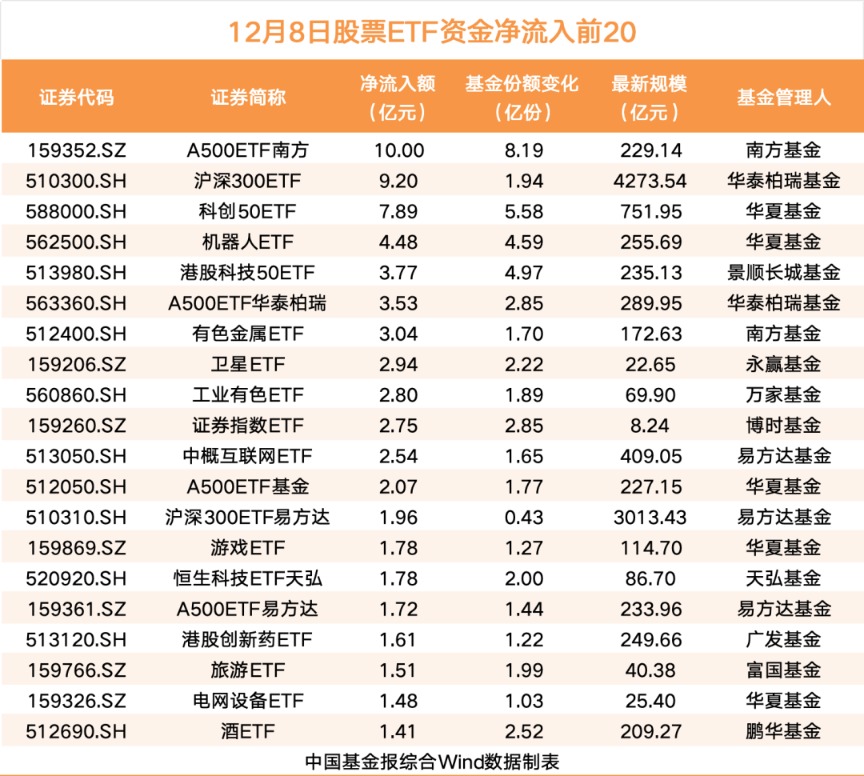
Group 1 - On December 8, the A-share market saw all three major indices rise, while the stock ETF market experienced a net outflow of over 3.86 billion yuan [1][2] - As of December 8, the total scale of 1,271 stock ETFs in the market reached 4.64 trillion yuan, with a reduction of 3.427 billion fund shares, leading to a net outflow of 3.863 billion yuan [2] - The Hong Kong stock market ETFs and broad-based ETFs saw significant net inflows of 2.128 billion yuan and 934 million yuan, respectively [2] Group 2 - The top three ETFs by net inflow on December 8 were A500ETF from Southern Fund with 1 billion yuan, followed by Huatai-PB's CSI 300 ETF with 920 million yuan, and Huaxia Fund's Sci-Tech 50 ETF with 789 million yuan [3] - The industry-themed ETFs experienced the largest net outflow, totaling 8.138 billion yuan [5] - Securities company index-related products also faced significant net outflows, amounting to 3.861 billion yuan [6] Group 3 - E Fund reported net inflows exceeding 250 million yuan for its China Concept Internet ETF and nearly 200 million yuan for its CSI 300 ETF [4] - Huaxia Fund's Sci-Tech 50 ETF and Robot ETF led in net inflows with 789 million yuan and 448 million yuan, respectively [4] - The market outlook remains positive, with expectations of economic resilience and stable funding supporting the A-share market [8]
超38亿,跑了!
中国基金报· 2025-12-09 06:09
Core Viewpoint - On December 8, the A-share market saw a collective rise in the three major indices, while the stock ETF market experienced a significant net outflow of over 3.8 billion yuan, indicating a trend of investors taking profits [2][4]. Market Performance - The Shanghai Composite Index rose by 0.54%, the Shenzhen Component Index increased by 1.39%, and the ChiNext Index surged by 2.6%. The communication sector led the gains, with CPO and other computing hardware sectors showing notable increases, while resource sectors like coal and oil experienced pullbacks [4]. ETF Market Overview - As of December 8, the total scale of 1,271 stock ETFs in the market reached 4.64 trillion yuan. On that day, the number of fund shares decreased by 3.427 billion, leading to a net outflow of approximately 3.863 billion yuan [4]. - In terms of fund flows, the Hong Kong market ETFs and broad-based ETFs saw the highest net inflows, amounting to 2.128 billion yuan and 934 million yuan, respectively [4]. Top Performing ETFs - On December 8, 29 ETFs recorded net inflows exceeding 1 billion yuan. The A500 ETF from Southern Fund led with a net inflow of 1 billion yuan, followed by the Huatai-PB CSI 300 ETF and the Huaxia Fund's Sci-Tech 50 ETF with net inflows of 920 million yuan and 789 million yuan, respectively [4][5]. Fund Company Performance - Leading fund companies continued to attract net inflows for their ETFs. E Fund's China Concept Internet ETF saw a net inflow of over 250 million yuan, while the Huatai-PB CSI 300 ETF and A500 ETF from E Fund attracted nearly 200 million yuan and 170 million yuan, respectively [6]. - Huaxia Fund's Sci-Tech 50 ETF and Robot ETF also performed well, with net inflows of 789 million yuan and 448 million yuan, respectively [6]. Sector Outflows - Industry-themed ETFs experienced the largest net outflows, totaling 8.138 billion yuan. Specifically, products related to securities companies saw a net outflow of 3.861 billion yuan [8][9]. Market Outlook - E Fund's Index Investment Department General Manager Lin Weibin expressed optimism about the market's resilience, stability in expectations, and favorable funding conditions, suggesting that A-shares have the foundation to maintain a diversified and balanced structure as the year ends [11]. - ICBC Credit Suisse Fund indicated a positive mid-term outlook for the A-share market, emphasizing the value of core Chinese economic assets during market adjustments [12].