
传统航油

Search documents
“绿色航油”新巨头来了!详解中国石化、中国航油重组
Sou Hu Cai Jing· 2026-01-10 14:31
Core Viewpoint - The restructuring between Sinopec and China Aviation Oil represents a strategic integration aimed at creating a "super refinery" and supply system, enhancing collaboration across the entire supply chain rather than merely combining resources [1]. Group 1: Reasons for Restructuring - The aviation industry is experiencing a strong recovery, with global jet fuel demand projected to reach 389 million tons by 2025, reflecting a year-on-year growth of 3.9%. Domestic jet fuel demand is expected to exceed 40 million tons, indicating significant growth potential in this sector [2]. - Sinopec seeks more direct sales channels, while China Aviation Oil aims to secure more stable upstream resources and reduce intermediary costs through this restructuring [2]. Group 2: Strategic Significance of the Restructuring - Sinopec's sustainable aviation fuel (SAF) has been successfully tested on domestic large aircraft such as the C919 and ARJ21, with the potential to reduce carbon emissions by over 50% compared to traditional jet fuel. China Aviation Oil plays a leading role in the promotion and application of SAF, serving 585 global airline customers [3]. - This restructuring is expected to facilitate the transition of "green jet fuel" from demonstration flights to large-scale commercial use [3]. Group 3: Impact on Consumers and Investors - As the demand for overseas travel among Chinese citizens increases, a robust Chinese aviation fuel service provider can offer more reliable and unified refueling services for international flights, benefiting industry development [6]. - Jet fuel typically accounts for one-third of an airline's total costs. The restructuring is anticipated to eliminate intermediary costs, potentially lowering jet fuel prices and alleviating profit pressures on airlines, thereby enhancing route stability and service quality [6].


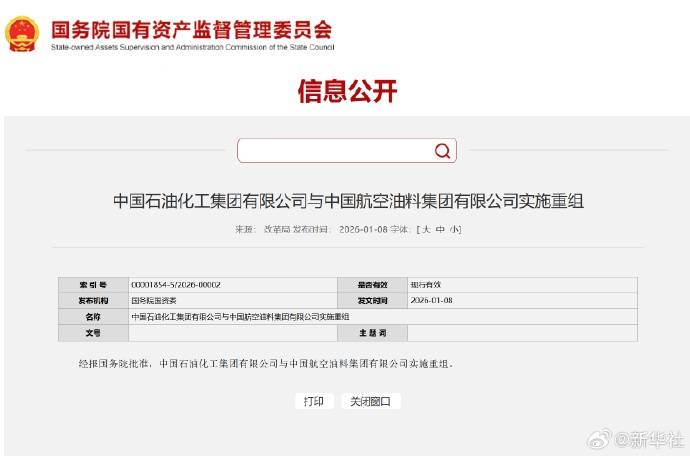
“绿色航油”新巨头来了!中国石化和中国航油实施重组
Huan Qiu Wang· 2026-01-08 10:26
Group 1 - The core viewpoint of the article is the announcement of a restructuring between Sinopec and China Aviation Oil, which combines the "super refinery" and "supply system" of aviation fuel, aiming for a full-chain collaboration rather than a simple addition [1][2]. Group 2 - The restructuring is driven by the strong recovery of the aviation industry, with global aviation fuel demand expected to reach 389 million tons by 2025, a year-on-year increase of 3.9%. Domestic aviation fuel demand is projected to exceed 40 million tons, indicating significant growth potential [2]. - Sinopec's sustainable aviation fuel (SAF) has completed test flights on domestic large aircraft C919 and ARJ21, with the potential to reduce carbon emissions by over 50% compared to traditional aviation fuel. China Aviation Oil serves 585 global airline customers, positioning itself as a leader in the promotion and application of SAF [3]. - The merger is expected to enhance the reliability and uniformity of fuel services for flights globally, benefiting the industry. With aviation fuel typically accounting for one-third of airline operating costs, the reduction of intermediary costs post-restructuring could alleviate profit pressures on airlines and improve service quality [4].
可持续航空燃料产量增速将放缓
Zhong Guo Hua Gong Bao· 2025-12-15 03:05
Core Insights - The International Air Transport Association (IATA) has released projections for sustainable aviation fuel (SAF) production, estimating a production of 1.9 million tons by 2025, which is a doubling from 1 million tons in 2024, but growth will significantly slow in 2026 to only 2.4 million tons [1] - The market share of SAF in total aviation fuel consumption is projected to be very low, at 0.6% in 2025 and 0.8% in 2026 [1] - The high cost of SAF is a major factor affecting its adoption, with current prices being twice that of traditional jet fuel and up to five times higher in regions with mandatory usage [1] - The aviation industry is expected to incur an additional cost of $3.6 billion for SAF usage in 2025 [1] - The production forecast of 1.9 million tons has been revised down from previous estimates due to insufficient policy support leading to underutilization of capacity [1]