
绿色航油

Search documents
“绿色航油”新巨头来了!详解中国石化、中国航油重组
Sou Hu Cai Jing· 2026-01-10 14:31
Core Viewpoint - The restructuring between Sinopec and China Aviation Oil represents a strategic integration aimed at creating a "super refinery" and supply system, enhancing collaboration across the entire supply chain rather than merely combining resources [1]. Group 1: Reasons for Restructuring - The aviation industry is experiencing a strong recovery, with global jet fuel demand projected to reach 389 million tons by 2025, reflecting a year-on-year growth of 3.9%. Domestic jet fuel demand is expected to exceed 40 million tons, indicating significant growth potential in this sector [2]. - Sinopec seeks more direct sales channels, while China Aviation Oil aims to secure more stable upstream resources and reduce intermediary costs through this restructuring [2]. Group 2: Strategic Significance of the Restructuring - Sinopec's sustainable aviation fuel (SAF) has been successfully tested on domestic large aircraft such as the C919 and ARJ21, with the potential to reduce carbon emissions by over 50% compared to traditional jet fuel. China Aviation Oil plays a leading role in the promotion and application of SAF, serving 585 global airline customers [3]. - This restructuring is expected to facilitate the transition of "green jet fuel" from demonstration flights to large-scale commercial use [3]. Group 3: Impact on Consumers and Investors - As the demand for overseas travel among Chinese citizens increases, a robust Chinese aviation fuel service provider can offer more reliable and unified refueling services for international flights, benefiting industry development [6]. - Jet fuel typically accounts for one-third of an airline's total costs. The restructuring is anticipated to eliminate intermediary costs, potentially lowering jet fuel prices and alleviating profit pressures on airlines, thereby enhancing route stability and service quality [6].


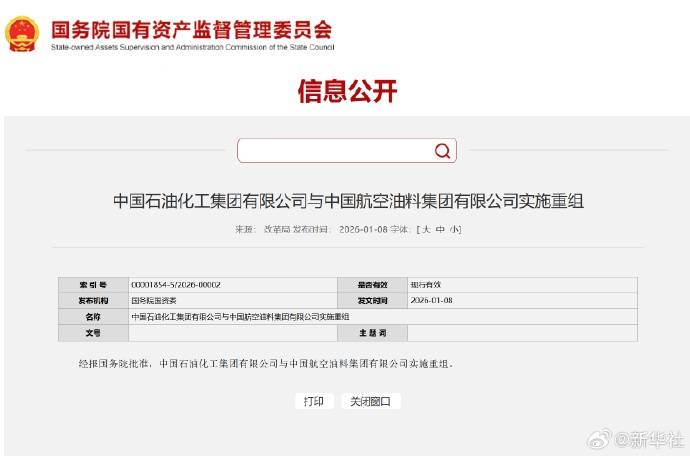
重磅“牵手”!中国石化与中国航油官宣重组
Hua Xia Shi Bao· 2026-01-08 11:47
Group 1 - The core viewpoint of the news is that the merger between Sinopec and China National Aviation Fuel is expected to enhance the resilience of the aviation fuel supply chain and ensure energy security for the aviation industry [2] - The restructuring is part of a broader trend where state-owned enterprises are optimizing their layouts and structures, focusing on strategic security and public service, with six groups of ten enterprises restructured during the 14th Five-Year Plan [2] - The State-owned Assets Supervision and Administration Commission (SASAC) plans to promote strategic and professional mergers and high-quality acquisitions among state-owned enterprises by 2026 [2] Group 2 - The aviation industry is experiencing a strong recovery, with global aviation fuel demand projected to reach 389 million tons by 2025, a year-on-year increase of 3.9%, while domestic demand exceeds 40 million tons [3] - For Sinopec, the merger provides a more direct sales channel, while for China National Aviation Fuel, it offers more stable upstream resources and reduced intermediary costs [3] Group 3 - Sinopec's sustainable aviation fuel (SAF) has completed test flights on domestic large passenger aircraft, significantly reducing carbon emissions by over 50% compared to traditional aviation fuel [4] - China National Aviation Fuel serves 585 global airline customers and plays a leading role in the promotion and application of SAF, which will be accelerated by this merger [4] Group 4 - The merger is expected to provide a more reliable and unified refueling service for increasing overseas travel demand among Chinese citizens, benefiting the overall industry [5] - The restructuring is anticipated to reduce intermediary costs in the aviation fuel supply chain, potentially lowering fuel costs for airlines, which typically account for one-third of their total expenses [5] Group 5 - As of the latest closing, Sinopec's stock price is 6.07 yuan per share, with a market capitalization of 689.8 billion yuan [6]
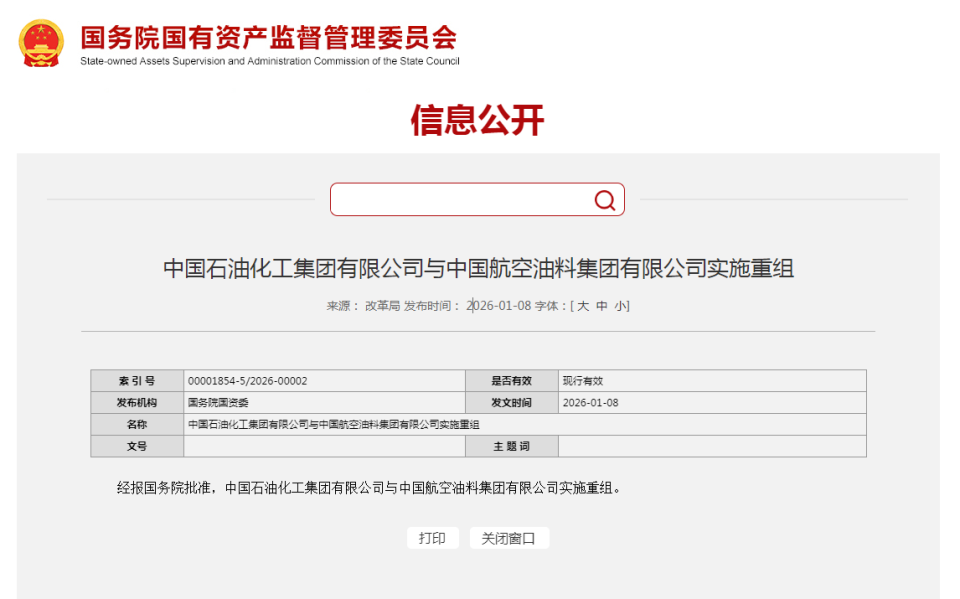
“绿色航油”新巨头来了!中国石化和中国航油实施重组
Huan Qiu Wang· 2026-01-08 10:26
Group 1 - The core viewpoint of the article is the announcement of a restructuring between Sinopec and China Aviation Oil, which combines the "super refinery" and "supply system" of aviation fuel, aiming for a full-chain collaboration rather than a simple addition [1][2]. Group 2 - The restructuring is driven by the strong recovery of the aviation industry, with global aviation fuel demand expected to reach 389 million tons by 2025, a year-on-year increase of 3.9%. Domestic aviation fuel demand is projected to exceed 40 million tons, indicating significant growth potential [2]. - Sinopec's sustainable aviation fuel (SAF) has completed test flights on domestic large aircraft C919 and ARJ21, with the potential to reduce carbon emissions by over 50% compared to traditional aviation fuel. China Aviation Oil serves 585 global airline customers, positioning itself as a leader in the promotion and application of SAF [3]. - The merger is expected to enhance the reliability and uniformity of fuel services for flights globally, benefiting the industry. With aviation fuel typically accounting for one-third of airline operating costs, the reduction of intermediary costs post-restructuring could alleviate profit pressures on airlines and improve service quality [4].
复洁环保:2025年上半年营收增长122.13% 全力推动绿色低碳转型
Zheng Quan Shi Bao Wang· 2025-08-28 10:36
Core Viewpoint - The company, Fujie Environmental Protection, reported significant growth in its first half of 2025, achieving a revenue of 140 million yuan, a year-on-year increase of 122.13%, and turning a profit with a net profit of 6.6369 million yuan, alongside a substantial increase in operating cash flow [1] Group 1: Business Performance - The company focused on three strategic areas: wastewater and sludge resource utilization, dual carbon comprehensive services, and green clean energy, leading to improved operational efficiency and steady business performance [2] - The company's high-end filter equipment and accessories business saw nearly 150% revenue growth, with overseas orders accounting for nearly 14% of total revenue, marking a transition from sporadic breakthroughs to significant growth in international markets [2] - Fujie Environmental Protection signed a contract for the expansion of the Bailong Port wastewater treatment plant, reinforcing its market position in key regions [3] Group 2: Green Fuel Initiatives - The company is actively innovating in hydrogen energy, green methanol, and green aviation fuel, with green methanol identified as a key alternative fuel for shipping and chemical industries [4] - The international maritime organization has set ambitious carbon reduction targets, which are driving the demand for alternative fuels like green methanol, supported by domestic policies promoting clean energy technologies [4] - The company is focusing on the production of green methanol from biomass and organic waste, positioning itself for significant growth in the green fuel sector post-2026 [5] Group 3: Technological Innovation - Technological innovation is central to the company's strategic transformation, with a high proportion of R&D investment ensuring product upgrades and project advancements [7] - The company has successfully implemented a hydrogen production and utilization project at a municipal wastewater treatment plant, showcasing its capabilities in the circular economy [7] - The company has developed high-temperature heat pump technology, which has been applied in various locations, significantly reducing operational costs and energy consumption [8] Group 4: Future Outlook - The company has rebranded to Shanghai Fujie Technology Co., Ltd., reflecting its strategic shift towards energy-efficient and low-carbon high-end equipment and comprehensive solutions [8] - With ongoing improvements in internal R&D and engineering capabilities, the company is well-positioned for growth in emerging clean energy sectors such as green methanol and hydrogen energy [8]
