
低空技术

Search documents
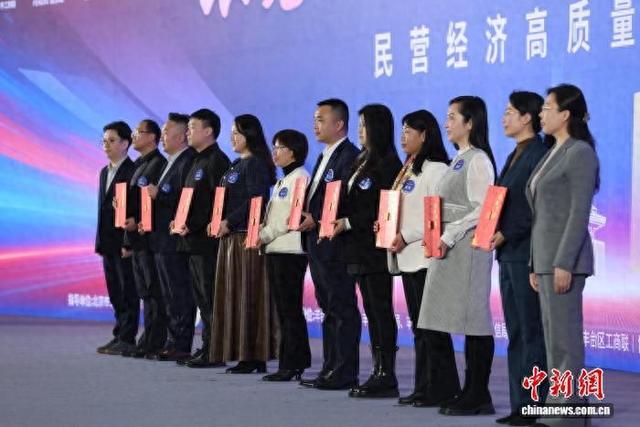
民营经济高质量发展丰台大会召开 北京民企科创中心成果发布
Xin Lang Cai Jing· 2026-01-21 14:27
Core Viewpoint - The Fengtai District of Beijing is emphasizing the importance of private enterprises, with 98% of its 207,000 businesses being private, and is actively promoting a high-quality development environment for these enterprises [1][3]. Group 1: Event Overview - The "High-Quality Development of Private Economy Fengtai Conference" was held, attended by over 400 participants including government officials, entrepreneurs, and experts [1][3]. - The conference highlighted the commitment of the Beijing municipal government to create a stable legal environment, efficient business environment, strong innovation environment, and a harmonious government-business relationship to support the private economy [3]. Group 2: Economic Statistics - Fengtai District has over 20,700 enterprises, with private enterprises making up 98% of the total [3]. - The district has more than 4,100 technology-based enterprises, with 93.4% being private [3]. - Fengtai is projected to have the highest growth rate of newly established enterprises in Beijing by 2025 [4]. Group 3: Initiatives and Programs - Fengtai District has launched a "Seven Ones" initiative to enhance the service system for the high-quality development of the private economy, which includes various components such as a platform, training, and funding [4][6]. - The Beijing Private Enterprise Technology Innovation Center was introduced as a dedicated innovation service platform for private enterprises, having hosted over 40 events and served more than 2,000 enterprises [5]. - The "Beijing Future Entrepreneurs Training Camp" has trained over 200 innovative private entrepreneurs through a systematic approach [5][6]. Group 4: Support Structures - A special fund, the "Beijing Future Entrepreneurs Special Fund," has been established to support the training camp and promote the development of innovative and growing private enterprises [6]. - The "Beijing Future Entrepreneurs Promotion Association" was launched to serve as a comprehensive empowerment platform for private entrepreneurs [6]. - The "Beijing Fengtai District Private Economy Promotion Center" was inaugurated to provide coordinated services and support for private enterprises [7]. Group 5: Innovation and Technology - The conference featured a "Private Enterprise Technology Achievements Exhibition," showcasing over 100 cutting-edge products and technologies from more than 30 technology companies in various fields [7].

多个省份发布“十五五”规划建议因地制宜发展新质生产力成关键词
Zheng Quan Shi Bao· 2025-11-27 19:35
Core Insights - The article discusses the regional development strategies during the "14th Five-Year Plan" period, emphasizing differentiated layouts and regional collaboration to drive high-quality economic growth across various provinces in China [1] Group 1: Economic Powerhouses Leading Innovation - Major economic provinces like Zhejiang, Hubei, and Beijing are focusing on becoming leaders in technological and industrial innovation by increasing R&D investments and targeting key technologies [1] - Zhejiang aims for a significant breakthrough in its innovation and industrial system by 2030, with a target R&D investment intensity of around 3.5% and over 1 trillion yuan in technology innovation investments during the "14th Five-Year Plan" [2] - Hubei is implementing a strategy to become a nationally influential technology innovation hub, focusing on foundational research and overcoming critical technological bottlenecks [2][3] Group 2: Innovation Transition in Emerging Regions - Regions like Chongqing and Inner Mongolia are making notable progress in innovation transitions, with Chongqing rising four places in the regional innovation capability rankings [3] - Chongqing plans to elevate technological innovation as a key strategy, aiming to shift from traditional factor-driven growth to innovation-driven development [3] - Inner Mongolia and Ningxia are focusing on new energy systems and high-value utilization of strategic resources like rare earths, with plans to establish significant innovation centers [5] Group 3: Collaborative Innovation in Urban Clusters - The article highlights the importance of collaborative innovation among urban clusters, such as the Beijing-Tianjin-Hebei region, to enhance industrial division and innovation cooperation [6] - Beijing is focusing on resource integration and improving the efficiency of technology transfer, while Hebei aims to attract quality elements from Beijing and Tianjin for technology incubation [6] - The Chengdu-Chongqing economic circle is also emphasized, with Chongqing planning to leverage its unique resources to build a comprehensive innovation framework [6] Group 4: Systematic Approach to Regional Development - The development of new quality productivity and regional coordination is described as a systematic project, requiring mechanisms for shared benefits and risk-sharing [7]