侧挂车保险连接证券

Search documents
升级风险管理“芯片”
Jin Rong Shi Bao· 2025-12-03 03:32
Core Insights - The release of the upgraded China Earthquake Catastrophe Model 3.7 by Zhongzai Catastrophe Risk Management Co., Ltd. enhances the precision of quantifying earthquake disaster losses and provides reliable data support for insurance actuarial work, disaster prevention planning, and emergency management [1] - The recent advancements in catastrophe risk management models reflect a broader trend in the industry, with multiple models being upgraded to improve disaster risk quantification [1][2] - The implementation of the "Action Plan" by the Financial Regulatory Bureau emphasizes the importance of developing catastrophe risk models for typhoons, floods, and earthquakes as part of a comprehensive disaster prevention and mitigation strategy [2] Industry Developments - The insurance industry is increasingly focusing on proactive disaster prevention measures, as demonstrated by the development of intelligent monitoring systems that can predict agricultural risks and provide timely warnings to farmers [3] - Emergency response capabilities have been enhanced, with insurance companies actively participating in disaster management, such as directing traffic during flooding events to prevent further losses [3] - The speed of claims processing has improved significantly, exemplified by rapid compensation for damages caused by natural disasters, showcasing the industry's commitment to efficient service [4] Regulatory Framework - The "Action Plan" has led to significant advancements in establishing a multi-layered catastrophe insurance protection mechanism, including the recent approval for domestic insurance companies to issue catastrophe-linked securities in Hong Kong [5] - The issuance of catastrophe-linked securities allows for better risk distribution and enhances the resilience of the insurance industry against natural disasters [5] Overall Impact - The insurance sector's role in disaster prevention, emergency response, and loss compensation has become increasingly prominent, with a closed-loop system being developed to enhance efficiency and societal resilience [6] - The industry is transitioning from passive compensation to proactive disaster reduction, supported by technological advancements and innovative mechanisms [6] - As catastrophe insurance systems deepen and emergency service mechanisms improve, the insurance industry's function within the national emergency management framework is expected to become more robust, providing stronger protection for public safety [6]


支持境内险企赴港发行“侧挂车” 保险业迎战巨灾风险添新工具
2 1 Shi Ji Jing Ji Bao Dao· 2025-11-04 09:13
Core Viewpoint - The Chinese insurance industry is accelerating the exploration of new paths for risk diversification in the context of increasing global climate change and frequent natural disasters, with the recent issuance of a notification supporting domestic insurance companies to issue "sidecar" insurance-linked securities in the Hong Kong market [1][4]. Group 1: Background and Context - Extreme weather and natural disasters have been on the rise, with significant losses reported both domestically and internationally. In 2024, natural disasters in China affected approximately 94.13 million people, resulting in direct economic losses of 401.11 billion yuan [3]. - The insurance payout for natural disasters in China is significantly lower than the global average, with only about 10% of losses covered by the insurance industry compared to the global average of around 40% [3][4]. Group 2: Regulatory Developments - The notification issued by the National Financial Regulatory Administration aims to implement the State Council's opinions on enhancing regulation and preventing risks while promoting high-quality development in the insurance industry, specifically focusing on exploring catastrophe bonds [4][5]. - The "sidecar" insurance-linked securities concept is defined, and the management requirements for special purpose insurance companies (SPI) are established, which will help in transferring catastrophe risks to the capital market [5][6]. Group 3: Risk Management Tools - The introduction of "sidecar" insurance-linked securities is expected to enrich the catastrophe risk management toolbox and create a multi-layered network for risk diversification [4][8]. - These securities allow insurance companies to transfer risks associated with natural disasters to specially established SPIs, which will issue equity or debt securities to raise funds for claims [5][6]. Group 4: Market Implications - The "sidecar" insurance-linked securities are anticipated to provide additional protection for insurance companies by allowing them to access the Hong Kong capital market, thus supplementing traditional reinsurance markets [8][9]. - This new financial product is expected to offer a low correlation with traditional financial assets, making it an attractive investment option in the Hong Kong market [9].


再保险积极参与全球风险治理
Jing Ji Ri Bao· 2025-11-03 22:08
Core Insights - The 2025 Shanghai International Reinsurance Conference highlighted industry innovations and discussions on global risk governance and reinsurance development [1] Group 1: Reinsurance Functionality - Reinsurance acts as an "amplifier," "regulator," and "connector" in the insurance industry, facilitating risk dispersion and enhancing market stability [2] - In the first nine months of 2025, the insurance industry in China reported premium income of 5.2 trillion yuan, a year-on-year increase of 8.5%, and claims of 1.9 trillion yuan, up 7.4% [2] Group 2: Catastrophe Bonds and Risk Management - The global natural disaster losses in 2024 exceeded $320 billion, significantly higher than the average over the past 30 years, with reinsurance companies playing a crucial role in risk dispersion [3] - Catastrophe bonds have seen substantial growth, with a total issuance of $7.1 billion in Q1 2025, marking a historical high [3] Group 3: Regulatory Developments - The Financial Regulatory Authority issued a notice supporting domestic insurance companies in issuing "sidecar" insurance-linked securities in Hong Kong, enhancing catastrophe risk management tools [4] Group 4: Climate Risk Management - The reinsurance industry is increasingly focused on climate risk management, with the establishment of the Climate Vision platform by China Re, aimed at providing insights into climate-related financial risks [5][6] - The platform integrates international modeling methods and local disaster characteristics to support regulatory standards and financial stability [6] Group 5: Internationalization and Market Development - China's reinsurance market accounts for only 4% of the global share, indicating a need for improved risk pricing and market leadership [8] - The Shanghai International Reinsurance Center has attracted 26 insurance institutions and 128 trading permissions, indicating a growing ecosystem [8] Group 6: Strategic Recommendations - Recommendations for enhancing Shanghai's reinsurance market include creating a favorable regulatory environment, improving market infrastructure, and developing a talent pool for international operations [10][11]
巨灾保险“出海”再提速,监管支持境内险企“侧挂车”
Nan Fang Du Shi Bao· 2025-10-30 10:30
Core Viewpoint - Catastrophe insurance is becoming increasingly important as extreme weather and natural disasters rise globally, with China facing significant challenges in its catastrophe insurance system despite recent policy advancements [2][4]. Group 1: Catastrophe Insurance Landscape in China - Over 70% of cities and more than 50% of the population in China are located in areas severely affected by natural disasters, highlighting the complex and concentrated nature of catastrophe risks [5]. - The catastrophe insurance system in China has been gradually improving, with significant developments such as the establishment of the earthquake catastrophe insurance community in 2016 and ongoing pilot programs in over 20 provinces [6]. - Despite a premium scale of 1.232 billion yuan and a compound annual growth rate exceeding 39% from 2014 to 2024, the insurance payout for natural disasters in China is only about 10% of the economic losses, compared to a global average of 50% [6]. Group 2: Regulatory Developments and Innovations - The Financial Regulatory Bureau has issued a notification allowing domestic insurance companies to issue "sidecar" insurance-linked securities in the Hong Kong market, which helps transfer risks to the capital market [3][4]. - "Sidecar" insurance-linked securities can provide additional protection for insurance companies, enhancing their financial stability and allowing them to share catastrophe risks with the capital market [4]. - The issuance of catastrophe bonds has been supported by recent regulatory changes, with the first catastrophe bond issued in Hong Kong in 2015 and subsequent issuances in 2021 and 2022 [9][10]. Group 3: Industry Trends and Future Outlook - The catastrophe bond market is expected to grow significantly, with predictions indicating a 20% increase in market size to approximately $60 billion by 2025 [10]. - The introduction of "sidecar" insurance-linked securities is anticipated to diversify capital markets and may lead to structural impacts on domestic stock markets, potentially attracting international capital back to mainland markets [11][12]. - The insurance industry is encouraged to adopt technology for risk management, shifting focus from post-disaster compensation to pre-disaster prevention, with companies like China Life and PICC developing advanced risk management platforms [7].


新金融产品来了!险企拟赴港试水
券商中国· 2025-10-30 09:53
Core Viewpoint - The article discusses the recent regulatory support from the Financial Regulatory Administration for domestic insurance companies to issue "sidecar" insurance-linked securities (ILS) in the Hong Kong market, enhancing the existing ILS framework and providing new risk management tools for catastrophe risk [2][3][4]. Group 1: Regulatory Support and Framework - The Financial Regulatory Administration issued a notification supporting domestic insurance companies in issuing "sidecar" ILS in Hong Kong, following the introduction of catastrophe bonds in 2021 [2][3]. - The notification aims to enrich the catastrophe risk management tools available to insurance companies and to build a multi-layered catastrophe risk dispersion network [3][4]. - "Sidecar" ILS allows insurance companies to transfer catastrophe risks from natural disasters or public health emergencies to specially established Special Purpose Insurers (SPI) [3][4]. Group 2: Benefits of "Sidecar" ILS - The introduction of "sidecar" ILS is expected to improve China's catastrophe risk protection system by providing additional coverage from the Hong Kong capital market, complementing traditional reinsurance [4]. - It enhances the financial stability of insurance companies by allowing them to share catastrophe risks with the capital market, thus smoothing operational volatility [4]. - "Sidecar" ILS offers a new investment product for the Hong Kong market, with low correlation to traditional financial assets, making it less affected by economic cycles [4]. Group 3: Comparison with Catastrophe Bonds - "Sidecar" ILS and catastrophe bonds are both forms of ILS but differ in their risk layers; catastrophe bonds typically cover higher-level losses, while "sidecar" ILS addresses lower-level losses [5][6]. - The issuance process for "sidecar" ILS is more flexible and quicker compared to catastrophe bonds, which are more standardized and complex [7]. - "Sidecar" ILS is considered higher risk and higher return due to its association with the operational performance of the reinsurance companies, while catastrophe bonds are simpler and more transparent [7]. Group 4: Industry Response and Future Outlook - Several leading insurance companies are preparing to issue "sidecar" ILS following the regulatory guidance provided in the notification [6][8]. - The Financial Regulatory Administration plans to monitor the implementation of the notification and continue supporting insurance companies in issuing "sidecar" ILS to enhance catastrophe risk management [8].
巨灾风险谁来兜底?监管支持境内保险公司“侧挂车”
Xin Lang Cai Jing· 2025-10-29 11:01
Core Viewpoint - The National Financial Regulatory Administration has issued a notice supporting domestic insurance companies to issue "sidecar" insurance-linked securities in the Hong Kong market, aiming to enhance catastrophe risk management tools [1][2]. Group 1: Regulatory Support and Market Context - The issuance of "sidecar" insurance-linked securities is a response to the significant operational pressures faced by insurance institutions when underwriting catastrophe risks, particularly given the complex and concentrated nature of such risks in China [2]. - Over 70% of cities and more than 50% of the population are located in areas severely affected by natural disasters, which can lead to losses in the hundreds of billions within a short time frame, impacting the solvency and capital levels of insurance companies [2]. Group 2: Financial Stability and Investment Opportunities - The introduction of "sidecar" insurance-linked securities is expected to improve the financial stability of insurance companies by allowing them to share part of the catastrophe risk with the capital market, thus smoothing operational volatility and enhancing resilience against catastrophe risks [4]. - These securities provide a new investment product for the Hong Kong market, characterized by low correlation with traditional financial assets, as their triggers are typically linked to natural disasters rather than conventional market factors [4]. Group 3: Comparison with Catastrophe Bonds - Catastrophe bonds, which allow insurance companies to package and transfer part of their catastrophe risks to investors, are more commonly used in the market. They enable a dual flow of risk and capital, offering high returns to investors if no disaster occurs, while providing funds for insurance losses if a disaster triggers payouts [4]. - Recent performance of catastrophe bonds has been strong, with an average annual return of approximately 7.4% since 2002, and double-digit growth expected in 2023 and 2024, indicating continued attractiveness for asset allocation [5]. Group 4: Development of Catastrophe Insurance System - China's catastrophe insurance system has been gradually improving since the establishment of the earthquake catastrophe insurance community in 2015, with ongoing expansion of the policy-based catastrophe insurance system [5]. - Regulatory authorities are set to further expand coverage and increase insurance amounts in 2024, encouraging the development of commercial catastrophe insurance, while local governments are exploring various underwriting models based on regional risk characteristics [5].

巨灾风险如何不“爆表”?保险公司“侧挂车”?
Jing Ji Guan Cha Wang· 2025-10-29 06:05
Core Insights - The Financial Regulatory Bureau has issued a notification supporting domestic insurance companies to issue "sidecar" insurance-linked securities in the Hong Kong market, aimed at transferring catastrophe risks to the capital market [2][3] Risk Management and Catastrophe Insurance - "Sidecar" insurance-linked securities are a method for insurance companies to transfer risks associated with catastrophe events like earthquakes and floods to the capital market [3][5] - Catastrophe risks are characterized by low frequency but high loss potential, necessitating innovative financial tools for risk management [4][9] - The Chinese catastrophe risk landscape is complex, with over 70% of cities and more than 50% of the population located in areas prone to natural disasters [4] Market Context and Trends - In 2024, global natural disasters caused approximately $320 billion in economic losses, marking the third-highest figure since 1980, driven primarily by extreme weather events [6] - The establishment of catastrophe insurance systems in China has progressed, with various regions developing local catastrophe insurance frameworks tailored to specific risks [6][7] Financial Instruments and Innovations - Insurance-linked securities, including "sidecar" securities and catastrophe bonds, are innovative financial instruments that allow insurance companies to manage and transfer risks effectively [9][10] - The issuance of catastrophe bonds has been growing, with a projected market size of approximately $60 billion by 2025, indicating a significant opportunity for investment [11] Conclusion - The introduction of "sidecar" insurance-linked securities represents a strategic move to enhance the resilience of the insurance industry against catastrophe risks, providing a new avenue for risk diversification and capital acquisition [2][9]

金融监管总局:支持境内险企在香港发行“侧挂车”保险连接证券
Guo Ji Jin Rong Bao· 2025-10-29 05:37
Core Viewpoint - The Financial Regulatory Administration has issued a notice supporting domestic insurance companies to issue "sidecar" insurance-linked securities in the Hong Kong market, aimed at enhancing catastrophe risk management tools and diversifying risk [1][4]. Group 1: Definition and Structure - "Sidecar" insurance-linked securities involve insurance companies transferring catastrophe risks from natural disasters or public health events to specially established special purpose insurance companies, which then issue equity or debt securities to raise funds for fulfilling compensation obligations [3]. - The establishment and management of these special purpose insurance companies must comply with specific requirements, including bankruptcy isolation and asset custody by qualified financial institutions [3]. Group 2: Regulatory Framework and Requirements - The notice outlines that the reinsurance receivables and reserves from the issuance of "sidecar" insurance-linked securities must adhere to solvency regulatory requirements [3]. - Special purpose insurance companies must ensure full cash collateral or equivalent protection mechanisms for the maximum liability to the transferring insurance companies throughout the duration of the reinsurance contracts [3]. Group 3: Benefits and Market Impact - The introduction of "sidecar" insurance-linked securities is expected to enhance China's catastrophe risk protection system by providing additional coverage beyond traditional reinsurance, thus expanding risk diversification channels [4]. - This mechanism is anticipated to improve the financial stability of insurance companies by allowing them to share catastrophe risks with the capital market, thereby smoothing operational volatility [4]. - The new securities will offer Hong Kong investors a novel investment product with low correlation to traditional financial assets, as their triggers are typically linked to natural disasters rather than economic cycles [4]. Group 4: Future Actions - The Financial Regulatory Administration plans to monitor the implementation of the notice and support willing insurance companies in issuing "sidecar" insurance-linked securities to enhance catastrophe risk management capabilities [5].
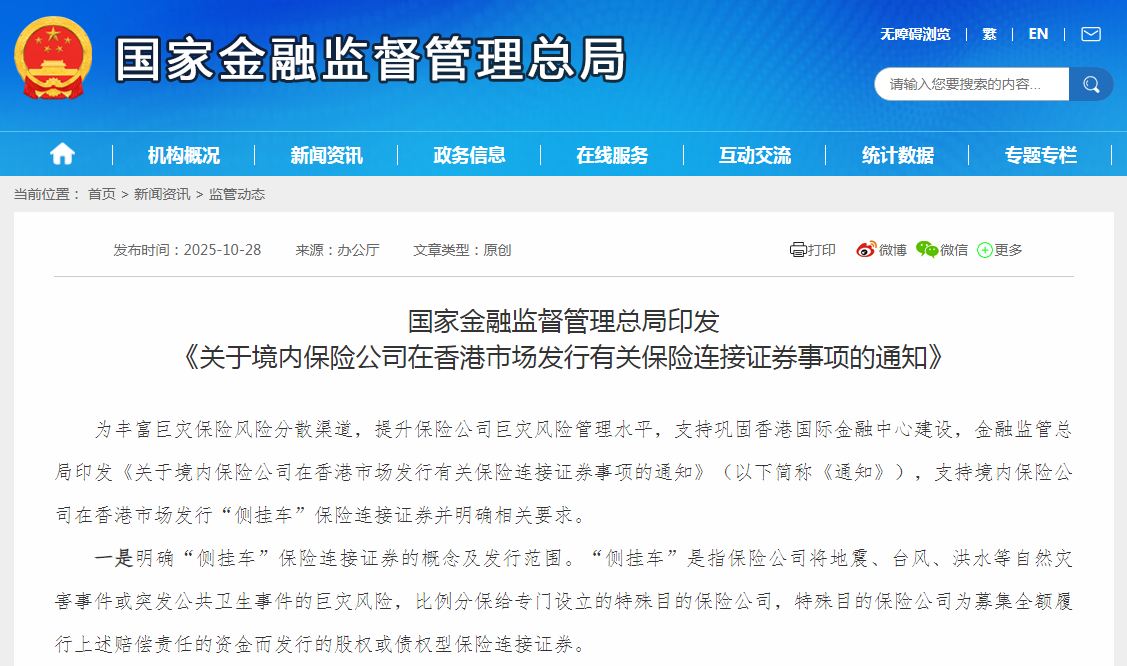
金融监管总局最新印发!
Sou Hu Cai Jing· 2025-10-29 02:54
Core Viewpoint - The National Financial Regulatory Administration has issued a notice to support domestic insurance companies in issuing "sidecar" insurance-linked securities in the Hong Kong market, aiming to enhance catastrophe risk management and solidify Hong Kong's status as an international financial center [1][2]. Group 1: Background and Purpose - The notice is part of efforts to explore catastrophe bonds and effectively use reinsurance to mitigate risks, as outlined in the State Council's opinions on strengthening regulation and promoting high-quality development in the insurance industry [3]. - The issuance of "sidecar" insurance-linked securities is intended to enrich the catastrophe risk management toolbox and build a multi-layered catastrophe risk dispersion network [3]. Group 2: Definition and Mechanism - "Sidecar" insurance-linked securities involve insurance companies transferring catastrophe risks from natural disasters or public health emergencies to specially established special purpose insurers (SPI) through proportional reinsurance [3][4]. - The SPI raises funds for compensation by issuing equity or debt securities, which are then invested in low-risk, highly liquid assets to ensure timely payment of claims [3][4]. Group 3: Benefits and Implications - The introduction of "sidecar" insurance-linked securities is expected to improve China's catastrophe risk protection system by providing additional coverage from the Hong Kong capital market, complementing traditional reinsurance [4]. - It enhances the financial stability of insurance companies by allowing them to share catastrophe risks with the capital market, thus smoothing operational volatility and increasing resilience against catastrophe risks [4]. - The new securities offer a novel investment product for the Hong Kong market, characterized by low correlation with traditional financial assets and typically triggered by natural disasters, making them less affected by conventional market factors [4].
新华财经早报:10月29日
Xin Hua Cai Jing· 2025-10-29 01:57
Group 1 - The "14th Five-Year Plan" emphasizes the promotion of emerging industries such as quantum technology, biomanufacturing, hydrogen energy, nuclear fusion, brain-computer interfaces, embodied intelligence, and sixth-generation mobile communication as new economic growth points [2] - The revised Cybersecurity Law will take effect on January 1, 2026, supporting AI development and enhancing risk assessment and regulation [2] - The Financial Regulatory Bureau supports domestic insurance companies to issue "catastrophe bonds" in the Hong Kong market, which are linked to natural disaster risks [2] Group 2 - The People's Bank of China reported that it will implement a moderately loose monetary policy to support economic recovery, ensuring that social financing and money supply growth align with economic growth targets [2] - The latest tax data shows a 229.8% year-on-year increase in the number of outbound travelers claiming tax refunds from January to September, with a 97.4% increase in refund amounts [2] - The digital RMB ecosystem has been preliminarily established, with a cumulative transaction amount of 14.2 trillion yuan by the end of September 2025 [2] Group 3 - Ganfeng Lithium reported a third-quarter revenue of 6.249 billion yuan, a year-on-year increase of 44.10%, and a net profit of 557 million yuan, a year-on-year increase of 364.02% [3][8] - The public fund industry saw significant growth in the third quarter, with an increase of 2.23 trillion yuan, bringing the total scale to over 35 trillion yuan [3][8] - The China-ASEAN Free Trade Area 3.0 upgrade covers nine areas, including digital economy and green economy [2]