
便携式超声

Search documents
战场上,医疗设备应该设计成什么样?
思宇MedTech· 2025-09-03 02:39
Core Viewpoint - The article emphasizes that battlefield medicine serves as an extreme testing ground for medical device innovation, focusing on the essential requirements of portability, durability, speed, and ease of use in high-stress environments [2][34]. Group 1: Core Issues in Battlefield Medicine - Battlefield medicine is characterized by complex injuries and extreme environments, necessitating rapid triage and treatment to prevent shock and death [6]. - Delays in transport and limited resources hinder timely medical intervention, contrasting sharply with civilian emergency systems [7]. - Harsh environmental conditions challenge the functionality of medical devices, requiring them to operate reliably without stable power sources [8]. - The lack of specialized medical personnel necessitates simplified devices that can be used by non-professionals [9]. - The treatment logic prioritizes life-saving measures over definitive treatment, emphasizing the need for quick interventions [10]. Group 2: General Requirements for Battlefield Medical Devices - Devices must be extremely portable, lightweight, and easy to deploy, allowing for single-handed operation [12]. - High environmental durability is essential, with devices needing to withstand extreme temperatures, dust, and vibrations [13]. - Simplified operation is crucial, as non-professionals often perform initial treatments [14]. - Rapid startup and application are necessary, with devices ready for use within seconds [15]. - Modular and multifunctional designs are preferred to maximize utility in limited carrying space [16]. - Remote communication capabilities are important for real-time data sharing with command centers [17]. - Devices should require minimal maintenance and have low dependency on consumables [18]. Group 3: Typical Device Configurations in Different Scenarios - Frontline individual care focuses on self-rescue and rapid control of life-threatening conditions [20]. - Battlefield ambulances aim to stabilize vital signs and ensure safe transport [21]. - Forward aid stations provide initial surgical care and rapid resuscitation [22]. - Field hospitals operate at a level close to rear hospitals, offering comprehensive surgical and post-operative care [23]. Group 4: Unique or Rare Medical Devices in Battlefield Medicine - Tactical hemostatic agents and specialized bleeding control methods are developed for battlefield conditions [27]. - Portable blood warming devices and rapidly deployable surgical facilities are essential for immediate care [27]. - Remote medical and satellite communication devices enhance operational efficiency [27]. - Drones and robotic support are emerging technologies for medical supply delivery and casualty evacuation [27]. Group 5: Insights for Medical Device R&D - Battlefield medicine highlights the need for extreme portability and miniaturization in device design [32]. - Modular and multifunctional integration is crucial for maximizing device utility [32]. - Devices must be designed for harsh environments with low maintenance requirements [32]. - Simplified operation and rapid usability are essential for effective deployment in emergencies [33]. - The trend towards remote medical capabilities and satellite communication is becoming increasingly relevant [33]. - Innovations from battlefield medicine can inform civilian medical device development, particularly in emergency and disaster response scenarios [36].


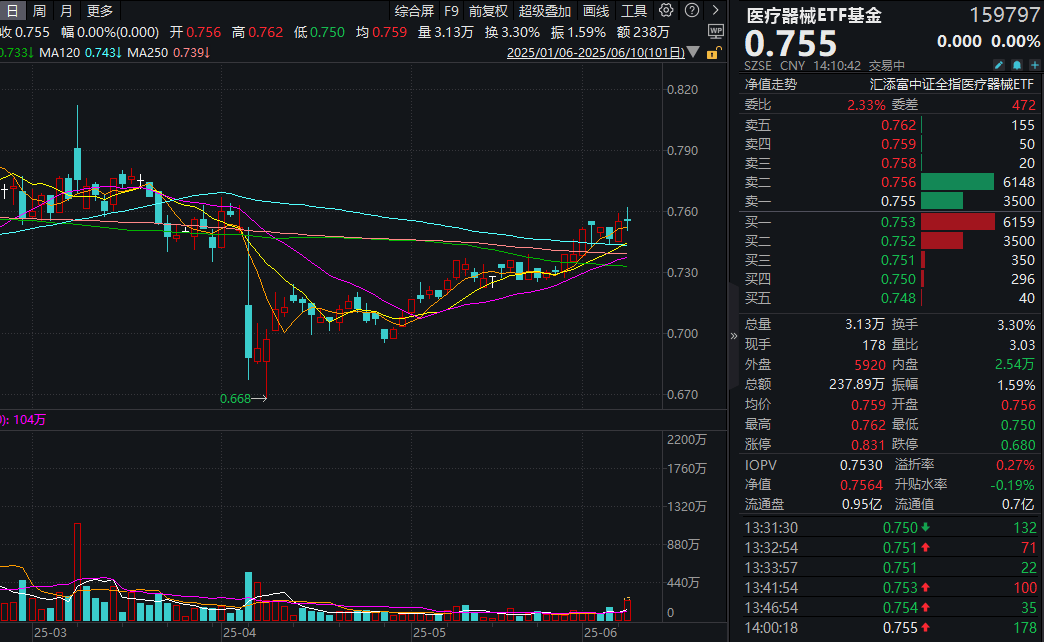
医疗器械再迎政策机遇!费率更低的医疗器械ETF基金(159797)震荡“吸金”!机构:业绩增速前低后高,下半年改善趋势明显!
Sou Hu Cai Jing· 2025-06-10 06:41
Group 1 - Medical device sector shows strong performance with ETF fund (159797) experiencing significant trading volume and net inflow of funds [1] - Recent policy document issued on June 9 aims to improve healthcare resources and insurance mechanisms, which is seen as a major driver for pharmaceutical companies [3] - Citic Securities predicts a trend of low-to-high earnings growth in the medical device sector, with significant improvements expected in the second half of the year [4] Group 2 - Structural investment opportunities exist within the medical device sector, with certain companies expected to achieve high growth in Q2 and Q3 [5] - The easing of US-China tariffs is beneficial for medical device companies, potentially lowering production costs and expanding overseas market share [6] - The medical device ETF fund (159797) covers core areas such as medical equipment and in vitro diagnostics, with top ten weighted stocks accounting for 46.78% [6][7]






关税缓和双机遇:CXO估值修复与医疗器械全球突围
Xiangcai Securities· 2025-05-13 11:34
Investment Rating - The report maintains a "Buy" rating for the healthcare services industry [6]. Core Insights - The easing of tariffs between China and the U.S. is expected to lead to a valuation recovery for the CXO sector, which has been under pressure due to previous tariff escalations [2]. - The tariff relief is anticipated to lower production costs for medical devices, enhancing competitiveness in overseas markets, particularly in the U.S. [3]. - The report suggests that domestic companies in the medical device sector are well-positioned to capture market opportunities in the U.S. due to increased demand for cost-effective products [3]. Summary by Sections CXO Sector - The impact of U.S.-China tariffs on the CXO sector is complex, with CRO services not directly affected by tariffs but facing uncertainty regarding future tariff increases [2]. - CDMO companies are also navigating complex influences, as their clients are often multinational firms with production bases outside the U.S., allowing them to mitigate tariff impacts [2]. Medical Devices - Domestic companies have made significant advancements in high-end medical equipment and diagnostics, gradually replacing imports [3]. - The tariff easing is expected to stabilize supply chain costs and improve the global market competitiveness of Chinese medical device manufacturers [3]. - There are specific opportunities in the U.S. market, particularly in price-sensitive segments and high-end equipment, where reduced tariffs could facilitate market entry [3]. Investment Recommendations - The report recommends focusing on companies with significant exposure to overseas CRO and CDMO markets, such as WuXi AppTec, and those with substantial U.S. sales in medical devices, like Yihua Jaye [4]. - Companies with strong international expansion capabilities, such as Aihua Long and Shengxiang Biology, are also highlighted as potential investment opportunities [4].