保妥适

Search documents
仲裁利好下,爱美客也难“翻身”
虎嗅APP· 2026-01-31 13:30
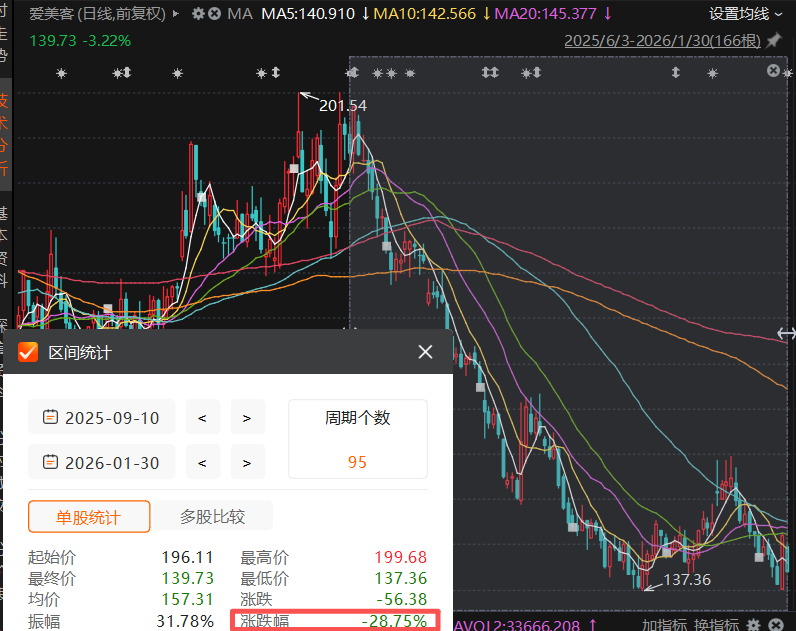
Core Viewpoint - The recent arbitration decision allows REGEN, a subsidiary of Aimeike, to sell AestheFill products in mainland China, but this is not a final ruling, and the ongoing dispute over distribution rights remains uncertain [2][8][20]. Group 1: Arbitration and Market Impact - Aimeike's subsidiary REGEN received a procedural decision from the Shenzhen International Arbitration Court, lifting a temporary measure that previously restricted its sales of AestheFill products in mainland China [2][8]. - Since the initial temporary measure was imposed on September 10, 2025, Aimeike's stock price has dropped nearly 30% [3]. - The arbitration dispute began after Aimeike acquired 85% of REGEN for $190 million in March 2025, leading to REGEN unilaterally terminating its exclusive distribution agreement with Dato Medical [6][8]. Group 2: Business Performance - Aimeike has faced a decline in revenue and profit for four consecutive quarters, with Q1-Q3 2025 revenues of 663 million, 636 million, and 566 million yuan, representing year-on-year declines of 17.90%, 25.11%, and 21.27% respectively [11]. - The decline in revenue is attributed to a weakened consumer confidence due to macroeconomic conditions and increased competition in the medical aesthetics industry [14][15]. - Aimeike's main revenue sources, solution and gel injection products, saw significant revenue drops, with total income from these products falling from 9.76 billion yuan in 2024 to 7.44 billion yuan in 2025 [15][16]. Group 3: Future Outlook - The AestheFill product, despite its potential, is expected to contribute only around 300 million yuan in annual sales, which may not significantly offset the revenue decline from Aimeike's core products [17]. - The competitive landscape for botulinum toxin products is also challenging, with established players dominating the market, making it difficult for Aimeike to gain market share with newly approved products [18]. - Overall, Aimeike is likely to continue facing significant performance pressures into 2026, despite the short-term positive impact of the arbitration decision [19][20].

仲裁利好下,爱美客也难“翻身”
Hu Xiu· 2026-01-31 09:16
Core Viewpoint - The arbitration decision to lift the temporary sales restriction on AestheFill products by REGEN, a subsidiary of Aimeike, is seen as a short-term positive development, but the underlying dispute over distribution rights remains unresolved, indicating potential volatility in the company's stock performance [1][4][14]. Group 1: Arbitration and Sales Rights - REGEN received a decision from the Shenzhen International Arbitration Court on January 29, 2025, which lifted a temporary measure that prohibited the sale of AestheFill products in mainland China [1]. - The temporary measure was initially imposed following REGEN's unilateral termination of its exclusive distribution agreement with Dato Medical, which claimed that Dato had transferred its distribution rights to a related party, violating the agreement [3][4]. - The arbitration decision is procedural and not a final ruling, meaning the dispute over the legality of REGEN's termination of the distribution rights is still ongoing [4]. Group 2: Financial Performance - Aimeike has experienced a decline in both revenue and profit for four consecutive quarters, with Q1-Q3 2025 revenues reported at 663 million, 636 million, and 566 million yuan, reflecting year-on-year decreases of 17.90%, 25.11%, and 21.27% respectively [5][6]. - The company's core products, including solution and gel injection products, saw significant revenue drops, with total income from these categories falling from 9.76 billion yuan in 2024 to 7.44 billion yuan in 2025 for solution products, and from 6.49 billion yuan to 4.93 billion yuan for gel products [9][10]. - The competitive landscape has intensified, with new entrants in the aesthetic medicine market impacting Aimeike's profit margins and market share [8][9]. Group 3: Future Outlook - The introduction of AestheFill is expected to provide some revenue support, but its annual sales of approximately 300 million yuan may not be sufficient to offset the significant revenue declines from Aimeike's core products [10][11]. - The company faces challenges in gaining market share for newly approved products, such as botulinum toxin, due to established competitors dominating the market [12][13]. - Overall, Aimeike is likely to continue facing substantial performance pressures into 2026, with the recent arbitration decision providing only a temporary boost [14].
爱美客还能赶上肉毒素“末班车”吗?
Xin Lang Cai Jing· 2026-01-09 14:17
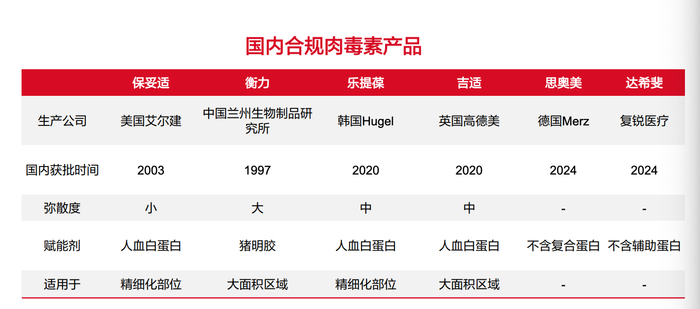
Core Viewpoint - Aimeike has received approval for its injectable type A botulinum toxin product, marking its first such product and the seventh in China, indicating a strategic expansion into the botulinum toxin market [1][2]. Group 1: Product Development and Market Position - Aimeike's foray into botulinum toxin began in 2021 with the acquisition of a 25.42% stake in Huons BioPharma for 856 million yuan [1]. - The newly approved product is positioned as a conventional offering in a market already populated by six established competitors, including Allergan's Botox and domestic brands like Hengli and LeTibao [2][4]. - The approval of Aimeike's botulinum toxin product is seen as a potential third growth driver for the company, although its market differentiation remains uncertain [2][5]. Group 2: Competitive Landscape - The competitive landscape for botulinum toxin products is characterized by established players with clear differentiation and market positioning, making it challenging for Aimeike to carve out a unique space [5][6]. - Aimeike's pricing strategy will significantly influence its market performance, as it may need to align closely with mainstream market prices to achieve sales targets [6][7]. - The existing products in the market have established brand loyalty and clinical advantages, particularly Allergan's Botox, which dominates the high-end market with multiple approved indications [6][7]. Group 3: Financial Performance and Market Trends - Aimeike's core products, including Hyaluronic Acid and PLLA-based fillers, have experienced slowing growth, reflecting increased competition in the aesthetic medicine sector [7][10]. - The revenue from Aimeike's Hyaluronic Acid products is projected to decline, with a significant drop of 23.79% expected in the first half of 2025 [13]. - The market for aesthetic injectables is becoming increasingly competitive, with over 40 brands of hyaluronic acid products approved in China, leading to price pressures and declining profit margins [18][19].
轻医美重塑行业发展生态
Zheng Quan Ri Bao Wang· 2025-11-28 07:41
Group 1 - China has become the second-largest medical beauty market globally, with a current penetration rate of only 4.5%, indicating significant growth potential compared to other developed countries [1] - The "light medical beauty" segment is reshaping the industry ecosystem due to its core advantages of low risk, short recovery time, and high frequency [1] Group 2 - The upstream consumables and equipment sector has high barriers to entry, with a focus on the development and manufacturing of injectables, energy-based devices, and biomaterials, which are core high-margin segments of the industry [2] - From early 2024 to July 2025, 43 Class III injectable products, 2 types of botulinum toxin, and 22 types of phototherapy devices have been approved in China, indicating a significant acceleration in product approvals [2] - The market for recombinant collagen is expected to exceed 40 billion yuan in 2024 and reach 58.57 billion yuan in 2025, while the market for "童颜针" (youthful needle) is projected to grow from 500 million yuan in 2021 to 4.2 billion yuan in 2025, a 740% increase [2] Group 3 - Companies like 四环医药 (Sihuan Pharmaceutical) are rapidly rising due to their technological advantages, having developed products like "童颜针" and "少女针," which have received Class III medical device registration [3] - 四环医药 has become the only domestic company to hold compliant registrations for both "童颜针" and "少女针," and has secured exclusive agency rights for a collagen-based product in mainland China [3] Group 4 - The current market is dominated by a few companies that can consistently obtain Class III medical device certifications, creating a concentrated oligopoly [4] - In 2025, 80% of newly approved products are expected to come from companies with Class III device qualifications, leading to a market environment where small institutions are rapidly exiting [4] - The emergence of new materials like agarose and hydroxyapatite marks a shift towards ingredient diversification, while the rise of regenerative materials signifies a transition from "filling" to "tissue regeneration" [4] Group 5 - The trend is accelerating the concentration of resources towards leading companies with R&D systems, clinical teams, and compliance capabilities, indicating an irreversible trend towards specialization and compliance in the industry [5]
深圳鹏爱医疗美容医院举办20周年庆典 聚焦医美行业健康发展
Zhong Zheng Wang· 2025-10-19 06:45
Core Insights - Shenzhen Pengai Medical Aesthetic Hospital celebrated its 20th anniversary, coinciding with the 45th anniversary of the Shenzhen Special Economic Zone, highlighting its growth alongside the city's development [1][2] - The hospital aims to continue advocating for "three regulations, safe beauty" and to enhance its medical technology and service details, focusing on lifecycle management of aesthetic services [1] - The "Shangxing Aesthetics" project was launched in collaboration with Aimeike, emphasizing a positive spirit and cultural significance beyond mere external beauty [2] Company Development - The celebration included participation from over 40 supply chain enterprises, showcasing Pengai's resource integration capabilities within the medical aesthetics industry [2] - The hospital's general manager, Pan Yousheng, reflected on the growth from inception to becoming a regional benchmark, emphasizing a commitment to safety and quality in aesthetic services [1][2] - A recognition ceremony was held for employees with over 15 years of service, underscoring the company's appreciation for long-term dedication [2] Future Strategy - Pengai Hospital views its 20th anniversary as both a milestone and a new starting point, pledging to drive progress in the Chinese medical aesthetics industry with a focus on customer-centricity and technological support [2] - The company aims to collaborate with excellent partners to create a more brilliant future in the next twenty years [2]
研判2025!中国肉毒素行业发展历程、产业链、发展现状、竞争格局及发展趋势分析:在颜值经济与医疗需求的双重驱动下,肉毒素行业市场需求持续上涨[图]
Chan Ye Xin Xi Wang· 2025-06-13 01:26
Core Viewpoint - The botulinum toxin industry in China is experiencing rapid growth, with the market size projected to increase from 1.9 billion yuan in 2017 to 9.9 billion yuan by 2024, reflecting a compound annual growth rate (CAGR) of 26.6% [1][13]. Industry Overview - Botulinum toxin, originally used for treating muscle spasms, has become a popular choice in medical aesthetics due to its minimal invasiveness and quick recovery time [3][13]. - The application range of botulinum toxin is expanding beyond traditional uses like wrinkle reduction and facial slimming to include treatments for conditions such as migraines and muscle tension disorders [1][13]. Market Dynamics - The medical aesthetics market in China is projected to reach 288 billion yuan by 2024, with a year-on-year increase of 8.03%, indicating a growing consumer demand for beauty enhancement services [11][13]. - The market is characterized by a "six-way split" among leading products, with brands like Botox, Hengli, and Letyb gaining significant market shares [15][17]. Competitive Landscape - The botulinum toxin market is competitive, with established companies like Fosun Pharma, Haohai Biological Technology, and Lanzhou Biological Products Research Institute leading the industry [17][18]. - New entrants are emerging, leveraging innovative technologies and marketing strategies to capture market share [17]. Development Trends 1. **Increasing Industry Penetration** - As living standards rise, the penetration rate of medical aesthetics is expected to increase, particularly in lower-tier cities and rural areas, driven by a younger consumer base [23]. 2. **Enhanced Regulatory Oversight** - The government is intensifying regulations on botulinum toxin production and distribution to ensure safety and quality, which will promote the healthy development of the market [24]. 3. **Rise of Recombinant Botulinum Toxin** - Recombinant botulinum toxin is anticipated to become a future trend due to its lower biological risks, higher purity, and production efficiency, addressing limitations of traditional products [25].


AbbVie:突破 Humira 专利壁垒,即将迎来蓬勃发展
美股研究社· 2025-04-10 11:29
Core Viewpoint - AbbVie has shown resilience in its financial performance despite facing challenges from the loss of exclusivity of its blockbuster drug Humira, with strategic acquisitions and strong growth in other product lines [1][17]. Group 1: Financial Performance - AbbVie’s stock price increased by 16% since November 2023, outperforming the S&P 500 index which returned 9.41% [1]. - Humira's revenue peaked at $21 billion in 2022 but is projected to decline by approximately 38% in 2024 to $8.993 billion due to the entry of biosimilars [2]. - The total revenue for AbbVie in Q4 was $15.1 billion, reflecting a year-over-year growth of 6.1% [6]. Group 2: Product Performance - AbbVie’s immunology drugs, Skyrizi and Rinvoq, have compensated for Humira's losses, with Skyrizi's revenue expected to reach $11.718 billion in 2024, a 50.9% increase, and Rinvoq's revenue projected at $5.971 billion, a 50.5% increase [4]. - The oncology segment, represented by Imbruvica, is facing competition, leading to a revenue decline of 6.9% to $3.347 billion in 2024, but Venclexta and Elahere are showing strong growth [5]. - AbbVie’s neuroscience efforts are yielding a 16.6% growth, driven by Botox Therapeutic and Vraylar [6]. Group 3: Strategic Acquisitions - AbbVie acquired ImmunoGen for $10 billion, enhancing its oncology portfolio with the ADC drug Elahere, approved for platinum-resistant ovarian cancer [1]. - The company also invested $8.7 billion in Cerevel Therapeutics, focusing on neuroscience products [1]. Group 4: Financial Guidance and Valuation - AbbVie adjusted its 2025 earnings guidance, projecting adjusted diluted EPS between $11.99 and $12.19, with a negative impact from acquired IPR&D expenses [7]. - The company maintains a stable operating cash flow between $18 billion and $22 billion annually, providing liquidity and leverage [8][9]. - A discounted cash flow analysis suggests AbbVie is undervalued by approximately 10% based on historical free cash flow margins [11]. Group 5: Market Outlook - AbbVie forecasts that total revenue from Rinvoq and Skyrizi will exceed $31 billion by 2027, indicating a compound annual growth rate of about 21% [4]. - The company’s strong cash generation capabilities and strategic positioning in immunology and oncology suggest a positive outlook despite challenges [17].