
数字产业化

Search documents
中国数字经济核心产业5年增长6万亿
第一财经· 2026-03-26 15:35
Core Viewpoint - The digital economy in China is increasingly supporting economic growth, with its share of GDP rising significantly during the "14th Five-Year Plan" period, indicating its foundational and pillar role in the national economy [3][5]. Digital Economy Growth - The core industries of the digital economy are projected to grow from approximately 8.1 trillion yuan to over 14.7 trillion yuan, with an average annual compound growth rate of 12.8%, surpassing the GDP growth rate during the same period [3][6]. - By 2025, the value added of the digital economy core industries is expected to account for over 10.5% of GDP, up from 7.8% in 2020 [5][6]. Industry Composition - In 2024, the value added of the digital economy core industries is anticipated to reach 14.1 trillion yuan, with the digital technology application sector contributing the largest share at 44.0% [6]. - The breakdown of the digital economy core industries in 2024 includes: - Digital technology application: 61,928 billion yuan (44.0%) - Digital product manufacturing: 48,145 billion yuan (34.2%) - Digital factor-driven: 26,519 billion yuan (18.8%) - Digital product services: 4,298 billion yuan (3.1%) [6]. Revenue and Growth Quality - The revenue scale of the digital industry is projected to reach 35.5 trillion yuan in 2024, with a nominal growth of 5.5%, outpacing the nominal GDP growth by 1.2 percentage points [7]. - The value added growth rate of the digital industry is expected to exceed revenue growth, indicating an improvement in development quality [7]. Digital Transformation and Cost Efficiency - Digitalization has shifted from extensive investment to a focus on investment efficiency, with digitalization contributing to a decrease in operational costs [14]. - A 1% increase in digital investment leads to a 9.17% reduction in main business cost rates, enhancing profit margins by 6.71% [14][15]. Data as a Key Variable - The report emphasizes that data has become a critical variable influencing future development, necessitating enhanced data circulation and quality [19]. - The "14th Five-Year Plan" aims to leverage China's rich data resources and comprehensive industrial system to stimulate data potential and accelerate technological innovation [19].


促进实体经济和数字经济深度融合:思考与建议|金融与科技
清华金融评论· 2026-02-18 08:42
Core Viewpoint - The integration of the real economy and digital economy is a strategic choice to gain an advantage in international competition and is essential for building a modern industrial system and achieving high-quality development during the 14th Five-Year Plan period [4]. Group 1: Understanding the Integration of Real and Digital Economies - The integration has evolved from conceptual discussions and isolated technological applications to systemic changes in labor processes, organizational forms, and industrial models, characterized by a shift from physical overlap to chemical reactions [6]. - The strong penetration of digital economy, driven by the development and application of digital technologies, allows for comprehensive integration with the real economy, leading to transformations in production factors, labor processes, and industry boundaries [6]. - Digital economy encompasses two main pillars: digital industrialization and industrial digitalization, both of which are deeply intertwined with the real economy [7]. Group 2: Strategic Significance of Integration - The deep integration of the real and digital economies will unleash the potential of domestic demand in various ways, including upgrading consumption supply, precise matching of supply and demand, and driving investment through digital infrastructure projects [10]. - The 14th Five-Year Plan period is crucial for achieving socialist modernization, and the integration of these economies is not merely about industrial collaboration but is closely related to national interests [10].

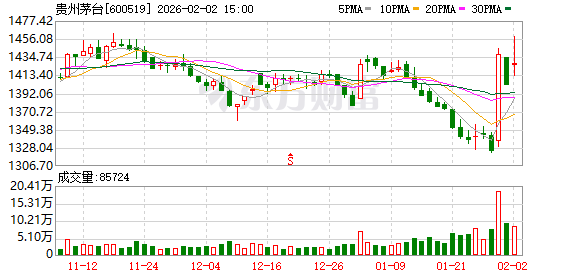
i茅台1月新增用户628万 飞天茅台成交订单超143万笔
Mei Ri Jing Ji Xin Wen· 2026-02-02 14:59
Core Insights - The "iMoutai" platform reported significant user growth and sales performance since its launch on January 1, with 6.28 million new users and over 15.31 million monthly active users [2] - A total of 1.45 million consumers purchased products, resulting in over 2.12 million transactions, with the flagship product, Flying Moutai, accounting for over 1.43 million orders [2] - The platform has implemented measures to enhance service efficiency, including expanding customer service teams and introducing AI support systems [3][4] User Growth and Sales Performance - iMoutai added 6.28 million new users in the past month, reaching over 15.31 million monthly active users [2] - More than 1.45 million consumers purchased products, leading to over 2.12 million transactions [2] - The sales volume of Flying Moutai is estimated to be between 143,000 to 942,000 bottles, translating to approximately 670 to 4,400 tons of product sold [2] Operational Enhancements - The platform intercepted 4.26 billion abnormal activities from January 1 to 29, with a total of 5.4 billion interceptions reported for the entire month of January [3] - New warehouses in Nanjing and Beijing have been established to reduce logistics time, with 75% of orders being delivered within five days [3] - Over 106,300 consumers have completed in-store pickups, indicating a steady progress in offline delivery [3] Company Strategy and Future Directions - The newly established Guizhou Ai Moutai Digital Technology Co., Ltd. aims to focus on digital transformation and enhance operational capabilities [4] - The company emphasizes the importance of aligning with market demands and improving platform operations to lead market reforms [4] - A collaborative approach is encouraged to foster a win-win ecosystem for Moutai's overall development [4]

别焦虑,AI是助手不是对手
Xin Hua Ri Bao· 2026-02-01 20:45
Group 1 - The core viewpoint is that AI is increasingly being adopted across various industries, with companies implementing AI as a standard practice to enhance efficiency and productivity [1][2] - Companies like Che300 are adopting an "AI for all" strategy, incentivizing employees to utilize AI tools, which is seen as essential for organizational growth [1] - AI is viewed as an assistant rather than a competitor, emphasizing the importance of human oversight in effectively leveraging AI capabilities [1][3] Group 2 - The application of AI is seen as a transformative force in bridging the digital divide for small and medium enterprises, enabling them to access advanced technologies at lower costs [4] - Companies are exploring innovative AI solutions, such as virtual digital employees and intelligent agents, to streamline operations and enhance service delivery [4] - The emergence of large models in AI is facilitating cost reduction and efficiency improvements for government and enterprise sectors, making digital transformation more achievable [4]
中经评论:协同推进数字产业化和产业数字化
Sou Hu Cai Jing· 2026-01-29 23:39
Group 1 - The digital industry has become a crucial carrier for developing new productive forces, with projected revenue of approximately 38.3 trillion yuan and profits of 3.1 trillion yuan by the end of 2025 [1] - The digital industry is characterized by its resilience, showing growth even during economic downturns, and plays a significant role in stabilizing overall economic development [1][2] - By 2025, the revenue and profit of China's digital industry are expected to grow by approximately 39.5% and 48.4% respectively compared to the end of the 13th Five-Year Plan [2] Group 2 - The digital industry serves as a "connector" between digital technology innovation and the transformation needs of the real economy, facilitating the digital transformation of traditional industries [2][3] - The integration of digital technology into various sectors, including manufacturing, services, and agriculture, is accelerating, with a focus on creating a mature digital application ecosystem [3] - The collaboration between digital industrialization and industrial digitalization is essential, as one provides the technological foundation while the other offers practical application scenarios [3][4] Group 3 - Strengthening digital industrialization involves increasing investment in core technology research and expanding the scale of the digital industry to enhance supply capabilities [4] - Deepening industrial digitalization requires identifying transformation needs across various sectors and creating typical application scenarios tailored to different industry characteristics [4] - The continuous advancement of both digital industrialization and industrial digitalization is expected to inject stronger digital momentum into the Chinese economy, promoting high-end, intelligent, and green manufacturing [4]
协同推进数字产业化和产业数字化
Jing Ji Ri Bao· 2026-01-29 22:15
Core Insights - The synergy between digital industrialization and industrial digitalization is essential for stimulating new momentum in the economy [1][4] - Digital industries are projected to generate approximately 38.3 trillion yuan in revenue and 3.1 trillion yuan in profit by the end of 2025, reflecting significant growth and resilience [1][2] - The digital industry serves as a critical driver of new productive forces, with a notable counter-cyclical property that stabilizes economic growth during downturns [1][2] Digital Industry Growth - By 2025, China's digital industry revenue and profit are expected to increase by approximately 39.5% and 48.4%, respectively, compared to the end of the 13th Five-Year Plan (2020) [2] - Key provinces such as Guangdong, Jiangsu, Beijing, Zhejiang, and Shanghai contribute over 90% to the national growth in digital industry revenue [2] - The digital industry is enhancing its innovation capabilities, acting as an "accelerator" for new economic drivers [2] Digital Technology Integration - The digital industry acts as a "connector" between digital technology innovation and the transformation needs of the real economy, facilitating a two-way channel for technological implementation and industrial upgrading [2][3] - The integration of digital technologies into core manufacturing processes is leading to improved quality, reduced costs, and increased efficiency [2] - The establishment of multi-layered, systematic industrial internet platforms is underway, covering all major industrial categories [2] Industrial Digitalization - Industrial digitalization is defined as the application of digital technologies to enhance various sectors, including manufacturing, services, and agriculture [3] - The rapid adoption of digital applications in the consumer internet sector has laid a strong foundation for further penetration into the industrial sector [3] - The collaboration between digital industrialization and industrial digitalization is crucial for overcoming technological bottlenecks and ensuring sustainable commercial returns [3][4] Future Outlook - Continued collaboration between digital industrialization and industrial digitalization is expected to inject stronger digital momentum into the Chinese economy [4] - This deep integration is anticipated to further solidify the foundation of the digital economy and drive the transformation of Chinese manufacturing towards higher-end, intelligent, and green development [4]
“十四五”期间新能源车制造同比增长14.3%
Xin Lang Cai Jing· 2026-01-29 09:25
Group 1 - The core viewpoint of the article highlights the significant growth in various sectors of China's economy during the "14th Five-Year Plan" period, indicating a shift towards high-quality development and innovation [1][2] Group 2 - The sales revenue of the equipment manufacturing industry has an average annual growth rate of 9.1%, with a projected 7.4% year-on-year growth in 2025, accounting for 47.7% of the manufacturing sector, an increase of 4.7 percentage points from 2021 [1] - High-tech industries show an average annual sales revenue growth of 13.9%, with a projected 13.9% year-on-year growth in 2025, and high-tech manufacturing and services expected to grow by 10.1% and 16.6% respectively [1] - The digital economy's core industries have an average annual sales revenue growth of 10.5%, with a projected 9.4% year-on-year growth in 2025, and enterprise procurement of digital technologies growing by 11.2% [2] - The new energy vehicle industry maintains a leading advantage with an average annual sales revenue growth of 49.5%, and a projected 14.3% year-on-year growth in 2025 [2] - The sales revenue from clean energy generation, including wind, solar, and nuclear, has an average annual growth of 13.9%, with a projected 17.3% year-on-year growth in 2025, making up 38.5% of total electricity production revenue, an increase of 6.9 percentage points from 2021 [2] - Inter-provincial trade sales as a percentage of total sales increased from 38.6% in 2021 to 41% in 2025, with 57.6% of tax-related business entities involved in cross-province sales by 2025 [2]
“十四五”期间,我国数字经济核心产业销售收入年均增长10.5%
Ren Min Wang· 2026-01-29 06:49
Core Insights - The core viewpoint of the article highlights the continuous acceleration of digital industrialization and industrial digitalization in China, as evidenced by significant growth in the digital economy's core industries and enterprise procurement of digital technologies during the "14th Five-Year Plan" period [1] Group 1: Digital Economy Growth - The sales revenue of the digital economy's core industries has an average annual growth rate of 10.5% during the "14th Five-Year Plan" period [1] - The procurement of digital technologies by enterprises has an average annual growth rate of 11.2% [1] Group 2: 2025 Projections - In 2025, the sales revenue of the digital economy's core industries is projected to grow by 9.4% year-on-year [1] - The amount spent by enterprises on digital technology procurement is expected to increase by 9.6% year-on-year, with the manufacturing sector showing a notable increase of 10.4% [1]
税收数据显示:“十四五”期间全国数字经济核心产业销售收入年均增长10.5%
Di Yi Cai Jing· 2026-01-28 07:29
Core Insights - The core sales revenue of the digital economy's key industries is projected to grow at an average annual rate of 10.5% during the 14th Five-Year Plan period [1] - The procurement of digital technologies by enterprises is expected to increase at an average annual rate of 11.2%, indicating a sustained acceleration in both digital industrialization and industrial digitalization [1] Summary by Category - **Sales Revenue Growth** - By 2025, the sales revenue of the digital economy's core industries is anticipated to increase by 9.4% year-on-year [1] - **Enterprise Procurement of Digital Technologies** - The total amount spent by enterprises on digital technologies is expected to rise by 9.6% year-on-year, with the manufacturing sector showing a notable increase of 10.4% in procurement [1]
2025年数字经济核心产业销售收入同比增长9.4%
Jing Ji Guan Cha Wang· 2026-01-27 03:06
Core Insights - The integration of digital technology with the real economy is deepening, as indicated by tax data analysis from the State Taxation Administration [1] Group 1: Digital Economy Growth - By 2025, the sales revenue of the core industries of the digital economy is expected to grow by 9.4% year-on-year [1] - The digital product manufacturing industry and digital technology application sectors are projected to grow by 9.4% and 13.8% year-on-year, respectively, reflecting the rapid development of digital industrialization [1] Group 2: Digital Technology Procurement - In 2025, the amount spent by enterprises on procuring digital technology is anticipated to increase by 9.6% year-on-year [1] - Specifically, the manufacturing sector's expenditure on digital technology procurement is expected to rise by 10.4% year-on-year, indicating an upgrade in industrial digitalization [1]