信用违约互换(CDS)

Search documents
软银CDS走阔、乐天趋稳:债务压力与AI押注分化市场情绪
Zhi Tong Cai Jing· 2025-11-27 08:53
Group 1 - The core viewpoint of the articles highlights that SoftBank Group's credit default swap (CDS) spreads have risen to their highest level since April, reflecting investor caution towards the company's debt-driven growth model amid increasing global competition [1] - SoftBank has been funding various AI projects, including collaborations with OpenAI and Oracle, and its five-year CDS rose to approximately 302 basis points, up from about 280 basis points the previous day [1] - The company is intensifying its fundraising activities, having set terms for issuing 500 billion yen (approximately 3.3 billion USD) in retail bonds with a coupon rate of 3.98%, with part of the proceeds aimed at repaying bridge loans related to its investment in OpenAI [1] Group 2 - In contrast, Rakuten Group has been reducing its debt burden to improve its credit profile, resulting in a moderate narrowing of its CDS spreads, which decreased from around 250 basis points in August to approximately 200 basis points recently [1] - The CEO of Fujiwara Capital noted that the rise in SoftBank's CDS may reflect market pricing factors, including declines in AI-related stocks, ongoing bond issuances by the company, and concerns over its concentrated investment in OpenAI [1]

“伦敦鲸”杀手再出手!AI泡沫论甚嚣尘上,传Saba基金出售甲骨文、微软等巨头CDS
Zhi Tong Cai Jing· 2025-11-18 12:21
Core Insights - Saba Capital Management has sold credit derivatives linked to major tech companies like Oracle and Microsoft due to concerns over risks associated with debt financing in the AI investment boom [1] - The demand for credit default swaps (CDS) from banks indicates a growing concern about potential losses in the tech sector, particularly as companies accumulate significant debt for AI projects [3] Group 1: Market Dynamics - The current market is eager to hedge against the rising valuations and increasing debt burdens of AI companies, with fears that a potential bubble could lead to a significant market correction [3] - Saba's sale of CDS for these tech companies marks a first for both the hedge fund and the banks seeking such protection [3] Group 2: Financial Metrics - Oracle's five-year CDS spread recently exceeded 105 basis points, while Alphabet and Amazon's CDS spreads are around 38 basis points, and Microsoft's is approximately 34 basis points [4] - The issuance of investment-grade bonds in the tech sector has surged, with the volume in September and October reaching over twice the annual average [5] Group 3: Investor Sentiment - Despite the increase in CDS prices for major tech companies, analysts note that the current levels remain lower than those of some investment-grade companies in other sectors [4] - There is a sentiment among some investment strategists that the best shorting opportunities lie within the corporate bonds of large AI companies [5]


大家又想起了次贷危机
Sou Hu Cai Jing· 2025-11-17 12:08
Group 1 - The current market is facing two main issues: the Federal Reserve's measures to address structural pressures in the money market and the risk hedging demands arising from the massive financing wave among AI giants [1] - A key indicator, the tri-party repo rate, has repeatedly breached the Federal Reserve's target range, indicating localized liquidity shortages within the financial system, primarily due to the Fed's quantitative tightening policy [2][3] - Companies are increasingly turning to the bond market for financing, particularly in the tech sector, as they seek to raise capital for AI investments despite having strong cash flows [4][5] Group 2 - The demand for new corporate bonds is high, but the widening credit spreads indicate that investors are seeking higher risk premiums, reflecting growing concerns about credit risk [5] - The trading volume of credit default swaps (CDS) related to Oracle surged from $200 million to approximately $4.2 billion year-on-year, highlighting a significant increase in risk hedging activity [6] - The focus has shifted to tech companies, with banks being the largest buyers of CDS as they seek to hedge against rising credit risks in the sector [7] Group 3 - The balance between technological revolution and financial market dynamics is crucial, with the Federal Reserve needing to find equilibrium between monetary pressures and available tools [8] - The long-term implications of government debt and corporate bond expansion driven by AI investments pose significant risks to the global financial system [8]
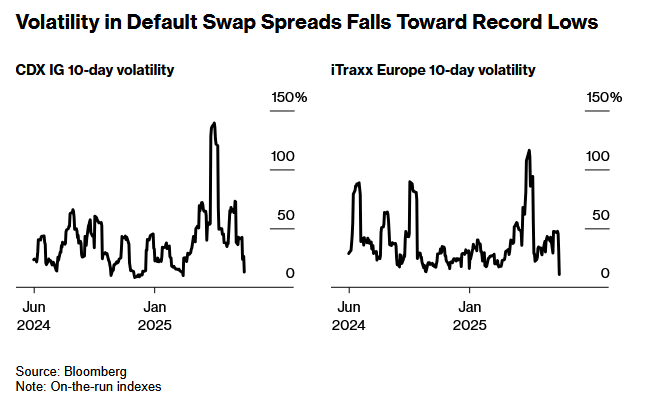
投资者谨慎观望 信贷市场波动率逼近历史低点
智通财经网· 2025-06-10 12:37
Group 1 - The credit market is experiencing low volatility, with North American corporate credit default swap (CDS) price fluctuations dropping nearly three-quarters, approaching historical lows [1][3] - Fund managers are adopting a cautious approach, avoiding increased risk exposure until U.S. tariff policies become clearer, leading to a stabilization in risk premiums [3][4] - Despite the low volatility, major banks' bond traders are preparing for potential market turbulence, indicating that future macroeconomic news could impact corporate fundamentals and investor risk appetite [4] Group 2 - The global corporate bond spread has returned to levels seen before the "liberation day" comments by Trump in April, reflecting a relatively tight market environment [3] - There are no fundamental reasons for a large-scale credit sell-off, and no specific industry is in clear distress, suggesting a different environment compared to previous cycles [3] - Investors are bracing for potential increases in volatility due to upcoming events such as the G7 meeting and the July 9 tariff deadline set by the Trump administration [4]