银行卡收单业务

Search documents
第三方支付行业收到新年首张千万元级罚单
Zheng Quan Ri Bao· 2026-01-20 16:47
Core Viewpoint - Yinsheng Payment has been fined over 15.84 million yuan for multiple violations, marking the first instance of a fine exceeding 10 million yuan in the third-party payment industry in 2026 [1] Group 1: Company Violations and Penalties - Yinsheng Payment was penalized for violating merchant management, clearing management, and account management regulations, resulting in a total fine of approximately 15.84 million yuan [1] - The company's chairman, Chen, was held accountable for these violations and received a warning along with a fine of 610,000 yuan [1] - This is not the first significant penalty for Yinsheng Payment; in March 2025, the company was fined approximately 3.24 million yuan for similar violations, and in March 2022, it faced a fine of about 22.45 million yuan for failing to comply with customer identity verification and transaction reporting requirements [2] Group 2: Industry Regulatory Environment - The payment industry has seen over 130 fines issued in 2025, including several exceeding 10 million yuan, indicating a trend of increasing regulatory scrutiny [2] - The regulatory environment is shifting towards a "precise classification and differentiated policy" approach, emphasizing strong regulation and zero tolerance for violations [3] - The "double penalty system" has become a fundamental enforcement principle, holding both institutions and responsible individuals accountable [3] Group 3: Challenges in Compliance - Common issues in the industry include a disconnect between governance and business operations, inadequate risk monitoring systems, and the rising costs of compliance versus pressure on profit margins [3] - The payment industry faces systemic governance issues, as highlighted by repeated violations despite significant penalties [2][3] Group 4: Future Regulatory Focus - Future regulatory priorities include differentiated management based on risk assessment, enhanced monitoring of cross-institutional and cross-border transactions, and stricter management of reserve funds and accounts [4] - There will be a focus on anti-money laundering obligations and the regulation of innovative financial technologies to ensure compliance and security [4]
商管、清算违规 嘉联支付被罚141万元
Bei Jing Shang Bao· 2025-12-09 15:44
Core Viewpoint - The recent fine imposed on JiaLian Payment highlights ongoing regulatory scrutiny in the payment industry, emphasizing the importance of compliance in merchant management and clearing processes [1][2][3] Group 1: Regulatory Actions - JiaLian Payment was fined 1.41 million yuan for violations related to merchant management and clearing regulations, with illegal gains of 1,293.91 yuan confiscated [1] - The company has previously faced penalties for similar violations, including a 2.99 million yuan fine in October 2023 for non-compliance in clearing management and merchant management [2] Group 2: Company Performance - JiaLian Payment processed approximately 721.8 billion yuan in transaction volume in the first half of the year, with revenue of 949 million yuan and a net profit of 88.5 million yuan [1] - As of the reporting period, the company had total assets of 2.356 billion yuan and net assets of 892 million yuan [1] Group 3: Industry Insights - The payment industry is facing challenges due to a focus on scale over compliance, leading to vulnerabilities in merchant management and clearing processes [3] - Regulatory changes, such as the "Non-Bank Payment Institutions Supervision Management Regulations," have imposed stricter requirements on merchant real-name systems and transaction authenticity, pushing companies to enhance their compliance frameworks [3][4] Group 4: Compliance and Risk Management - Companies in the payment sector need to improve their qualification review capabilities and establish robust security measures to prevent issues like cash-out and money laundering [4] - JiaLian Payment plans to adopt a risk-based approach to strengthen its compliance management and ensure a closed-loop control process for merchants [3]
支付行业三季度业绩透视:银行卡收单承压、跨境业务增长强劲
2 1 Shi Ji Jing Ji Bao Dao· 2025-12-03 05:37
Core Insights - The payment industry is experiencing a mixed performance, with some companies achieving revenue growth through diversified strategies while others face pressure from declining transaction volumes in card acquiring business [1][2][3] - The implementation of the 259 Document by the People's Bank of China is impacting transaction volumes, particularly in card acquiring, leading to a strategic shift towards cross-border payment services [1][5] Financial Performance - Haike Rongtong's parent company, Cuiwei Co., achieved a revenue of 1.71 billion yuan, a year-on-year increase of 0.86%, but reported a net loss of 311 million yuan [2] - Guotong Xingyi's parent company, Newland, reported a revenue of 6.244 billion yuan, a 12.04% increase, with a net profit of 937 million yuan, up 14.03% [2] - Lakala reported a revenue of 4.068 billion yuan, a decline of 7.32%, and a net profit of 339 million yuan, down 33.90% [3][4] Impact of Regulatory Changes - The 259 Document restricts card acquiring operations, leading to a decrease in transaction volumes and impacting revenue for many payment institutions [5] - The regulation aims to eliminate illegal practices in card acquiring, which has resulted in a contraction of transaction volumes across the industry [5] Growth in Cross-Border Payments - Cross-border payment services are emerging as a significant growth area for payment institutions, with companies like Lakala reporting a cross-border payment volume of 60.2 billion yuan, a year-on-year increase of 71.91% [6] - Newland's overseas payment device revenue grew over 26%, and the company is expanding its cross-border payment operations [6] - Companies are increasingly focusing on global market expansion, with Newland planning to issue H-shares to enhance its international strategy [6] Market Trends - The global payment market is projected to grow significantly, with offline payment volumes expected to exceed 42.6 trillion USD by 2027, indicating a robust demand for cross-border payment solutions [7] - The demand for localized payment solutions is rising as Chinese companies expand overseas, with significant growth in cross-border payment transaction volumes reported by various companies [8]

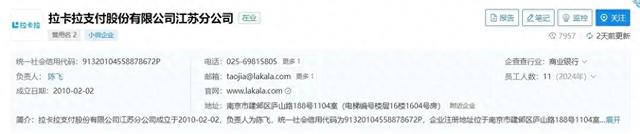
违反收单业务管理规定,拉卡拉江苏分公司被罚没超30万元
Guan Cha Zhe Wang· 2025-10-12 08:20
Group 1 - The People's Bank of China (PBOC) Jiangsu Branch announced administrative penalties against Lakala Payment Co., Ltd. Jiangsu Branch for violating acquiring business management regulations, resulting in the confiscation of illegal gains amounting to 61,423.7 yuan and a fine of 250,000 yuan [1] - Lakala Payment Co., Ltd. Jiangsu Branch was established on February 2, 2010, and operates in the business services industry. The parent company, Lakala Payment Co., Ltd., was founded in 2005 and went public on the Shenzhen Stock Exchange in April 2019 under stock code 300773 [1] - Recent changes in Lakala's shareholder structure include reductions in shareholding by Lenovo Holdings and Sun Haoran, with their respective holdings decreasing to 23.97% and 0%. The company stated that these changes will not affect its governance structure and control [1] Group 2 - Nanjing Citizen Card Payment Co., Ltd. received a warning and a fine of 85,000 yuan for violating prepaid card business management regulations [1] - The PBOC Tianjin Branch also announced a penalty against Tianjin Urban One Card Payment Co., Ltd. for violating prepaid card business management regulations, resulting in a fine of 30,000 yuan [2] - Prepaid cards, also known as single-purpose prepaid cards, are issued by enterprises in retail, accommodation, catering, and resident services sectors in China, and can only be redeemed for goods or services within the issuing enterprise or its affiliated group [2]