
儿童类微短剧

Search documents
把跑偏的儿童微短剧拉回来
Jing Ji Ri Bao· 2026-02-10 22:21
Core Viewpoint - The National Radio and Television Administration has issued a management notice for children's micro-dramas, aiming to curb the rising trends of "adultification," "utilitarianism," and "entertainment" in the industry, thereby protecting the mental and physical health of minors [1][2]. Group 1: Current Issues in Children's Micro-Dramas - There are three prominent distortions in the creation of children's micro-dramas: 1. Adultification, where some works intentionally create "manipulative" child characters and depict adult themes like "bullying," which contradicts the innocence and developmental needs of children [1]. 2. Utilitarian exploitation, where production companies lure families into investing heavily under the guise of "star-making" and subject children to excessive filming hours [1]. 3. Lowbrow entertainment, where some productions produce illogical and vulgar content under the pretense of humor, promoting a utilitarian growth mindset [1]. Group 2: Impact on Children and Society - Excessive work hours for child actors can harm their health and encroach on essential learning and rest time, potentially leading to psychological confusion and identity issues [2]. - The portrayal of "fame at a young age" and distorted values from "manipulative" characters can mislead young viewers' developing worldviews and values [2]. - This trend fosters a utilitarian parent-child relationship, viewing children as "investment products," which undermines family emotional foundations and could harm societal culture in the long run [2]. Group 3: Recommendations for Improvement - Addressing the issues in children's micro-dramas requires a collaborative governance system involving regulation, platforms, industry, and families [2]. - Regulatory bodies should move from general guidelines to detailed governance, establishing operational industry standards for child actors' working hours, filming content boundaries, and necessary psychological support [2]. - Content platforms must shift from a "traffic-first" approach to a "responsibility-first" model, optimizing recommendation algorithms to promote quality children's content while limiting low-quality and non-compliant content [2]. - Parents should adopt a rational mindset, resisting the urge to push children towards fame and prioritizing their mental and physical well-being [2][3].
儿童类微短剧,别走偏(微观)
Ren Min Ri Bao· 2026-02-05 22:25
Core Viewpoint - The article emphasizes the need for strict regulation and high-quality content creation in the children's micro-drama sector to protect minors while addressing the growing popularity and associated issues of such content [1][2][3]. Group 1: Industry Growth and Challenges - The micro-drama industry is expanding rapidly, with over 600 million users, leading to a rise in children's micro-dramas that often feature inappropriate themes [1]. - Children's performances attract viewers easily, allowing producers to save on costs and achieve efficient commercial returns through advertising and brand partnerships [1]. Group 2: Content Production and Ethical Concerns - Many micro-dramas exploit children by placing them in adult-themed narratives, which can confuse their understanding and hinder healthy development [2]. - There are significant concerns regarding the safety and well-being of child actors, with reports of excessive filming hours and inadequate safety measures [2]. Group 3: Regulatory and Collaborative Measures - A multi-faceted approach is necessary to protect minors, involving parents, online platforms, industry organizations, and regulatory bodies to create a comprehensive protection network [3]. - The "14th Five-Year Plan" suggests promoting healthy development in online literature, games, and audiovisual content while enhancing protections for minors [3].
强效规范儿童类微短剧创作传播
Xin Lang Cai Jing· 2026-02-02 21:08
Core Viewpoint - The current children's micro-short dramas exhibit significant issues of adultification, instrumentalization, and entertainment, leading to content that deviates from children's developmental needs and promotes vulgar storylines, exacerbated by algorithm-driven traffic, necessitating urgent regulatory reform [1] Group 1: Regulatory Recommendations - Establish a multi-faceted regulatory and educational guidance system, enhancing regulatory efforts through a cross-departmental enforcement mechanism to combat the production and dissemination of vulgar, violent, and utilitarian children's micro-short dramas [2] - Promote the formation of a self-regulatory alliance within the children's micro-short drama industry to create a self-regulatory charter, guiding creators to adhere to industry standards and accept social oversight [2] - Incorporate media literacy education into moral education curricula in schools to improve resistance to harmful information, while families must fulfill their guardianship responsibilities by guiding children's viewing of online content [2] Group 2: Content Classification and Creation Guidelines - Develop a scientific grading review and creation guideline mechanism, detailing grading standards based on children's cognitive development and physical growth characteristics, and implement a dual review system requiring creators to submit creative explanations for platform approval [2] - Publish a creative guideline manual led by industry authorities, outlining creation principles, content prohibitions, and quality case studies to guide creators in producing engaging and educational works [2] Group 3: Algorithm and Traffic Optimization - Scientifically optimize platform algorithms and traffic distribution systems by reconstructing recommendation logic to prioritize educational value, appropriate age, and production quality as core evaluation metrics [3] - Establish a special traffic pool for high-quality children's micro-short dramas to enhance their visibility, while providing parents with content filtering tools to set viewing permissions based on their children's ages, minimizing exposure to harmful micro-short dramas [3]
别让流量“啃小”!儿童微短剧该回归纯真了
Xin Jing Bao· 2026-01-09 07:30
Core Insights - The micro-short drama industry is experiencing explosive growth, with a market size exceeding 50 billion yuan, particularly in children's content featuring "cute kids" and "parent-child" themes, which have quickly become popular due to their "contrast cuteness" appeal [1] - However, this boom has led to concerning trends, including the adultification of children's dramas, which prioritize entertainment over the healthy development of minors, potentially causing cognitive confusion and psychological burdens [2][3] - The National Radio and Television Administration has issued management guidelines addressing three main issues in children's micro-short dramas: adultification, toolization, and entertainment-focused content, signaling a need for self-regulation and a return to appropriate creative standards [1][4] Industry Challenges - The adultification trend in children's micro-short dramas has led to narratives that include themes like "bullying" and "wealthy family conflicts," which disregard children's developmental needs and can mislead their understanding of reality [2] - Children are often treated as tools for various adult desires, leading to exploitative working conditions, such as long hours and early morning shoots, which compromise their education and well-being [3] Regulatory Response - The management guidelines set clear boundaries, prohibiting adult-themed content and the commercialization of children's roles, while encouraging the creation of age-appropriate stories [4] - A comprehensive regulatory approach is being implemented, including a tiered review system for micro-short dramas based on investment amounts, which aims to increase compliance costs and shift focus from chasing viral hits to producing quality content [4] Future Directions - The industry is expected to shift towards realistic and educational themes, moving away from sensationalized content, as the guidelines encourage stories that foster parent-child relationships and emotional education [5] - The responsibility for protecting children in the entertainment industry lies not only with regulators but also with parents and the industry itself, emphasizing the need for a collective effort to ensure a healthy content ecosystem for children [5][6]

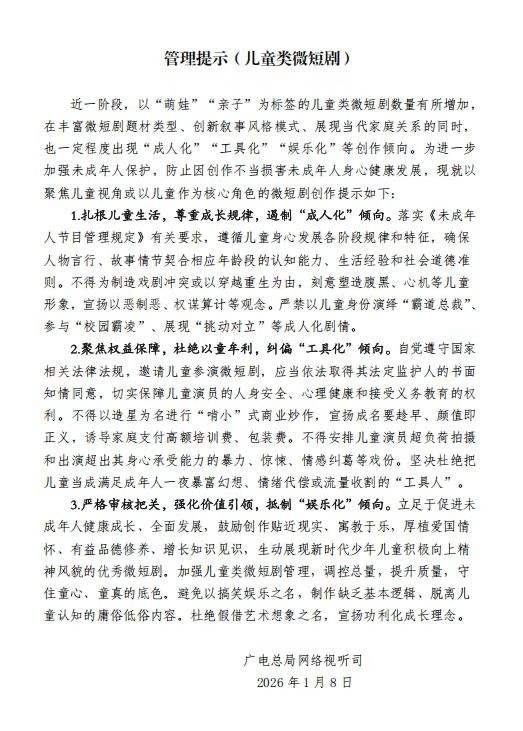
遏制儿童类微短剧“成人化”倾向
Xin Lang Cai Jing· 2026-01-08 23:08
Core Viewpoint - The National Radio and Television Administration (NRTA) has issued management guidelines for children's micro-dramas, emphasizing the need to curb adult-oriented tendencies, correct tool-like approaches, and resist entertainment-focused trends in content creation [1] Group 1: Content Creation Guidelines - Children's micro-dramas should not depict adult themes such as "overbearing CEOs," school bullying, or promote divisive narratives [2] - The creation of children's content must avoid using children as tools for adult fantasies, emotional compensation, or for generating traffic [2] - Content should not promote a utilitarian growth mindset under the guise of artistic imagination [2] Group 2: Production Standards - Children's micro-dramas must not engage in commercial exploitation under the pretext of stardom, nor should they encourage families to incur high training or packaging costs [1] - There should be strict limits on the workload of child actors, ensuring they do not perform in scenes that exceed their physical and emotional capacities [1] - The production of content should avoid low-quality, illogical, or vulgar material that is disconnected from children's understanding [1]
广电总局要求遏制儿童类微短剧“成人化”倾向
Xin Hua She· 2026-01-08 15:08
Core Viewpoint - The National Radio and Television Administration (NRTA) has issued management guidelines for children's micro-short dramas, emphasizing the need to curb adult-oriented tendencies, correct tool-like tendencies, and resist entertainment-oriented tendencies [1] Group 1 - The NRTA aims to address the "adultification" trend in children's programming [1] - The guidelines seek to rectify the "toolization" tendency, which may undermine the educational value of children's content [1] - There is a strong emphasis on resisting the "entertainmentization" trend that could distract from the primary purpose of children's programming [1]