先锋标普500 ETF

Search documents
韩元贬值背后:韩国散户狂买海外股票
Hua Er Jie Jian Wen· 2026-01-16 04:28
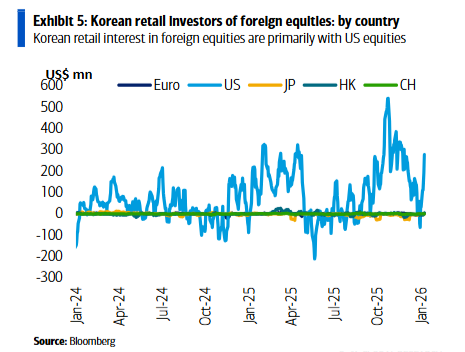
Core Viewpoint - The South Korean won experienced a brief rebound at the end of 2025 due to government intervention, but it quickly returned to a depreciation trend in early 2026, primarily driven by retail investors' renewed enthusiasm for foreign stocks, especially U.S. equities [1][3][15]. Group 1: Retail Investor Behavior - South Korean retail investors net purchased $2 billion in foreign stocks within the first ten days of 2026, indicating a significant outflow of capital that could not be offset by the country's trade surplus or U.S. Treasury concerns [3][10]. - The top stocks purchased by South Korean retail investors included Tesla ($452 million), Direxion's Tesla 2x leveraged ETF ($323 million), and Alphabet Class A shares ($195 million) [8][9]. - Retail investors have become the dominant force influencing the exchange rate, with their cross-border investment behavior deeply intertwined with the future trajectory of the won [3][4]. Group 2: Economic Indicators and Government Response - Despite a strong current account surplus of $12.2 billion as of November 2025, the outflow from retail investors, totaling $11 billion, significantly contributed to the financial account deficit [10][11]. - The South Korean government has attempted to support the won through verbal interventions and monetary support, but these measures have proven to be short-lived [15][17]. - A potential solution to stabilize the won could involve tax policy changes, such as reducing capital gains tax on foreign stock sales, which may encourage capital repatriation [17][18].

先锋标普500 ETF稳居第一大ETF位置——海外创新产品周报20250324
申万宏源金工· 2025-03-25 06:51
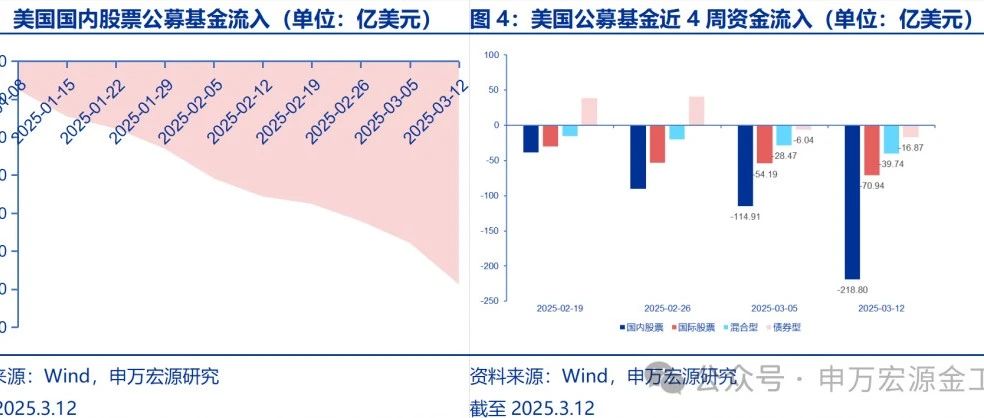
Group 1 - The core viewpoint of the article highlights the recent developments in the U.S. ETF market, particularly the introduction of innovative products such as the Solana futures ETF and the significant inflow of funds into domestic equity products [1][2][3]. Group 2 - The U.S. ETF market saw a total of 10 new products launched last week, with a notable issuance of a municipal bond index product by BlackRock, reflecting strong demand for tax-exempt municipal bonds [1]. - Individual leveraged products have gained popularity, with Defiance and Leverage Shares issuing four 2x leveraged products linked to companies like Robinhood, Palo Alto Networks, and Adobe [1]. - Fortuna launched a Bitcoin strategy product that primarily invests in Bitcoin futures and employs options strategies, including Covered Calls, to provide a safety net [1]. - MarketDesk introduced a high-concentration momentum product that selects stocks based on quality and momentum factors, emphasizing strong performance over the past six months [1]. - Invesco launched a futures strategy product that invests in various futures, including stock index, bond, and foreign exchange futures, with a relatively pessimistic outlook on U.S. stocks [1]. Group 3 - The inflow into U.S. domestic equity products exceeded $60 billion last week, indicating a stabilization in overall U.S. stock performance [3]. - There were significant differences in fund flows among the three major S&P 500 ETFs, with State Street's SPDR S&P 500 ETF experiencing outflows, while Vanguard and BlackRock's products saw substantial inflows [5][8]. - The top inflow products included iShares Core S&P 500 ETF (IVV) with $173.38 million and Vanguard S&P 500 ETF (VOO) with $163.53 million, while SPDR S&P 500 ETF Trust (SPY) faced outflows of $222.23 million [6]. Group 4 - The performance of U.S. ETFs has shifted, with low volatility factors emerging as the strongest performers this year, while growth and quality styles have seen significant pullbacks [9]. - Despite the strong performance of low volatility factors, there has been no significant inflow into these products, whereas dividend products have seen more pronounced inflows [9].