韩元汇率

Search documents
韩央行行长候选人称支持提高房地产税以遏制通胀
Xin Lang Cai Jing· 2026-02-09 06:42
Group 1 - The next potential governor of the Bank of Korea, Lee Seung-hun, advocates for increasing property holding taxes to curb soaring housing prices that could trigger inflation, but he believes it is too early to shift towards a more aggressive monetary tightening policy [1][5] - Lee Seung-hun, previously the senior deputy governor, is seen as a candidate to succeed the current governor, Lee Chang-yong, whose four-year term ends on April 20 [1][5] - He emphasizes the need for stricter government measures on the real estate market to prevent rising housing prices from exacerbating inflation and hindering middle-class families from purchasing homes [1][5] Group 2 - Lee Seung-hun's support for increasing property taxes aligns with President Yoon Suk-yeol's stance, who has urged owners of multiple properties to sell before the government raises property taxes [2][6] - He believes the current exchange rate of the Korean won is reasonable, with the rate against the US dollar at approximately 1465.30, suggesting a fair range between 1400 and 1470 [3][7] - He notes that while the exchange rate may briefly exceed 1500, such a level is unlikely to be sustainable [4][8]
韩元在岸交易开盘报1美元兑1446.1韩元
Mei Ri Jing Ji Xin Wen· 2026-01-26 00:11
Core Viewpoint - The South Korean won opened at 1,446.1 KRW per USD, showing a significant appreciation compared to the previous closing price of 1,462.5 KRW per USD [1] Group 1 - The onshore trading of the Korean won indicates a strengthening of the currency against the US dollar [1] - The previous trading day's closing price was 1,462.5 KRW per USD, highlighting a notable change in the exchange rate [1]
韩国总统李在明释放强力维稳信号 韩元汇率承压反弹
Xin Hua Cai Jing· 2026-01-21 07:21
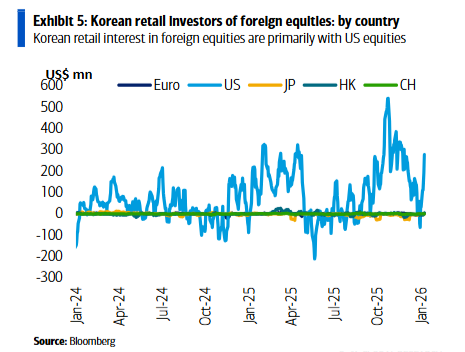
Core Viewpoint - The South Korean President Lee Jae-myung expressed optimism that the Korean won will stabilize around 1400 won per US dollar within the next one to two months, which has boosted market confidence [1]. Group 1: Currency Performance - The Korean won appreciated by 0.7% during trading, reaching 1468.00 won against the US dollar [1]. - President Lee noted that the recent depreciation of the won is not unique to South Korea, and compared its performance to the yen, suggesting that if the won depreciated at the same rate as the yen, it could approach 1600 won [1]. - Despite record high exports of 700 billion USD and a trade surplus, the won remains near last year's low, which hit a 17-year low [1]. Group 2: Government Actions - To alleviate pressure on the foreign exchange market, the South Korean government has decided to postpone its commitment to invest 20 billion USD in the US this year, part of a larger 350 billion USD investment plan [1]. - This decision reflects the authorities' cautious assessment of current capital outflows and financing capabilities [1]. Group 3: Market Sentiment - Retail investors in South Korea have shown a strong preference for US stocks, with their holdings reaching nearly 172 billion USD, setting a new record [1]. - Foreign investors have been continuously selling Korean stocks, further exerting pressure on the won [1]. - Kookmin Bank economists noted that the President's strong statements on foreign exchange issues are rare and indicate a firm commitment to stabilizing the market [2].
韩国将免除金融机构外汇稳定税六个月,以促进美元供应
Xin Lang Cai Jing· 2026-01-21 07:20
Core Viewpoint - The South Korean government is temporarily exempting banks and financial institutions from the foreign exchange stability tax until June as part of measures to promote the supply of US dollars in the market [1][2]. Group 1: Government Measures - The six-month exemption from the special tax will be retroactive to January 1 [1][2]. - The existing mechanism requires financial institutions to pay taxes when holding foreign currency liabilities above a certain level [1][2]. Group 2: Market Impact - The tax exemption is expected to lower the cost of foreign currency borrowing and increase the supply of US dollars in the foreign exchange market [1][2]. - The measures come as the Korean won continues to depreciate against the US dollar, although it rebounded slightly following a positive statement from President Yoon Suk-yeol about the won [1][2]. - As of 3 PM local time, the exchange rate was 1,470.3 won per dollar, an increase of 9.5 won from the previous trading day [1][2].
李在明称美国若提高芯片关税将加剧通胀
Xin Lang Cai Jing· 2026-01-21 04:27
Core Viewpoint - South Korean President Lee Jae-myung attempts to downplay concerns regarding the proposed 100% tariff on semiconductor imports by the U.S., suggesting that such tariffs could exacerbate inflation in the U.S. [1][2] Group 1: U.S. Tariff Concerns - The U.S. Secretary of Commerce, Howard Lutnick, indicated that South Korean chip manufacturers could face tariffs as high as 100% unless they commit to increasing production in the U.S. [1][2] - President Lee stated that imposing a 100% tariff on semiconductor products would likely lead to a significant increase in domestic chip prices in the U.S. [1][2] Group 2: Currency and Market Stability - President Lee addressed the issue of the declining Korean won, noting that South Korea's foreign exchange authorities expect the won to reach a level of 1400 against the U.S. dollar within approximately one month. [1][2] - He emphasized that domestic policies alone would not be sufficient to stabilize the market, as it is somewhat related to the weakness of the Japanese yen, adding that the performance of the won is comparatively better than that of the yen. [1][2]
韩国总统李在明表示韩元相对坚挺 或于两个月内企稳
Xin Lang Cai Jing· 2026-01-21 03:32
Core Viewpoint - The South Korean President Lee Jae-myung indicated that the country's struggling currency may strengthen in the next two months, stabilizing around 1,400 KRW per USD [1][3]. Group 1: Currency Situation - The recent depreciation of the Korean won is not unique to South Korea, with the Japanese yen facing even greater pressure [1][5]. - The won has depreciated over 8% against the dollar since the second half of 2025, reaching its lowest level since the global financial crisis [2][5]. - The current exchange rate is hovering near a 17-year low, despite record exports of $700 billion and ongoing trade surpluses [1][4]. Group 2: Economic Measures and Investments - The government is exploring various measures to stabilize the exchange rate, acknowledging that it cannot solely rely on domestic policies [2][5]. - As part of a trade agreement, South Korea committed to investing $350 billion in the U.S., raising concerns about its ability to finance this capital expenditure [2][5]. - Due to the ongoing pressure on the won, South Korea plans to delay its commitment to invest $20 billion in the U.S. this year [2][5]. Group 3: Investor Behavior - A significant factor contributing to the downward pressure on the won is the strong preference of South Korean retail investors for U.S. stocks, with holdings reaching a record high of nearly $172 billion this month [2][5]. - Compared to Japan, the depreciation of the won has been relatively smaller; if it were to depreciate similarly to the yen, the exchange rate would be around 1,600 KRW per USD [6].
韩元贬值背后:韩国散户狂买海外股票
Hua Er Jie Jian Wen· 2026-01-16 04:28
Core Viewpoint - The South Korean won experienced a brief rebound at the end of 2025 due to government intervention, but it quickly returned to a depreciation trend in early 2026, primarily driven by retail investors' renewed enthusiasm for foreign stocks, especially U.S. equities [1][3][15]. Group 1: Retail Investor Behavior - South Korean retail investors net purchased $2 billion in foreign stocks within the first ten days of 2026, indicating a significant outflow of capital that could not be offset by the country's trade surplus or U.S. Treasury concerns [3][10]. - The top stocks purchased by South Korean retail investors included Tesla ($452 million), Direxion's Tesla 2x leveraged ETF ($323 million), and Alphabet Class A shares ($195 million) [8][9]. - Retail investors have become the dominant force influencing the exchange rate, with their cross-border investment behavior deeply intertwined with the future trajectory of the won [3][4]. Group 2: Economic Indicators and Government Response - Despite a strong current account surplus of $12.2 billion as of November 2025, the outflow from retail investors, totaling $11 billion, significantly contributed to the financial account deficit [10][11]. - The South Korean government has attempted to support the won through verbal interventions and monetary support, but these measures have proven to be short-lived [15][17]. - A potential solution to stabilize the won could involve tax policy changes, such as reducing capital gains tax on foreign stock sales, which may encourage capital repatriation [17][18].

韩国综合股价指数收涨0.8% 连续7个交易日上涨 韩元连跌9日
Xin Lang Cai Jing· 2026-01-12 06:46
Group 1 - The Korea Composite Stock Price Index (Kospi) has risen for seven consecutive trading days, increasing by 0.8% to close at 4624.79 points, with gains in battery and construction stocks [1][3]. - South Korean authorities have summoned seven local banks to inquire about the increase in dollar deposits amid the weakening of the Korean won [1][3]. - The Foreign Exchange Management Department held a meeting with these banks to review foreign currency deposits and related services [1][3]. Group 2 - The Korean won has depreciated by 0.24% to 1462.5 won per dollar, marking its ninth consecutive day of decline and reaching the lowest level in over two weeks [2][4]. - The Financial Supervisory Service (FSS) has also inquired about the increase in dollar deposits at local banks to assess overall data and trends [1][3].
韩元汇率较日内高点贬值1%,现报1美元兑1472.2韩元
Mei Ri Jing Ji Xin Wen· 2025-11-26 08:20
Group 1 - The South Korean won depreciated by 1% from its intraday high, currently trading at 1,472.2 won per US dollar [1]
人民币汇率最新数据出炉,你的钱换值了还是贬了?
Sou Hu Cai Jing· 2025-08-06 16:47
Core Insights - Exchange rate fluctuations significantly impact various aspects of daily life, including overseas consumption, investment decisions, and travel plans [1][2][8] Group 1: Impact on Overseas Study and Travel - Minor differences in exchange rates can accumulate, leading to substantial losses when exchanging currency for studying abroad or traveling [3] - For those planning to study or travel abroad, current exchange rates should be monitored closely to optimize currency exchange [9][10] Group 2: Cross-Border E-commerce and Purchasing - Prices of overseas goods fluctuate in real-time with exchange rate changes, affecting cross-border e-commerce and purchasing decisions [5][8] Group 3: Financial Investments and Corporate Earnings - Exchange rate volatility influences the profitability of multinational companies, which in turn affects stock market performance and returns on foreign currency investment products [6][8] - Companies engaged in import and export activities face direct impacts on their operating costs due to exchange rate changes [7][8] Group 4: Currency Trends Analysis - The current exchange rate of the Chinese Yuan against the US Dollar shows a slight increase of 0.14% since August 1, indicating a stable outlook for the Yuan [9] - The Euro has depreciated recently due to economic weaknesses in the Eurozone, suggesting potential savings for travelers or students in Europe [10] - The Japanese Yen has appreciated slightly due to increased demand for safe-haven currencies amid global uncertainties, but caution is advised for those planning to exchange Yen [11] Group 5: Emerging Market Currency Performance - The performance of various emerging market currencies reflects their respective economic fundamentals, with the Korean Won showing significant depreciation [15] - The Malaysian Ringgit has strengthened, indicating a stable economic foundation [16] - The Russian Ruble remains supported by energy exports, while currencies like the South African Rand and Turkish Lira exhibit high volatility due to inflation and interest rate factors [17][18] Group 6: Future Outlook for the Chinese Yuan - Recent policy signals suggest that the Chinese Yuan will maintain a pattern of "two-way fluctuations and stable ranges," requiring close monitoring of policy developments for strategic adjustments [19]