全息通信

Search documents
北京将从应用生态等多方面推动6G产业发展
Zhong Guo Xin Wen Wang· 2025-11-04 14:02
Core Viewpoint - Beijing aims to promote the development of the 6G industry through various aspects including application ecology, core technology, and industrial layout [1] Group 1: Application Ecology - Beijing will cultivate application ecology focused on business scenarios, leveraging advantages in integrated communication to develop typical applications such as holographic communication and autonomous driving [1] - The strategy emphasizes driving industrial development from the application end and promoting deep integration of technology with vertical industries [1] Group 2: Core Technology Development - The city will systematically promote research and development of key core technologies, focusing on critical areas such as sensing, intelligent computing, and integrated communication technology [1] - Efforts will be made to overcome technical barriers in core communication equipment development, including next-generation base stations, satellite communication terminals, and high-speed transmission modules [1] - The goal is to enhance equipment performance and stability, driving application upgrades in industries like holographic communication, autonomous driving, and smart wearables [1] Group 3: Industrial Layout Optimization - Beijing plans to create innovative outcomes around technology industry breakthroughs, results transfer and transformation, local characteristic industry layout, and the construction of a 6G innovation ecosystem [1] - The establishment of a communication and collaboration platform among upstream and downstream enterprises in the 6G industrial chain is intended to explore the potential of key enterprises in the core industrial chain [1] - The initiative aims to promote a "leading goose effect" by coordinating 6G innovation resources across the city [1]
未来产业,大国科技竞赛“必争之地” | 新京报专栏
Xin Jing Bao· 2025-10-28 16:24
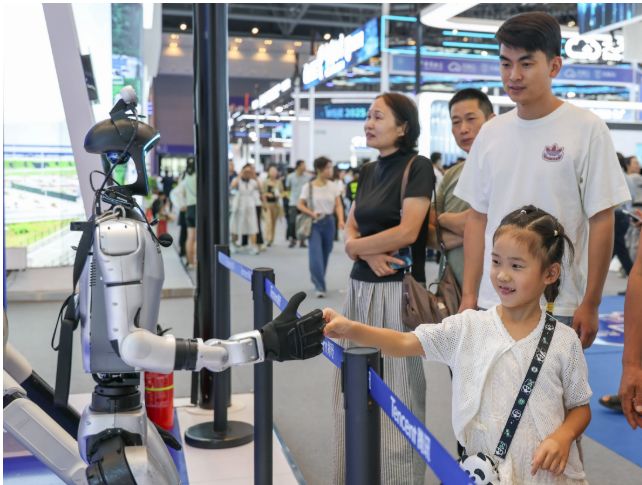
Core Insights - The "15th Five-Year Plan" outlines strategic priorities for China's economic and social development, emphasizing the importance of future industries such as quantum technology, biomanufacturing, hydrogen energy, nuclear fusion, brain-computer interfaces, embodied intelligence, and 6G technology as new economic growth points [2][3][11] Future Industries - The six identified future industries are expected to fundamentally alter production methods and drive high-quality economic development, reflecting China's strategic response to global technological competition [3][4] - Quantum technology is anticipated to initiate a second quantum revolution, while hydrogen and nuclear fusion energy may provide ultimate solutions for energy challenges [3][4] - Brain-computer interfaces and embodied intelligence are set to usher in a new era of human-machine integration, and 6G will define the infrastructure for future intelligent societies [3][4] Social Impact - The development of these future industries is projected to significantly transform social structures and lifestyles, with brain-computer interfaces potentially unlocking human cognitive boundaries and aiding in the treatment of severe diseases [4][5] - Embodied intelligence, combining robotics and AI, is expected to reshape various sectors including industry, services, and healthcare [4][5] - The alignment of these technologies with sustainable development goals is highlighted, with hydrogen and nuclear fusion supporting carbon neutrality, and biomanufacturing reducing reliance on petroleum-based materials [4][5] Economic Transformation - Future industries are positioned as core engines for economic transformation, shifting the growth model from factor-driven to innovation-driven [5][11] - Biomanufacturing is identified as a key pathway for a green industrial revolution, with projections indicating that by 2030, biobased chemicals could replace 25% of organic chemicals and 20% of petroleum fuels in the U.S. [5] - China's biomanufacturing market is valued at 420 billion yuan in 2023, with significant growth potential compared to the U.S. [5] Strategic Value - Maintaining a leading position in these fields is crucial for national security and industrial autonomy, especially in the context of intensified global competition [6][11] - Quantum communication's unconditional security is seen as a means to establish a national information highway, while biomanufacturing technology is critical for food and pharmaceutical supply chain stability [6][11] Regional Collaboration - The future industries involve a global competition for strategic advantage, with China adopting a "top-level design + regional collaboration" approach to drive development [6][7] - Major cities like Beijing, Shanghai, and Shenzhen are emerging as technology hubs, leveraging their resources to lead in quantum technology, brain-computer interfaces, and 6G [6][7] - The regional economic structure is expected to deepen, with eastern coastal areas dominating core technology R&D and high-end manufacturing, while central and western regions focus on supporting functions [7] International Cooperation - China is enhancing international cooperation, as evidenced by the signing of the upgraded free trade agreement with ASEAN, which includes digital and green economy collaboration [7][10] - Major cities are hosting international future industry summits to attract global talent and capital, fostering an open innovation ecosystem [7][10] Long-term Vision - The global competition for future industries is intense, with countries vying for strategic advantages in technological transformation [8][9] - China's proactive planning through the "15th Five-Year Plan" aims to capitalize on technological iterations and achieve a leapfrog development in key areas [10][11] - The focus on establishing a collaborative innovation ecosystem and participating in international standard-setting is essential for enhancing China's influence in global industrial chains [10][11]