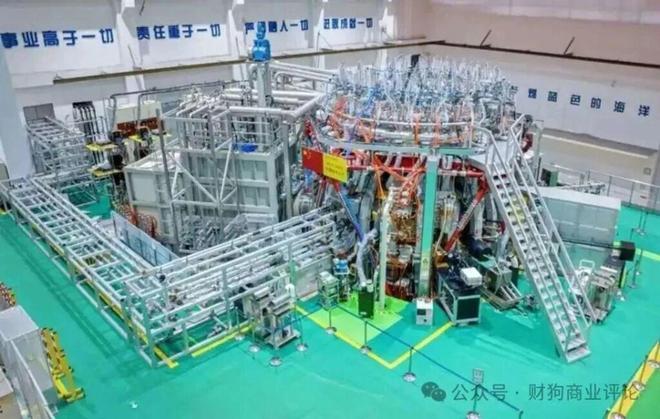
全超导托卡马克核聚变实验装置(东方超环)

Search documents
核聚变大会?我这辈子能用上“人造太阳”发的电吗?
Tai Mei Ti A P P· 2026-01-14 03:32
Core Insights - The upcoming "2026 Nuclear Fusion Energy Technology and Industry Conference" signifies a shift from theoretical research to practical industrial applications of controlled nuclear fusion, aiming to integrate this technology into everyday energy use [2][3]. Group 1: Conference and Industry Implications - The conference will gather scientists, engineers, entrepreneurs, and investors to discuss the commercialization of nuclear fusion technology, indicating a significant step towards making "artificial sun" energy accessible to the public [2][3]. - The event is hosted at a key research facility in Hefei, showcasing tangible advancements in nuclear fusion technology, which could lead to a trillion-dollar energy market [3]. Group 2: Technological Milestones - The EAST (Experimental Advanced Superconducting Tokamak) has achieved a world record by maintaining plasma stability at 100 million degrees Celsius for 1066 seconds, surpassing the sun's core temperature and marking a critical milestone for future fusion power plants [4][6]. - The HL-3 (Chinese Fusion Reactor) has also reached a significant milestone by achieving "double hundred million" plasma temperatures, moving closer to practical fusion reactions [8][10]. Group 3: Future Developments and Timeline - The next-generation fusion reactor, BEST, is set to be completed by 2027, with plans to demonstrate fusion energy generation by 2030, ahead of international projects like ITER [10][26]. - A comprehensive timeline outlines milestones for fusion energy commercialization, targeting operational fusion energy by 2040-2045 [30][33]. Group 4: Ecosystem and Market Dynamics - Hefei has developed a robust innovation ecosystem for nuclear fusion, integrating government, industry, academia, and finance, which is crucial for transforming research advantages into industrial benefits [20][22]. - The presence of 47 publicly listed companies in China's "controlled nuclear fusion" sector indicates a growing market, with many firms serving as core suppliers for both domestic and international fusion projects [23].

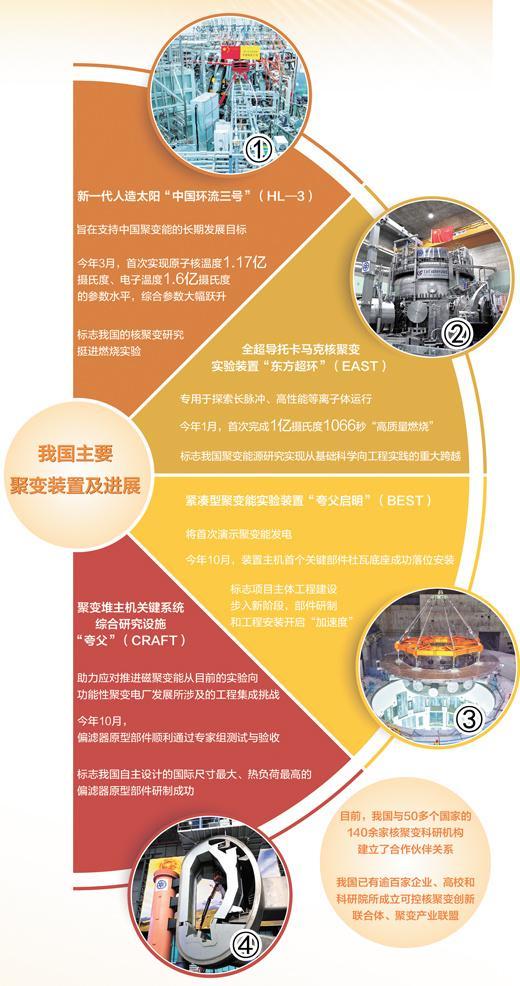
“人造太阳”加速商业化意味着什么(瞰前沿·大国重器)
Ren Min Wang· 2025-10-18 21:58
Core Insights - The commercialization of fusion energy is accelerating globally, with significant advancements in China's fusion research and technology [4][8][10] - China is transitioning its fusion research facilities from experimental tools to industrial hubs, supported by government policies and international collaboration [4][10][11] Group 1: Technological Advancements - China's "Artificial Sun," the HL-3, achieved a nuclear temperature of 117 million degrees Celsius and an electron temperature of 160 million degrees Celsius, marking a significant leap in fusion research [4] - The EAST facility set a world record by maintaining a plasma state at 1 million degrees Celsius for 1066 seconds, showcasing over 200 core technologies developed independently [5] - The "Kua Fu" facility completed the installation of its main components, addressing critical engineering challenges for future commercial fusion reactors [5][6] Group 2: Industry and Policy Support - The Chinese government has prioritized controlled nuclear fusion as a key area for achieving carbon neutrality and advancing green technologies [4][10] - Various local governments are establishing fusion energy industrial clusters, such as in Anhui and Sichuan, to attract related enterprises and foster a billion-yuan industry scale [10][11] Group 3: Global Collaboration and Investment - Nearly 40 countries are advancing fusion plans, with over 160 fusion devices in operation, under construction, or planned, and private investments exceeding $10 billion [8] - China is a key partner in the ITER project, contributing to the design and manufacturing of critical components, and has established collaborations with over 140 fusion research institutions worldwide [11] Group 4: Future Outlook and Challenges - The timeline for achieving commercial fusion energy includes milestones such as starting burning experiments by 2027 and developing the first engineering test reactor by around 2035 [9] - Despite significant progress, challenges remain in technology, industrial ecosystem maturity, and regulatory frameworks that need to be addressed for successful commercialization [9][10]