再生有色金属

Search documents
我国十大品种再生资源回收总量超4亿吨
Ren Min Ri Bao Hai Wai Ban· 2026-01-20 04:49
Group 1 - The Chinese government has issued the "Recycled Materials Application Promotion Action Plan," aiming to enhance the application of recycled materials and promote a circular economy by 2030 [1][3][5] - The plan outlines a roadmap for increasing the supply of high-quality recycled materials, including recycled steel, non-ferrous metals, plastics, and paper, to support the expansion of recycled materials usage [3][5] - By 2024, the total recovery of ten major types of recycled resources in China is expected to exceed 400 million tons, with scrap steel and paper accounting for approximately 21% and 70% of the raw materials used in production, respectively [3][5] Group 2 - Companies are enhancing their capabilities in the recycled materials sector, with many developing specialized networks for collection and processing [6][7] - For instance, Guangxi Fanfeng Environmental Technology Co., Ltd. has established a comprehensive recycling network and plans to launch a large-scale appliance dismantling base by 2026, aiming for an annual dismantling capacity of over 3 million units [7][8] - Jin Tian Copper Industry has developed a closed-loop industry chain for recycled copper, achieving a 75% reduction in carbon emissions while maintaining product quality comparable to virgin materials [8][9] Group 3 - Recycled materials are increasingly being integrated into everyday products, with companies like Beijing Baopu Recycled Environmental Technology Co., Ltd. producing high-quality recycled items for events like marathons [10] - The China Resource Recycling Group is focusing on advanced technologies for resource recycling, including AI and near-infrared spectroscopy for intelligent sorting of materials [11] - Klaus-Maffei Group is leveraging its advanced recycling technologies to enhance the processing of recycled plastics, aligning with the government's plan to expand the use of recycled materials [12][13]

我国十大品种再生资源回收总量超4亿吨——再生材料利用“路线图”来了
Ren Min Ri Bao Hai Wai Ban· 2026-01-20 00:34
Group 1 - The Chinese government has issued the "Recycled Materials Application Promotion Action Plan," aiming to enhance the application of recycled materials and promote a circular economy by 2030 [1][3] - The plan outlines a roadmap for increasing the supply of high-quality recycled materials, improving waste recycling systems, and expanding the application of recycled materials in various industries [3][5] - By 2024, the total recovery of ten major types of recycled resources in China is expected to exceed 400 million tons, with significant contributions from scrap steel and paper [3][5] Group 2 - Companies like Ningbo Nuoding are actively engaging with partners in the recycling and manufacturing sectors to enhance collaboration and improve the efficiency of recycling processes [2][3] - The industry is witnessing a rise in specialized and large-scale operations, with companies developing extensive offline and online recycling networks to facilitate resource recovery [7][8] - Advanced technologies, such as AI and near-infrared spectroscopy, are being utilized to improve the sorting and recycling of materials, enhancing the quality and efficiency of recycled products [10][11] Group 3 - The plan emphasizes the need for a robust management system for recycled materials, including the establishment of standards and certification systems to promote their use [5][6] - Companies are increasingly focusing on the development of low-carbon recycled products, which can significantly reduce carbon emissions while meeting high purity standards required by high-tech industries [8][11] - The promotion of recycled materials is expected to play a crucial role in resource security and energy conservation, with specific targets set for the recovery and utilization of various materials by 2030 [5][6]
我国首个再生材料应用推广政策文件出台
Xin Lang Cai Jing· 2026-01-05 16:39
Core Viewpoint - The "Action Plan for Promoting the Application of Recycled Materials" is China's first dedicated policy document aimed at promoting the use of recycled materials, focusing on key sectors such as steel, non-ferrous metals, plastics, and paper, as well as industries like automotive, electronics, batteries, textiles, and packaging [1][2]. Group 1: Goals and Targets - By 2030, the recycling system for waste will be further improved, with annual recycling volumes of scrap steel and waste paper exceeding 300 million tons and 8 million tons, respectively. The annual production of recycled non-ferrous metals and plastics is expected to exceed 25 million tons and 19.5 million tons, respectively [1][2]. - The application of recycled materials in key sectors will steadily increase, enhancing their role in resource security and energy conservation [1]. Group 2: Tasks and Measures - Enhance the supply capacity of recycled materials by improving the quality of recycled steel, non-ferrous metals, plastics, and paper, and revising the "Recycling Management Measures" to support the expansion of recycled material applications [2][3]. - Increase the application of recycled materials in key products, particularly in automotive, electronics, batteries, textiles, and packaging industries, to foster market demand for recycled materials [2]. Group 3: Management and Policy Framework - Establish a management system for the use of recycled materials, including the development of standards and certification systems, and promote data traceability for recycled materials to ensure safety and reliability [3]. - Improve policies for promoting the application of recycled materials, including integrating projects into the national greenhouse gas voluntary reduction trading market and enhancing incentives for certified recycled material products in government procurement [3][4]. Group 4: Implementation and Coordination - The National Development and Reform Commission will coordinate efforts across various departments to ensure the effective implementation of the Action Plan, including tracking progress, quality management, and public awareness campaigns [4].
七部门联手加强再生材料应用推广
Xin Lang Cai Jing· 2026-01-03 23:23
Core Viewpoint - The "Action Plan for Promoting the Application of Recycled Materials" aims to increase the application ratio of recycled materials, accelerate the green and low-carbon transformation of key industries, ensure the safety of industrial and supply chains, and enhance the effectiveness of the circular economy [1][2]. Group 1: Goals and Objectives - By 2030, the recycling system for waste will be further improved, with annual recycling volumes of waste steel and waste paper exceeding 300 million tons and 8 million tons respectively, and production of recycled non-ferrous metals and recycled plastics reaching over 25 million tons and 19.5 million tons respectively [1][2]. - The application of recycled materials in sectors such as automotive, electronics, textiles, and packaging will steadily increase, enhancing their role in resource security and energy conservation [1][2]. Group 2: Supply and Demand Enhancements - The plan emphasizes enhancing the supply capacity of recycled steel, improving the supply level of recycled non-ferrous metals, and increasing the production capacity of high-quality recycled plastics [2]. - It encourages the application of more recycled materials in automotive manufacturing, electronics, and battery production, while promoting the use of recycled materials in textiles and packaging [2]. Group 3: Policy and Management Framework - The plan proposes to establish a standard certification system for the promotion and application of recycled materials, advance data traceability management, and improve market mechanisms for carbon reduction related to recycled materials [2]. - It aims to create incentive policies for promoting the application of recycled materials and facilitate the utilization of overseas recycled raw materials [2]. Group 4: Significance and Impact - The implementation of the "Action Plan" is seen as a significant step towards transforming resource utilization methods and improving resource efficiency, contributing to the green and low-carbon transformation of key industries and the stability of supply chains [3].
国家发改委等七部门发布重要行动方案
中国能源报· 2026-01-02 07:43
Core Viewpoint - The article discusses the "Action Plan for Promoting the Application of Recycled Materials," which aims to enhance the recycling system, promote circular economy development, and ensure resource security in China by increasing the application of recycled materials across various industries [3][4]. Group 1: Overall Requirements - The plan emphasizes the importance of recycled materials in enhancing supply chain resilience and achieving carbon neutrality goals, focusing on materials like recycled steel, non-ferrous metals, plastics, and paper [3][4]. - By 2030, the recycling system is expected to be further improved, with annual recycling volumes of scrap steel and paper exceeding 300 million tons and 8 million tons, respectively [4]. Group 2: Enhancing Supply Capacity of Recycled Materials - The plan encourages the establishment of large-scale scrap processing centers to improve the recycling and processing of scrap steel [6]. - It supports technological upgrades in non-ferrous metal recycling to enhance quality and recovery rates [6]. - The initiative aims to develop a high-value recycling system for waste plastics and improve the quality of recycled paper and glass [6][7]. Group 3: Increasing Application of Recycled Materials in Key Products - The automotive industry is encouraged to increase the use of recycled materials in components such as frames and body parts, aiming for a closed-loop supply system [7][8]. - The electronics sector is urged to enhance the use of recycled materials in non-critical components and packaging [8]. - Battery manufacturers are supported in establishing recycling systems and using recycled metals in production [8]. Group 4: Improving Management Systems for Recycled Materials - The plan calls for the establishment of quality standards and certification systems for recycled materials to ensure safety and environmental compliance [9]. - It promotes the development of a data traceability platform for recycled materials to enhance transparency and management [9]. Group 5: Policy Enhancements for Promoting Recycled Materials - The plan suggests integrating recycled materials into carbon reduction trading markets and improving international competitiveness through alignment with global standards [10]. - It encourages government procurement policies to favor products made from certified recycled materials [10]. Group 6: Strengthening Implementation and Oversight - The National Development and Reform Commission will coordinate efforts across various departments to monitor the progress of recycled materials application [10]. - Quality management measures will be enforced to combat counterfeit products and ensure compliance with safety standards [10].


我国到2030年将逐步建立再生材料推广应用等标准和认证体系
Xin Hua She· 2025-12-31 11:53
Core Viewpoint - The "Recycled Materials Application Promotion Action Plan" aims to enhance the waste recycling system and promote the application of recycled materials by 2030, which is crucial for resource security, supply chain resilience, and achieving carbon neutrality in China [1]. Group 1: Recycling Goals - By 2030, the annual recycling volumes for waste steel and waste paper are projected to exceed 300 million tons and 8 million tons, respectively [1]. - The annual production of recycled non-ferrous metals and recycled plastics is expected to surpass 25 million tons and 19.5 million tons, respectively [1]. - The proportion of recycled materials used in sectors such as automotive, electronics, textiles, and packaging is set to steadily increase [1]. Group 2: Infrastructure and Support - The plan encourages the establishment of large-scale waste steel processing and distribution centers in regions with concentrated electric furnace steel production, promoting integrated development of waste steel recycling, dismantling, processing, and distribution [1]. - It supports the construction of waste paper sorting and processing centers, focusing on major categories such as boxboard, book paper, and newsprint [1]. - The plan advocates for battery production companies to accelerate the establishment of a comprehensive recycling system for used batteries [1].
七部门:到2030年废钢铁、废纸年回收利用量分别超过3亿吨、8000万吨
Xin Hua Cai Jing· 2025-12-31 08:50
Core Viewpoint - The National Development and Reform Commission, along with six other departments, has issued the "Action Plan for Promoting the Application of Recycled Materials," aiming to enhance the recycling system and increase the utilization of recycled materials by 2030 [1] Group 1: Recycling Goals - By 2030, the recycling of waste steel and waste paper is expected to exceed 300 million tons and 8 million tons annually, respectively [1] - Annual production of recycled non-ferrous metals and recycled plastics is projected to surpass 25 million tons and 19.5 million tons, respectively [1] - The application of recycled materials in sectors such as automotive, electronics, textiles, and packaging is expected to steadily increase, enhancing resource security and promoting energy conservation and carbon reduction [1] Group 2: Supply Assurance for Recycled Materials - The plan encourages the establishment of large-scale waste steel processing and distribution centers in regions with concentrated electric furnace steel production, promoting integrated development of waste steel recycling, dismantling, processing, and distribution [2] - It supports the upgrading of technology and equipment for recycled non-ferrous metal processing enterprises, aiming to improve the quality and recovery capabilities of recycled non-ferrous metals [2] - The initiative aims to enhance the production capacity of high-quality recycled plastics by establishing a comprehensive classification and supply system for recycled plastics [2] Group 3: Other Recycled Materials and Waste Management - Support is provided for the construction of waste paper sorting and processing centers, and the adoption of efficient de-inking technologies to improve the quality of recycled paper [3] - The plan encourages the establishment of regional waste glass sorting and processing centers, utilizing optical sorting technology to enhance the quality of recycled glass [3] - It emphasizes the need for a comprehensive waste recovery system, focusing on the classification and fine dismantling of end-of-life vehicles, electronic waste, and other materials to improve sorting precision and recycling efficiency [3]
国家发改委等七部门发布《再生材料应用推广行动方案》
智通财经网· 2025-12-31 08:40
Core Viewpoint - The National Development and Reform Commission (NDRC) and six other departments have released the "Recycled Materials Application Promotion Action Plan," aiming to enhance the recycling system and promote the use of recycled materials by 2030, with specific targets for various materials and industries [1][2][4]. Group 1: Overall Requirements - The plan emphasizes the importance of recycled materials in ensuring resource security, enhancing supply chain resilience, and achieving carbon neutrality [4]. - By 2030, the recycling system is expected to be further improved, with annual recycling targets set at over 300 million tons for scrap steel, 8 million tons for waste paper, 25 million tons for recycled non-ferrous metals, and 19.5 million tons for recycled plastics [5]. Group 2: Enhancing Supply Capacity of Recycled Materials - The plan encourages the establishment of large-scale scrap steel processing and distribution centers to improve the recycling and processing of scrap steel [6]. - It supports the upgrading of technology and equipment for recycled non-ferrous metals to enhance their quality and recovery capabilities [6]. - The initiative aims to improve the production capacity of high-quality recycled plastics and establish a comprehensive recycling system for waste plastics [6]. Group 3: Increasing Application of Recycled Materials in Key Products - The automotive industry is encouraged to increase the use of recycled materials, particularly in components like frames and bodies, while ensuring compliance with safety and performance standards [7]. - The electronics sector is urged to enhance the application of recycled materials in non-critical components and packaging, promoting the use of recycled plastics and metals [7]. - The plan also advocates for the use of recycled materials in battery production, particularly in lead-acid batteries and energy storage systems [7]. Group 4: Improving Management Systems for Recycled Materials - The action plan calls for the establishment of a certification system for recycled materials to ensure quality and safety [8]. - It promotes the development of a data traceability management system for recycled materials to enhance transparency and accountability in the recycling process [8]. Group 5: Policy Enhancements for Recycled Materials Promotion - The plan suggests integrating recycled materials into the national greenhouse gas voluntary reduction trading market to enhance their marketability [8]. - It encourages the development of incentive policies to support the recycling industry and promote the use of certified recycled materials in government procurement [8]. Group 6: Strengthening Implementation and Oversight - The NDRC will coordinate with relevant departments to monitor the progress of recycled materials application promotion and ensure compliance with quality standards [9]. - The plan emphasizes the need for public education and awareness campaigns to promote the use of recycled materials and green consumption [9].
预计年底我国再生有色金属产量将首超2000万吨
Xin Hua Wang· 2025-11-12 06:06
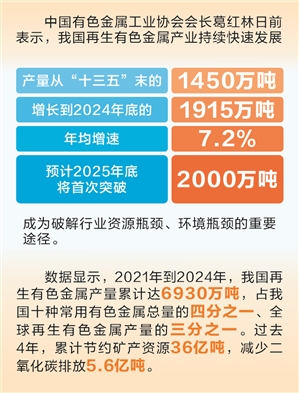
Core Insights - The China Nonferrous Metals Industry Association predicts that the output of recycled nonferrous metals in China will exceed 20 million tons by the end of 2025, marking a significant milestone in addressing resource and environmental bottlenecks in the industry [1][2] Group 1: Industry Growth and Projections - The output of recycled nonferrous metals in China is expected to grow from 14.5 million tons at the end of the 13th Five-Year Plan to 19.15 million tons by the end of 2024, with an average annual growth rate of 7.2% [1] - Cumulatively, from 2021 to 2024, China's recycled nonferrous metal output is projected to reach 69.3 million tons, accounting for one-quarter of the total output of ten commonly used nonferrous metals in the country and one-third of the global output [1] Group 2: Environmental Impact - The recycled nonferrous metal industry has saved 3.6 billion tons of mineral resources and reduced carbon dioxide emissions by 560 million tons over the past four years [1] Group 3: Industry Structure and Innovation - The structure of China's recycled nonferrous metal industry is continuously optimizing, with significant technological innovations. The utilization rate of recycled raw materials is increasing, becoming a core source for many processing enterprises, with some achieving over 60% utilization [1] - The strategic role of recycled raw materials is highlighted, as primary enterprises are increasingly sourcing high-quality recycled copper materials or recycled copper anodes to supplement mineral shortages [1] Group 4: Future Development Goals - The 14th Five-Year Plan period is identified as a critical time for the Chinese recycled metal industry to transition from parallel development to leading the sector, focusing on high-quality development and enhancing the raw material supply system [2]
时报数说 我国再生有色金属产量 预计将首次突破2000万吨
Zheng Quan Shi Bao· 2025-11-11 23:08
Core Insights - The production of recycled non-ferrous metals in China is expected to exceed 20 million tons for the first time [1] Industry Overview - The anticipated growth in recycled non-ferrous metal production highlights a significant milestone for the industry, reflecting advancements in recycling technologies and increasing demand for sustainable materials [1] - This increase in production is likely to impact the overall non-ferrous metal market, potentially leading to shifts in pricing and supply dynamics [1]