北京甲级写字楼租赁服务

Search documents
报告称四季度北京甲级写字楼空置率持续回落
Zhong Guo Xin Wen Wang· 2025-12-29 17:29
Core Insights - The report by DTZ indicates a continued decline in the vacancy rate of Grade A office spaces in Beijing, driven by sustained demand from the TMT sector, despite ongoing downward pressure on rental prices [1][2] Group 1: Market Overview - As of the end of Q4, the total stock of Grade A office space in Beijing remains at 13.68 million square meters, with no new supply throughout the year [1] - The overall vacancy rate for Grade A office spaces decreased by 0.6 percentage points quarter-on-quarter and by 2.4 percentage points year-on-year to 15.89% [1] - The vacancy rate in the five core business districts fell by 0.4 percentage points quarter-on-quarter and by 1.8 percentage points year-on-year to 10.37% [1] Group 2: Rental Trends - Effective rental prices for Grade A office spaces in Beijing decreased by 4.6% quarter-on-quarter and by 16.0% year-on-year, reaching 205.62 RMB/month/square meter [1] - In the five core business districts, effective rental prices fell by 5.6% quarter-on-quarter and by 18.6% year-on-year, amounting to 235.96 RMB/month/square meter [1] Group 3: Demand Dynamics - The leasing demand in the office market is primarily driven by traditional sectors, with TMT, professional services, and finance accounting for over 70% of new leases and relocations, with TMT alone representing 38.5% [2] - The artificial intelligence sector is identified as a key growth driver within the TMT industry [2] Group 4: Future Outlook - By the end of 2028, an estimated 1.879 million square meters of new supply is expected to enter the market, with 1.26 million square meters anticipated to be completed in 2026, mainly in the Central Business District, Tongzhou, and Wangjing-Jiu Xianqiao areas [2] - This influx of new supply is expected to exert continued pressure on the market, potentially leading to a temporary increase in vacancy rates and ongoing downward pressure on rental prices [2] - However, policies aimed at developing high-tech industries are expected to stimulate leasing demand and provide momentum for market recovery [2]
机构:三季度北京甲级写字楼市场净吸纳量创年内新高
Zhong Guo Xin Wen Wang· 2025-09-24 10:17
Core Insights - The net absorption of Grade A office space in Beijing reached a record high for the year in Q3, with a total of 125,000 square meters absorbed, marking nine consecutive quarters of absorption [1][2] - The overall vacancy rate in Beijing's office market decreased by nearly 1 percentage point due to a significant increase in demand [1] - Despite the positive absorption figures, the average effective rent for office space in Beijing fell by 3.5% quarter-on-quarter to 227.3 RMB per square meter [1] Market Trends - The Q3 net absorption in the Zhongguancun area exceeded 63,000 square meters, contributing to a substantial drop in the vacancy rate to 15.1% [1] - Among 24 monitored Grade A office projects in Zhongguancun, 14 had a vacancy rate below 10%, with 10 projects below 5% [2] - The growth of new productivity enterprises in Zhongguancun is driving continuous demand for office space, benefiting from Beijing's push to establish itself as an international technology innovation center [2] Strategic Shifts - Companies are increasingly shifting from inefficient assets to high-quality assets in response to the dual cycles of "technology innovation" and "office market rebalancing," which are expected to drive supply-side reforms focused on quality and efficiency [2]
莱坊:二季度北京甲级写字楼平均空置率为18.4% 租金跌幅环比收窄
Cai Jing Wang· 2025-07-10 15:36
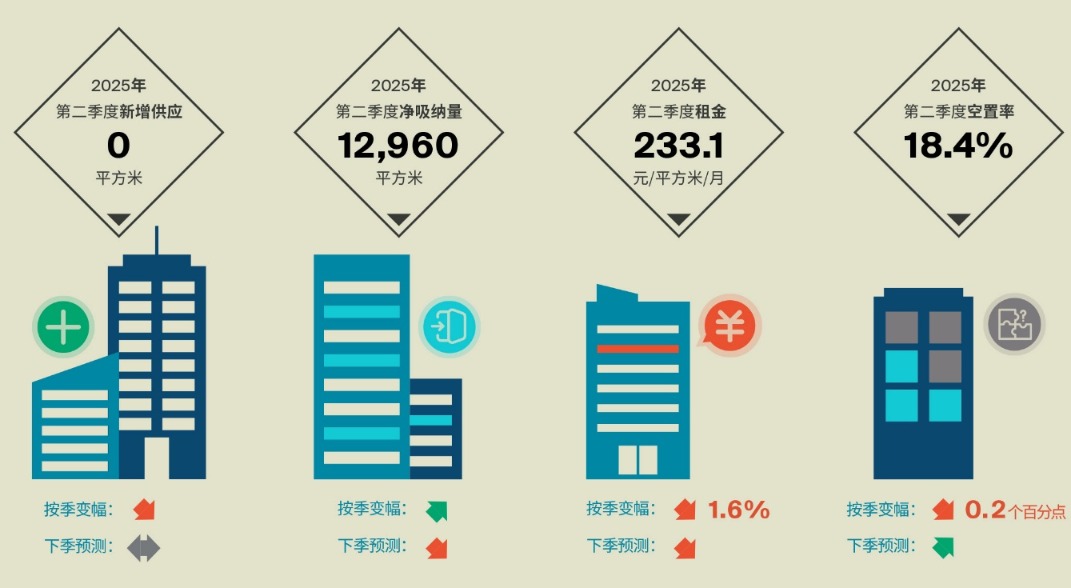
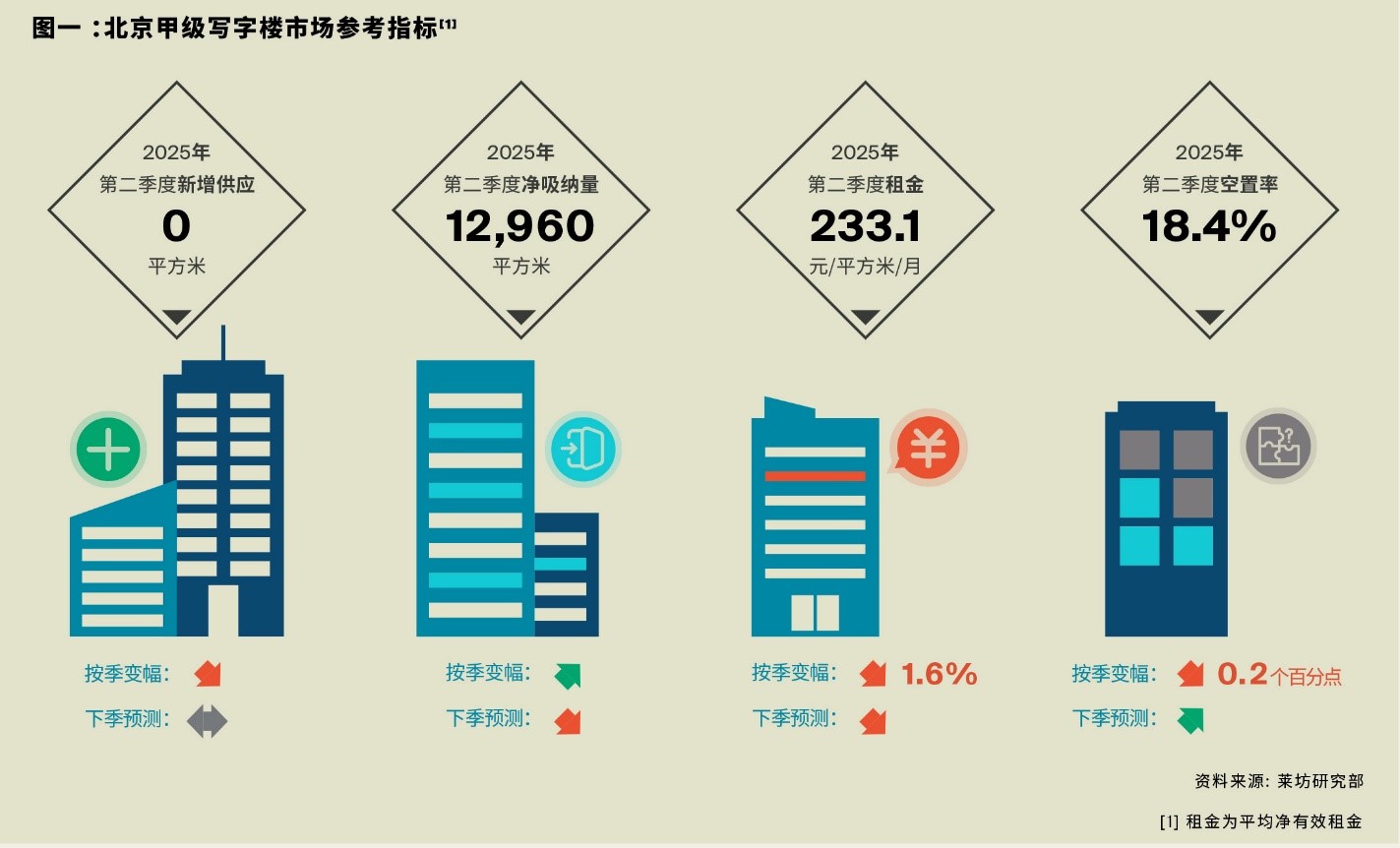
Group 1 - The high-tech industry is the main driver of leasing transactions in the first half of the year, accounting for 34% of the total transaction area [6] - In the second quarter, the average vacancy rate in Beijing's Grade A office market was 18.4%, a slight decrease of 0.2 percentage points from the previous quarter, with a net absorption of 12,960 square meters [1][6] - The average rent for Grade A offices in Beijing decreased by 1.6% to RMB 233.1 per square meter per month, with a year-on-year decline of 7.4% compared to Q4 2024 [1][6] Group 2 - The supply peak year is expected to be 2026, with an anticipated 757,000 square meters of office space, including 409,000 square meters in the central business district [9] - Domestic enterprises are maintaining a cautious attitude towards long-term investments due to global economic uncertainties, while consumption-boosting policies have positively impacted production and market demand [9] - The market is expected to tilt further towards tenants, with landlords adopting flexible lease terms and enhanced service quality to attract tenants [9]

莱坊:北京写字楼租金跌幅收窄 科技行业成租赁交易主力
Xin Hua Cai Jing· 2025-07-10 10:06
Core Insights - The report by Knight Frank indicates a recovery in Beijing's Grade A office market in Q2 2025, with net absorption turning positive at 12,960 square meters [1][2] - Average rental rates have decreased by 1.6% to RMB 233.1 per square meter per month, with a narrowing decline compared to previous quarters [2][3] Market Demand and Supply - Limited new supply in the first half of 2025, with only one new project completed; no new projects are expected in the second half of 2025 [2] - Vacancy rate in Beijing's Grade A office market decreased by 0.2 percentage points to 18.4%, stabilizing compared to Q4 2024 [2] Sector Performance - The technology sector led leasing transactions, accounting for 34% of total transaction area, followed by finance and professional services at 22% and 16% respectively [2] - High-quality state-owned enterprises are becoming more cautious in their office expansion plans, impacting the core area office market [2] Rental Trends - Financial Street's rental rates fell below RMB 400, decreasing by 6.1% to RMB 389.2 per square meter per month, with a year-on-year decline of 8.7% [3] - Central Business District rents decreased by 2.8% to RMB 255.4 per square meter, down 12.5% year-on-year; vacancy rate decreased by 0.7 percentage points to 15.1% [3] - Zhongguancun area saw a rental rate of RMB 258.2 per square meter, with a 1.0% decrease and a significant vacancy rate drop of 3.2 percentage points to 12.8% [3] Future Outlook - Knight Frank anticipates a peak supply year in 2026, with 757,000 square meters of office space expected [4] - The domestic consumption-boosting policies have positively impacted market demand, leading tenants to prioritize flexible lease terms [4]