匡威

Search documents
耐克(NKE.US)深陷四十年来最长熊市 瑞银找到了看涨信号
智通财经网· 2025-12-28 00:52
Core Viewpoint - Nike's stock has experienced a historic decline, but recent investments by Apple CEO Tim Cook and UBS's latest survey data suggest that the company may be building a bottom, although a full recovery will take time [1][6]. Group 1: UBS Survey Insights - UBS analyst Jay Sole highlighted that Nike's new CEO Elliott Hill's strategies of "returning to wholesale channels" and "refocusing on athletic attributes" are showing positive results [3]. - The survey indicates an increase in the global consumer perception of Nike products being "easy to find" in stores and online, rebounding to a new high after a decline from 2019 to 2022 [3]. - The percentage of consumers who believe Nike is "suitable for sports" has returned to peak levels seen in 2019 [3]. Group 2: Key Brand Metrics - Nike holds the highest Net Promoter Score (NPS) globally, ranking first in all major regions surveyed (U.S., U.K., Germany, China) and showing an upward trend [4]. - The brand ranks first or second globally in categories such as "high-quality products," "suitable for sports," "prestigious brand," and "innovative brand" [5]. - There is an increase in global consumers' intent to purchase more Nike footwear and apparel in the next 12 months [5]. Group 3: Executive Actions and Market Response - Tim Cook invested approximately $2.9 million in Nike, purchasing 50,000 shares at an average price of $58.97, nearly doubling his personal holdings [7]. - This significant insider buying is interpreted as a vote of confidence in Nike's long-term strategy and valuation, leading to a notable rebound in Nike's stock price following the announcement [7]. Group 4: Analyst Ratings and Future Outlook - Despite the positive survey results, UBS maintains a "neutral" rating on Nike, indicating that the recovery process will take longer than market expectations [9]. - UBS sets a target price of $62 based on a projected earnings per share (EPS) of $2.15 for the fiscal year 2028, applying a 29x price-to-earnings ratio [9]. - The survey also revealed a slight decline in brand awareness among the 16-24 age group, suggesting a potential challenge for Nike in maintaining its appeal to younger consumers [9].


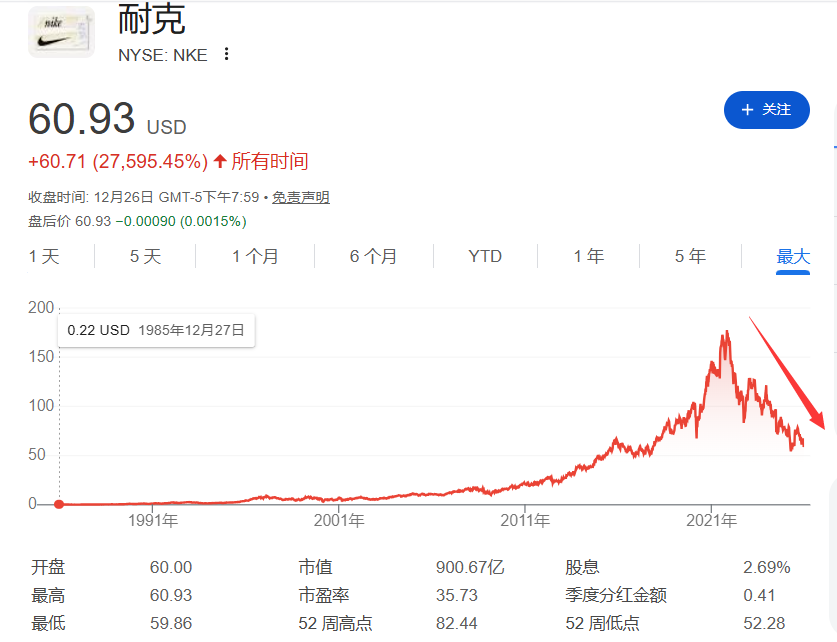
耐克深陷四十年来最长熊市,瑞银找到了看涨信号
Hua Er Jie Jian Wen· 2025-12-27 03:59
Core Viewpoint - Nike's stock has experienced a historic decline, but recent investments by Apple CEO Tim Cook and UBS's latest survey data suggest that the company may be building a bottom, although a full recovery will take time [1][10]. Group 1: UBS Survey Insights - UBS's global sports apparel survey indicates a bullish trend for Nike, driven by new CEO Elliott Hill's strategies of "returning to wholesale channels" and "refocusing on athletic attributes" [3]. - The availability of Nike products has improved, with the percentage of global consumers finding Nike products "easy to find" in stores and online rebounding to a new high after a decline from 2019 to 2022 [3]. - The perception of Nike as "suitable for sports" has returned to peak levels seen in 2019, indicating a successful repositioning of the brand [3]. Group 2: Key Brand Metrics - Nike's Net Promoter Score (NPS) is the highest among all brands, showing an upward trend across major regions including the US, UK, Germany, and China [6]. - The brand ranks first or second globally in categories such as "high-quality products," "suitable for sports," "well-known brand," "innovative brand," and "fashionable" [6]. - There is an increase in global consumer intent to purchase more Nike footwear and apparel in the next 12 months, reflecting improved brand perception [6]. Group 3: Insider Buying Activity - Tim Cook invested approximately $2.9 million in Nike, purchasing 50,000 shares at an average price of $58.97, nearly doubling his personal holdings [7]. - This significant insider buying is interpreted as a vote of confidence in the company's long-term strategy and valuation, contributing to a notable rebound in Nike's stock price following the announcement [7]. Group 4: Analyst Ratings and Projections - UBS maintains a "neutral" rating on Nike, suggesting that while brand strength is improving, the path to profitability will take longer than market expectations [10]. - The target price for Nike is set at $62, based on a projected earnings per share (EPS) of $2.15 for the fiscal year 2028, applying a price-to-earnings ratio of 29 times [10]. - Two mild negative data points were noted: a slight decline in brand recognition among the 16-24 age group and lackluster performance from the Converse brand [11].
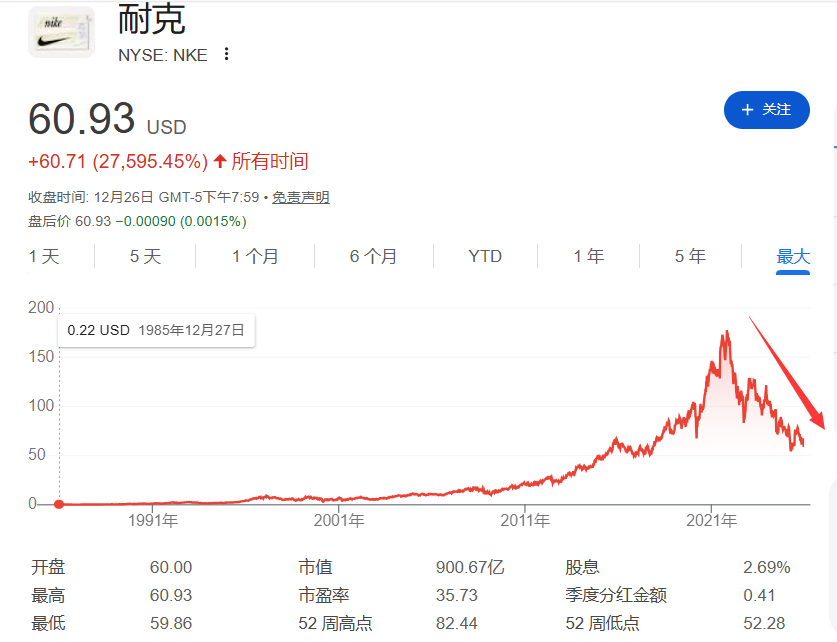
大行评级丨花旗:对耐克2027财年的复苏保持谨慎态度 目标价降至65美元
Ge Long Hui· 2025-12-22 03:44
Core Viewpoint - Citigroup's report indicates that Nike's second-quarter earnings per share exceeded market expectations due to stronger North American sales and reduced selling and administrative expenses [1] Financial Performance - The implied earnings per share guidance for the third quarter is between $0.15 and $0.25, significantly lower than the market expectation of $0.46 [1] - The second quarter saw a 16% decline in sales and a 49% drop in EBIT in the Chinese market, which is expected to persist throughout the remainder of fiscal year 2026 [1] Market Outlook - Management anticipates that the weak performance in the Chinese market and the Converse brand will continue to impact results, leading to a cautious outlook for recovery in fiscal year 2027 [1] - The earnings per share forecast for fiscal year 2027 is projected at $2.16, compared to the market expectation of $2.62, highlighting the complexity of Nike's ongoing transformation and recovery [1] Price Target and Rating - The target price for Nike has been reduced from $70 to $65, with a rating of "neutral" assigned [1]
耐克季度营收超预期 但中国市场与匡威品牌持续疲软
Ge Long Hui A P P· 2025-12-18 22:40
Core Viewpoint - Nike's latest quarterly sales exceeded expectations, indicating progress in overcoming operational challenges, but weaknesses in the Chinese market and the Converse brand persist [1] Financial Performance - In the second fiscal quarter, the company's revenue grew by 1% to $12.4 billion, surpassing analysts' average expectations [1] - Earnings per share also exceeded forecasts, although direct-to-consumer sales fell short of expectations [1] Market Reaction - Following the earnings report, Nike's stock dropped by 5% in after-hours trading [1] - The stock has declined by 13% year-to-date and may face its fourth consecutive annual decline [1] Strategic Focus - The company is intensifying its focus on core sports categories and key cities while rebuilding relationships with retail partners to regain growth and investor confidence [1] - Despite regaining some momentum, management faces scrutiny regarding the performance of the Converse brand, which saw a 30% decline in sales during the period, and the Chinese market [1]
业绩下滑,宝胜国际等运动品牌代理商如何自救
Di Yi Cai Jing· 2025-08-04 10:31
Core Viewpoint - Traditional sports brand distributors are facing significant challenges due to the dual pressures of direct retail and e-commerce, leading to declining sales and profitability [1][2][3] Group 1: Company Performance - Baosheng International (03813.HK) reported a projected revenue of approximately RMB 91.59 billion for the six months ending June 30, 2025, a decrease of about 8.3% year-on-year, with a profit attributable to shareholders of approximately RMB 1.88 billion, down 44.1% [1] - For the fiscal year 2024, Baosheng International's revenue was approximately RMB 184.54 billion, a decline of 8% year-on-year, while profit attributable to shareholders increased by 0.2% to RMB 4.91 billion [1] - Tmall (06110.HK) announced a total revenue decline of 6.64% to RMB 270.13 billion for the fiscal year 2024/25, with net profit dropping by 41.89% to RMB 12.86 billion [2] Group 2: Market Challenges - Both Baosheng International and Tmall are experiencing store closures, attributed to their reliance on traditional distribution channels, which are becoming less viable in a rapidly changing market [2] - The shift in strategy from some international brands towards direct retail and factory outlet stores has further squeezed the margins and customer base of traditional distributors [2] Group 3: Strategic Adjustments - Baosheng International has begun to seek transformation by partnering with new brands, such as Dynafit and XEXYMIX, to diversify its offerings and enter new market segments like yoga apparel and outdoor sports [3] - Tmall is also pursuing diversification by introducing partnerships with niche brands like norda and Mitchell & Ness, as well as outdoor brands like Norrøna [3] - Despite these efforts, the new brands lack the recognition and market scale of established names like Nike and Adidas, posing a challenge for growth [3] Group 4: Market Dynamics - The commercial real estate sector is witnessing a surge in international sports brands opening new stores in China, indicating a competitive landscape where new brands are eager to establish a presence in high-end commercial projects [4]