华商可转债债券

Search documents
华商基金张永志:在股债之间寻找"确定性锚点"
Xin Lang Cai Jing· 2026-02-14 00:53
Core Viewpoint - The A-share market is experiencing a structural trend driven by technological advancements and policy expectations, while the bond market is undergoing a range-bound fluctuation, testing investors' decision-making abilities. The "fixed income +" strategy is increasingly favored by investors as a tool to navigate through cycles [1][8]. Group 1: Market Overview - In early 2026, the A-share market continues to show structural trends influenced by technology and policy expectations [1][8]. - The bond market is characterized by a range-bound fluctuation, with a "top" and "bottom" scenario, challenging investors' decision-making [1][8]. - The "fixed income +" strategy is gaining traction among investors for its ability to provide both offensive and defensive opportunities [1][8]. Group 2: Insights from Zhang Yongzhi - Zhang Yongzhi, General Manager of the Multi-Asset Investment Department at Huashang Fund, has nearly 20 years of experience in the securities industry, focusing on macro asset allocation and the development of "fixed income +" products [3][11]. - His investment style emphasizes a balanced approach, aiming for long-term sustainable returns while capturing certain opportunities in equity investments based on valuation [3][11]. Group 3: Bond Market Analysis - In Q4 2025, the bond market showed stable overall performance, with a steepening yield curve. Short-term bonds benefited from a loose funding environment, while medium to long-term bonds faced adjustments due to rising inflation expectations [4][12]. - The convertible bond market exhibited characteristics of both bond market liquidity and equity market risk appetite, with performance influenced by underlying stocks, particularly in growth sectors driven by industrial policies [4][12]. Group 4: Equity Market Analysis - The equity market is experiencing an upward shift in its oscillation center, with significant trading volume during periods of favorable policies. The market is characterized by a "high-low" process, driven by policy support and a search for sectors with marginal improvements in fundamentals [5][12]. - Strong performance continues in technology sectors, while defensive and high-dividend sectors like coal and banking are gaining attention in the current market environment [5][12]. Group 5: 2026 Outlook - Looking ahead to 2026, despite the recent rise in A-shares, the "stock-bond value ratio" indicates that equity prices still hold investment value, providing a rationale for medium to long-term capital allocation to equity assets [5][13]. - The investment philosophy emphasizes independent thinking and a long-term perspective, aiming to create stable returns for investors through flexible asset allocation and strict credit risk control [5][14].


华商基金张永志:以宏观视野穿越市场迷雾 在适度宽松政策周期中捕捉确定性机会
Zhong Guo Jing Ji Wang· 2026-02-14 00:52
Group 1 - The A-share market is experiencing a structural trend influenced by technological waves and policy expectations, while the bond market is testing investors' decision-making abilities in a fluctuating environment [1] - The "fixed income +" strategy is becoming a preferred tool for many investors to navigate through cycles, characterized by its ability to both seize opportunities and mitigate risks [1] - Zhang Yongzhi, a seasoned expert with nearly 20 years of experience in the "fixed income +" field, emphasizes a macro perspective on asset allocation to pursue long-term sustainable returns [1][3] Group 2 - In Q4 2025, the bond market showed stable overall performance, with a steepening yield curve; short-term bonds benefited from a loose funding environment, while medium to long-term bonds faced adjustments due to rising inflation expectations [2] - The convertible bond market exhibited characteristics of high-priced stocks, with performance influenced by both the liquidity environment of the bond market and the risk appetite of the stock market [2] - The equity market is characterized by an upward oscillation, with significant trading volume during periods of favorable policies; sectors such as technology and cyclical stocks are highlighted for their defensive and allocation value [3] Group 3 - Despite the recent rise in A-shares, the "stock-bond value ratio" indicates that the stock market still holds allocation value, providing a rationale for long-term capital to invest in equity assets [3] - Zhang Yongzhi advocates for independent thinking and a focus on absolute returns in a complex market environment, aiming to create long-term stable returns through flexible asset allocation and strict credit risk control [3]
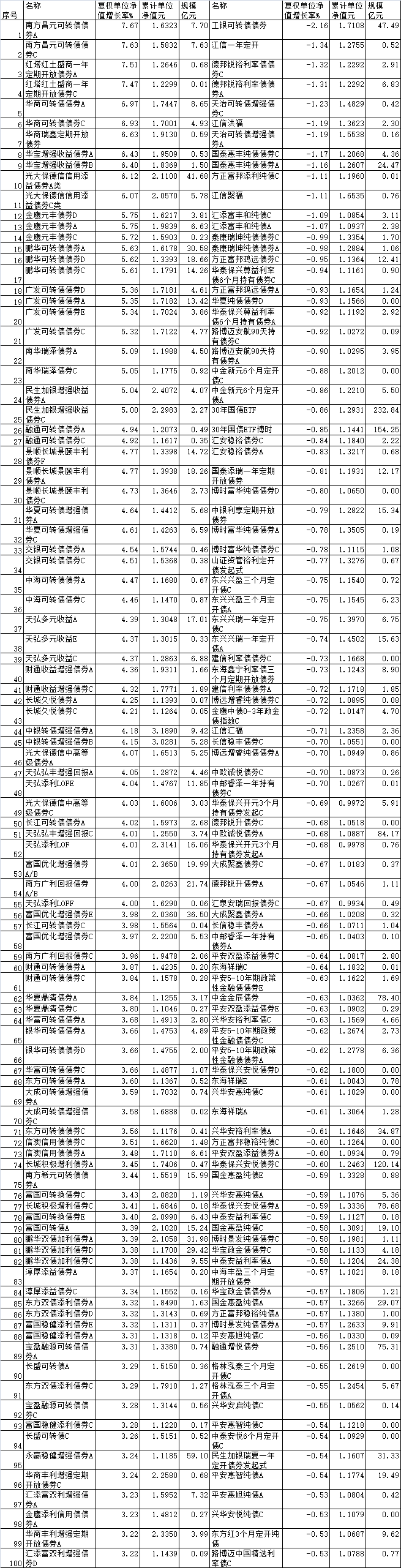
7月份超六成债基上涨 光大保德信信用添益A涨6.12%
Zhong Guo Jing Ji Wang· 2025-08-04 23:17
Group 1 - As of July 31, 2025, among 7217 comparable bond funds, 4489 funds saw performance increases, accounting for 62% of the total, while 2555 funds experienced declines [1] - The top-performing bond funds included Southern Changyuan Convertible Bond A and C, and Hongta Hongtu Shengshang One-Year Regular Open Bond A and C, with increases of 7.67%, 7.63%, 7.51%, and 7.47% respectively [1] - Southern Changyuan Convertible Bond is managed by Liu Wenliang, who has nearly 10 years of management experience [1] Group 2 - Hongta Hongtu Shengshang One-Year Regular Open Bond is managed by Yang Xingfeng, who has extensive experience in investment management since 2006 [2] - The top five holdings of this fund are all government bonds, with the top ten stocks including companies like Gaozheng Minbao and Xizang Tianlu [2] - Other notable funds that increased in July include Huashang Convertible Bond A and C, and Huashang Ruixin Regular Open Bond, with increases of 6.97%, 6.93%, and 6.63% respectively [2] Group 3 - Zhang Yongzhi, who manages Huashang Convertible Bond, has 14 years of public fund management experience and focuses on undervalued stocks [3] - The funds that saw increases in July also included Huabao Enhanced Income Bond A and B, and Everbright Credit Enhanced Bond A and C, all rising over 6% [3] - Only 13 bond funds experienced declines of over 1% in July, primarily those holding financial bonds [3]