
债券型基金

Search documents
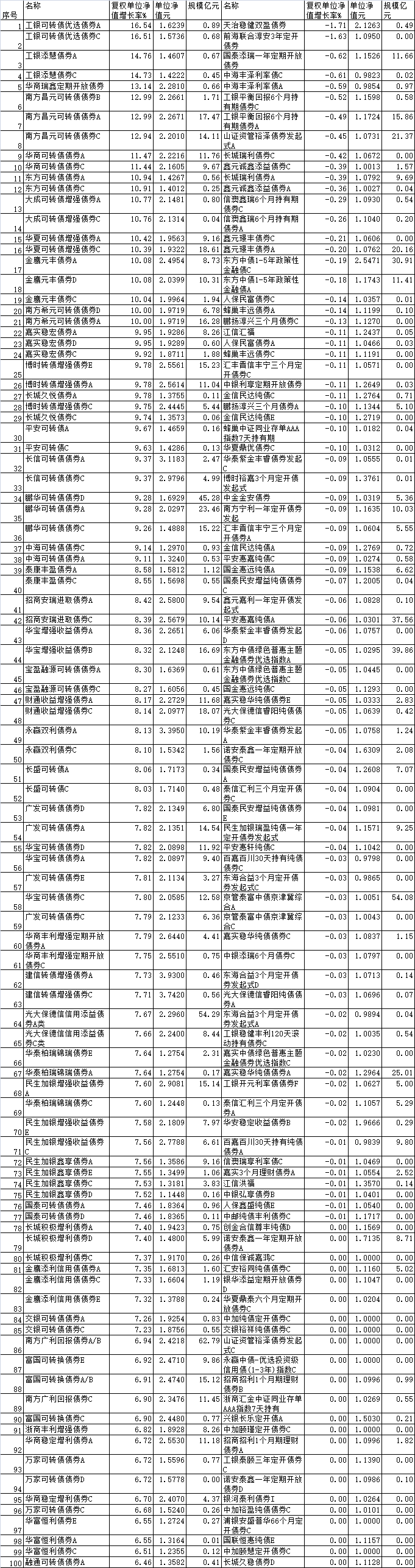
2026年元月98%债基上涨 工银可转债优选上涨16%
Zhong Guo Jing Ji Wang· 2026-02-03 23:13
Core Insights - In January 2026, 98% of the 7,578 comparable bond funds reported positive performance, with 7,459 funds increasing in value, while only 77 funds declined and 42 remained flat [1] - The strong performance in the stock market and stability in the bond market contributed to the rise, with 21 bond funds increasing by over 10% [1] - The top-performing funds included 工银可转债优选债券A and 工银可转债优选债券C, which achieved returns of 16.54% and 16.51% respectively [1] Fund Performance - 工银可转债优选债券A and C led the performance rankings with returns of 16.54% and 16.51%, respectively, with significant holdings in convertible bonds and a portion in stocks, primarily in gold mining [1] - 工银添慧债券A and C followed closely with returns of 14.76% and 14.73%, focusing on government and financial bonds, along with mining stocks [1] - 华商瑞鑫定期开放债券 and 华商可转债债券A and C also performed well, with returns of 13.14%, 11.47%, and 11.44% respectively, emphasizing convertible bonds and semiconductor stocks [2] Underperforming Funds - The bottom performer was 天治稳健双盈债券, which declined by 1.71% in January, with a significant portion of its assets in government and corporate bonds [3] - Other underperformers included 中海丰泽利率债C and A, which fell by 0.61% and 0.59%, respectively, focusing on financial bonds [4]

永赢丰享90天持有期债券型证券投资基金基金份额发售公告
Xin Lang Cai Jing· 2026-01-21 19:34
Group 1 - The fund is named Yongying Fengxiang 90-Day Holding Period Bond Fund, with two classes of shares: Class A and Class C [19][20] - The fund is a bond-type securities investment fund, operating as a contractual open-end fund [20][21] - The minimum holding period for each fund share is set at 90 days, during which no redemption or transfer out is allowed [22][16] Group 2 - The fund's subscription period is from February 2, 2026, to February 27, 2026, with a maximum fundraising period of three months [36][35] - The minimum total subscription amount for the fund is set at 200 million shares [30] - The fund's investment objective is to achieve returns that exceed the performance benchmark while effectively controlling investment risks [27] Group 3 - The fund will invest at least 80% of its assets in bonds, with a maximum of 20% in stocks and related equity assets [29][28] - The fund's investment range includes various financial instruments such as government bonds, corporate bonds, and stocks approved by the China Securities Regulatory Commission [28][11] - The fund will not sell to financial institutions' proprietary accounts, except for the fund manager's own funds [26] Group 4 - The fund has two share classes: Class A shares, which may incur subscription fees, and Class C shares, which do not incur subscription fees [24][41] - The subscription fee for Class A shares varies based on the amount subscribed, with larger amounts attracting lower fees [41][42] - Investors can subscribe multiple times during the fundraising period, but each subscription request is treated individually [40][39]

美国债基规模为何持续扩张?
CAITONG SECURITIES· 2026-01-20 13:09
1. Report Industry Investment Rating No information provided regarding the industry investment rating in the report. 2. Core Views - Since the first open - ended fund was launched in the US in 1924, the US public fund industry has evolved over a century. The bond - type funds entered the growth stage in the 1980s and have experienced multiple interest - rate cycles. The long - term low - interest environment from 2011 - 2016 provides a historical model for analyzing China's current bond investment path [3]. - The US low - interest rate evolved in four steps: rapid decline (2011.1 - 2011.9), low - level fluctuation (2011.10 - 2013.6), interest - rate recovery (2013.7 - 2013.12), and return to decline (2014.1 - 2016.9). Each stage had different impacts on bond - type funds' performance, scale, and asset allocation [3]. - The US bond - type funds could continuously expand due to factors such as the relative attractiveness of US interest rates globally, the expansion of the US asset - management industry, the tool - based and passive nature of bond - type funds in a low - interest environment, and investors' "Reaching for Yield" behavior [3]. - US bond - type funds did not continuously increase duration in the low - interest period because the spread was extremely compressed, interest - rate fluctuations were large, and there were more investment tools and a wider investment scope [3]. 3. Summary by Relevant Catalog 3.1 US Bond - type Fund Development History and Classification 3.1.1 US Bond - type Fund Development History - The US fund industry's development can be divided into three stages: traditional mutual - fund development (1924 - 1980) dominated by stock and hybrid funds; the rise of pension - based asset allocation (1980 - 2000) forming the buyer's investment - advisor model; and the shift to passive investment (2000 - present) with fund companies transforming into investment - advisory services [7]. - For bond - type funds, the period from 1980 to the present can be further divided into three stages: a stable growth period (1980 - 2007) when the US interest rate declined for nearly 30 years, and the bond - type fund scale grew from $46.24 billion in 1984 to $1.68 trillion in 2007, also benefiting from the 401(k) plan and product innovation; a rapid development period (2008 - 2020) after the 2008 financial crisis, with bond - type funds rebounding in scale due to Fed's policies and the stock - bond rebalancing strategy; a recovery growth period (2020 - present) with fluctuations caused by the public - health event and Fed's interest - rate hikes [9][12]. 3.1.2 US Bond - type Fund Classification - Classified by tax, US bond - type funds are divided into taxable bond funds and municipal bond funds. If the proportion of municipal bonds in bond assets exceeds 67%, it is defined as a municipal bond fund; otherwise, it is a taxable bond fund. The median remaining term of municipal bond funds from 2010 - 2024 was 15.79 years, with a median credit score of 7.49 (A -) and a median quarterly return of 0.88%. Taxable bond funds, accounting for 84% of the total bond - type funds in 2024, mainly invest in non - municipal bonds and have a more complex composition [14]. - Taxable bond funds can be further divided into investment - grade, high - yield, global, federal - government, and mixed - bond types. Municipal bond funds can be divided into state - and - local - municipal and national - municipal bond types [15]. 3.2 How Did US Bond - type Funds Respond During the Long - term Low - interest Period? 3.2.1 Four - step Deduction of Low Interest Rates - Rapid decline stage (2011.1 - 2011.9): Bond - type fund scale increased, credit grade rose slightly, government - bond fund duration decreased, and high - yield bond funds' returns declined significantly due to the European debt crisis and the US debt - ceiling crisis [23]. - Low - level fluctuation stage (2011.10 - 2013.6): Government - bond fund scale declined after reaching a peak, corporate - bond fund scale growth slowed, credit grades declined, and bond - type fund performance declined after reaching a peak [23]. - Interest - rate recovery stage (2013.7 - 2013.12): Government - bond fund scale declined sharply, investment - grade bond fund scale remained stable, high - yield bond fund scale increased, and bond - type fund performance declined comprehensively [24]. - Return to decline stage (2014.1 - 2016.9): Government - bond and investment - grade bond fund scales increased, high - yield bond fund scale first increased then decreased, credit grades rose, and bond - type fund returns first increased then decreased [24]. 3.2.2 Reasons for the Continuous Expansion of US Bond - type Funds - Globally, US interest rates were still attractive compared to other developed countries from 2011 - 2016 [34]. - Macroeconomically, the US asset - management industry was in an expansion period, benefiting from stock - bond balanced allocation and population aging and pension plans. The stock - bond rebalancing strategy led to the expansion of bond - type funds during the stock - market boom, and pension plans brought continuous capital inflows [34][35]. - In the long - term low - interest environment, bond - type funds became more tool - based and passive. Indexed bond funds had advantages such as low fees, transparent investment strategies, diversified risks, and high liquidity [36]. - In the low - interest environment, US investors' "Reaching for Yield" behavior was more prominent. Bond - type funds used credit - sinking strategies and increased overseas investment to pursue returns and maintain scale expansion [39]. 3.3 US Bond - type Fund Fee Issues - US mutual funds mainly charge operating fees and sales commissions. Currently, commission - free funds are mainstream in the US fund market. Operating fees include fund management fees, 12b - 1 fees, and other operating costs [44]. - The fee rate of bond - type funds is slightly lower than that of stock - type funds. In 2024, the asset - weighted average fee rate of US bond - type funds was 0.38%. The fee rate of bond - type funds has decreased significantly from 1996 - 2024, mainly due to the indexation trend [45]. 3.4 Appendix I: US Bond - type Fund Data Processing - A relatively complete US bond - type fund database was constructed based on the CRSP database combined with other data. The database contains about 550,000 quarterly samples of US bond - type funds since 2000 [50]. - SEC data is authoritative and discloses monthly data. In the first quarter of 2025, the total scale of US bond - type funds (excluding ETFs and closed - end funds) in mutual funds was $5.45 trillion, including $4.63 trillion in taxable bond funds and $0.82 trillion in municipal bond funds [52]. - ICI data has a longer time span and more detailed classification. In 2024, the scale of US bond - type mutual funds was $5.07 trillion according to ICI statistics [58]. - Morningstar classifies US bond - type funds into nearly 50 unique categories, providing more data dimensions that investors are concerned about [59]. 3.5 Appendix II: "Reaching for Yield" Behavior in a Low - interest Environment - In the US fund market, investors generally chase returns, but in China, there is a redemption anomaly where fund performance and capital flow are inversely related, which can be explained by the prospect theory and the disposition effect [63][64]. - In the low - interest era, corporate - bond funds optimize asset allocation and performance through "risk - taking/chasing returns," but the risk - adjusted alpha is not stable, and the tail risk increases [67]. - The "Reaching for Yield" index (RFY) can be decomposed into "credit sinking" (RFR), "lengthening duration" (RFM), and "selecting higher - yield bonds within the same rating and maturity bucket" (RFY_WRM). Higher RFY corresponds to higher nominal returns but no stable alpha after risk adjustment [68]. - Fixed - income funds can use interest - rate derivatives (IRDs) to increase duration exposure, but when interest rates reverse, losses are significantly magnified [70]. - The positive feedback between capital flow and yield strengthens the universality and importance of "Reaching for Yield" in a low - interest environment [74]. - When interest rates decline, capital not only re - distributes within bond funds but also flows to the stock market, especially high - dividend stock funds. In an ultra - long - term low - interest environment, the motivation of bond - type funds to deviate actively decreases [75][77].

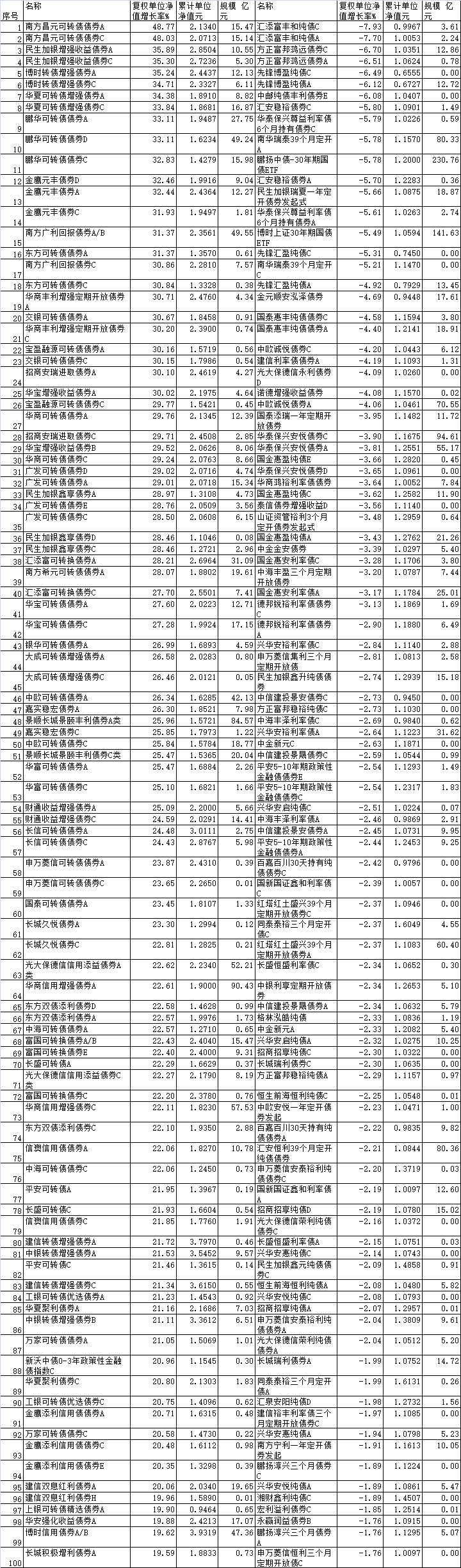
2025年九成债券基金上涨 南方昌元可转债债券涨48%
Zhong Guo Jing Ji Wang· 2026-01-11 23:11
Core Insights - In 2025, 90% of the 6,697 comparable bond funds reported positive performance, with 6,009 funds increasing in value, 28 remaining flat, and 660 declining [1] - The top-performing funds included Southern Changyuan Convertible Bond A and C, which achieved returns of 48.77% and 48.03% respectively [1] - Several other bond funds, such as Minsheng Jianyin Enhanced Income Bond and Bosera Convertible Bond Enhanced, also saw significant increases, exceeding 30% [2] Fund Performance - Southern Changyuan Convertible Bond A and C led the performance with increases of 48.77% and 48.03% respectively, holding 81.90% in bond assets and 16.21% in stocks [1] - Minsheng Jianyin Enhanced Income Bond A and C reported increases of 35.89% and 35.30%, with major holdings in convertible bonds and a small portion in stocks [2] - Bosera Convertible Bond Enhanced A and C achieved returns of 35.24% and 34.71%, with a focus on government bonds and convertible bonds [2] Declining Funds - Only seven funds experienced declines greater than 6%, with the largest drop being 6.70% for the Fangzheng Fubon Hongyuan Bond C, primarily holding government bonds [2] - Vanguard Boying Pure Bond C and A fell by 6.49% and 6.12%, respectively, with significant holdings in government and corporate bonds [3] - Zhongyou Pure Bond Fengli Bond E also saw a decline of 6.08%, focusing on corporate and financial bonds [3] Fund Management - Southern Changyuan Convertible Bond is managed by Liu Wenliang, who has over 10 years of experience in the industry [1] - Minsheng Jianyin Enhanced Income Bond A and C are managed by veteran manager Xie Zhihua, with a track record of 14 years [2] - Bosera Convertible Bond Enhanced is co-managed by Guo Jun and Gao Hui, both with significant experience in fund management [2]
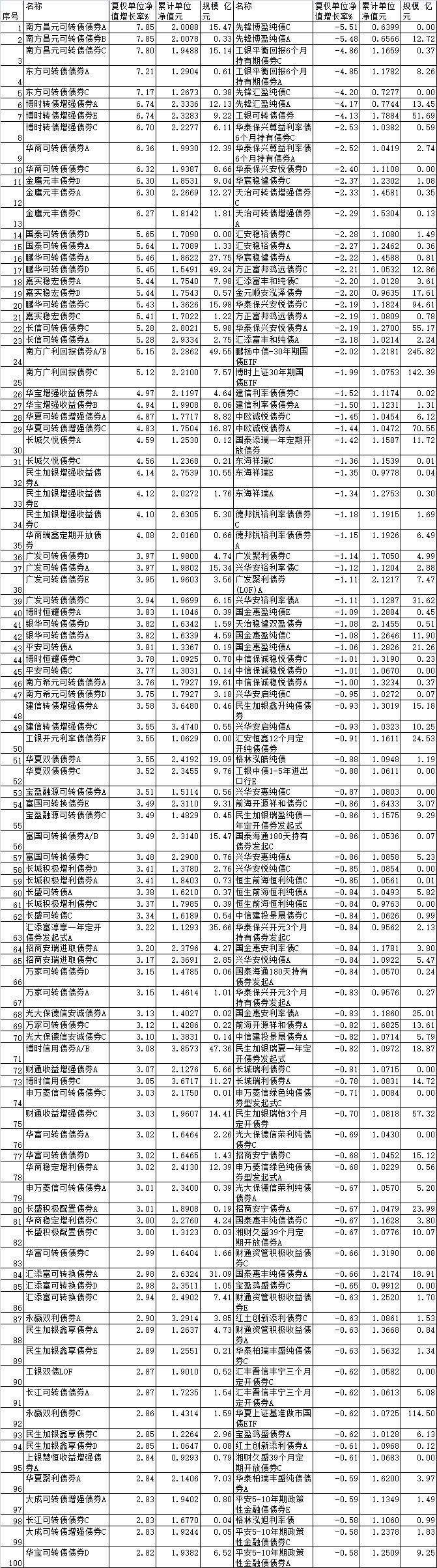
2025年12月超八成债基上涨 南方昌元可转债债券领涨
Zhong Guo Jing Ji Wang· 2026-01-07 23:16
Group 1 - In December 2025, 82% of the 7485 comparable bond funds reported positive performance, with 6160 funds increasing in value, while 1221 funds decreased and 104 remained flat [1] - The top three performing funds were Southern Changyuan Convertible Bond A, B, and C, with monthly gains of 7.85%, 7.85%, and 7.80% respectively [1] - Southern Changyuan Convertible Bond's asset allocation included 81.90% in bonds and 16.21% in stocks, with its top five bond holdings being convertible bonds [1] Group 2 - The Eastern Convertible Bond A and C, along with several funds from Bosera, also achieved gains exceeding 6% in December [1] - The bottom performers included Pioneer Boying Pure Bond C and A, with declines of -5.51% and -5.48%, respectively, and a cumulative loss exceeding 30% since inception [2] - The current fund managers of the bottom-performing funds have varying backgrounds, with experience ranging from 3 to 9 years in the industry [2][3] Group 3 - The top five bond holdings for Pioneer Boying Pure Bond included various government bonds, indicating a conservative investment strategy [3] - Other funds such as Industrial Bank Balanced Return and Huatai's various bond funds also reported declines of over 2% in December [3] - The performance data reflects a broader trend in the bond market, with significant variations in fund performance based on management and asset allocation strategies [2][3]
东海增裕债券型发起式证券投资基金基金份额发售公告
Shang Hai Zheng Quan Bao· 2025-12-29 18:29
Fund Overview - The fund is named Donghai Zengyu Bond Type Initiated Securities Investment Fund, with a minimum total subscription of 10 million units and a minimum fundraising amount of 10 million RMB [13][2]. - The fund is a contract-based open-end bond fund, with an indefinite duration [13][14]. Fund Management and Custody - The fund is managed by Donghai Fund Management Co., Ltd., and the custodian is Bank of Communications Co., Ltd. [1][46]. Fund Subscription Details - The fund will be publicly offered from January 6, 2026, to April 3, 2026, with a maximum fundraising period of three months [19][19]. - The minimum subscription amount for both initial and additional subscriptions is 1 RMB, including subscription fees [22][29]. Subscription Process - Investors must open a fund account with the management company to purchase the fund, and only one account per investor is allowed [6][30]. - Subscription applications must be fully paid, and any incomplete payments will be deemed invalid [20][22]. Fees and Interest Handling - The A-class fund shares will incur a subscription fee that decreases with the amount subscribed, while C-class shares do not have a subscription fee [22][24]. - Interest accrued on valid subscription funds during the fundraising period will be converted into corresponding fund shares for the investors [25][43]. Risk Management - The fund may face various risks, including market risk, credit risk, and liquidity risk, particularly due to its investment in securities and futures markets [5][7]. - The fund has specific provisions for managing large redemption requests through a side pocket mechanism [11][10]. Investor Eligibility - The fund is open to individual investors, institutional investors, qualified foreign institutional investors, and other investors permitted by laws and regulations [17][18]. Sales Channels - The fund will be sold through direct sales and other sales institutions, with specific details available in the fund's sales announcement [15][18].

国泰利享鑫益90天持有期债券型证券投资基金基金份额发售公告
Shang Hai Zheng Quan Bao· 2025-12-04 19:11
Core Points - The fund "Guotai Lixiang Xinyi 90-Day Holding Period Bond Fund" has been approved for registration by the China Securities Regulatory Commission (CSRC) [1] - The fund is a bond-type open-ended fund with a minimum holding period of 90 days, during which investors cannot redeem or transfer their shares [1][16] - The fund will be publicly offered from December 8, 2025, to December 19, 2025, with a maximum fundraising period of three months [3][21] Fund Structure - The fund is managed by Guotai Fund Management Co., Ltd., with the custodian being Industrial Bank Co., Ltd. [1][55] - The fund has two classes of shares: Class A and Class C, with specific codes assigned for each [15][16] - The minimum total fundraising amount for the fund is set at 200 million shares [17] Investment and Subscription Details - The fund is open to individual investors, institutional investors, qualified foreign investors, and other investors permitted by law [2][19] - The maximum subscription amount for a single investor per day is capped at 10 million yuan, with specific exceptions [2][20] - Investors can subscribe multiple times during the fundraising period, and the minimum subscription amount is 1 yuan [10][34] Sales and Distribution - The fund will be sold through designated sales institutions, including direct sales by the fund management company and other sales agencies [3][21] - Investors must open a fund account with Guotai Fund Management Co., Ltd. before subscribing, and the subscription application must be confirmed after account opening [10][34] - The fund's subscription fee for Class A shares will be calculated separately for each application, while Class C shares do not incur a subscription fee [22][23] Fund Management and Operations - The fund's assets will be managed in accordance with principles of diligence, honesty, and prudence, but there is no guarantee of profit [12][55] - The fund's net asset value may fluctuate due to market conditions, and investors should be aware of the inherent risks associated with fund investments [11][12] - The fund will undergo a verification process by a legal verification agency after the fundraising period ends, and the fund contract will take effect upon CSRC confirmation [51][52]

“小阳春”!11月基金发行近千亿元
券商中国· 2025-12-01 02:01
Core Viewpoint - The public fund issuance market experienced a "small spring" in November, with a total new fund scale reaching 96.616 billion yuan, indicating strong investor enthusiasm for subscriptions [1][5]. Fund Issuance Overview - A total of 136 new funds were established in November, showcasing a positive trend in both volume and price, driven by increased year-end capital allocation needs [1][7]. - The top fund by issuance scale was E Fund's E Fund Ruiyi Ying'an 6-Month Holding A, with 5.848 billion yuan, followed by Great Wall Fund's Great Wall Yuanli A at 5.251 billion yuan [1][3]. Fund Types and Performance - Equity funds (stock and mixed types) remained the main force in the market, with stock fund issuance reaching 30.669 billion yuan, accounting for 32.43% of the total scale [5]. - Mixed funds followed with an issuance scale of 23.999 billion yuan, making the total for equity funds 54.669 billion yuan, which constituted 57.81% of the total issuance [5]. Popular Fund Products - Notable high-raising products included mixed equity funds like Fu Guo Xing He A (3 billion yuan) and Peng Hua Qi Hang Quantitative Stock Selection (2.982 billion yuan) [5]. - Passive index funds also gained traction, covering various sectors, with notable products like Wan Jia Zhong Zheng 800 Dividend Low Volatility Index A raising 1.723 billion yuan [5]. International Market Interest - Funds targeting overseas emerging markets, particularly two ETFs focused on Brazil, attracted significant interest, raising a total of 3 billion yuan, exceeding their initial fundraising cap by over seven times [6]. Stability and Growth in Fund Types - Bond funds raised 21.666 billion yuan, accounting for 22.91% of the issuance market, serving as an important stabilizer [6]. - Fund of Funds (FOF) also performed well, with an issuance scale of 16.975 billion yuan, reflecting investor preference for professional fund selection and risk diversification [6]. Market Sentiment and Future Outlook - Analysts noted that the concentration of fund establishment dates in November allowed new products to meet year-end capital allocation needs, indicating that public funds continue to attract incremental capital into the market [7][8]. - The issuance volume approaching 100 billion yuan is seen as a positive signal for market confidence and structural optimization for the upcoming year [7][8].

平安添元6个月持有期债券型证券投资基金基金份额发售公告
Zhong Guo Zheng Quan Bao - Zhong Zheng Wang· 2025-11-16 22:35
Group 1 - The core point of the article is the launch of the "Ping An Tian Yuan 6-Month Holding Period Bond Fund," which has been registered with the China Securities Regulatory Commission (CSRC) and is set to be publicly offered from November 24, 2025, to December 5, 2025 [1][3][24] - The fund is categorized as a bond-type securities investment fund and operates as a contractual open-end fund, with a minimum holding period of 6 months for each fund share [2][20] - The fund aims to achieve long-term stable appreciation of assets while maintaining good liquidity through proactive investment management [20] Group 2 - The maximum fundraising limit for the fund is set at 5 billion RMB, and if the total subscription amount approaches this limit, the fund manager will implement a "last day proportion confirmation" method to control the scale effectively [4][25] - The fund will be available for subscription to individual investors, institutional investors, qualified foreign investors, and other investors permitted by laws and regulations [3][21] - The fund's subscription process includes specific requirements for both individual and institutional investors, including the need to open a fund account and submit various documentation [34][48] Group 3 - The fund will have two classes of shares: Class A, which charges a subscription fee, and Class C, which does not charge a subscription fee but deducts a service fee from the fund's net asset value [27][29] - Investors can subscribe multiple times during the fundraising period, but once a subscription application is accepted, it cannot be withdrawn [10][11] - The fund manager reserves the right to adjust the fundraising period and conditions based on market conditions and subscription status [16][19]

摩根士丹利中债1-5年政策性金融债指数证券投资基金基金份额发售公告
Shang Hai Zheng Quan Bao· 2025-11-11 19:10
Fund Overview - The fund is named Morgan Stanley China Government Bond Index Fund (1-5 Years) and is categorized as a bond-type open-ended fund [12] - The fund's initial share value is set at RMB 1.00, with no upper limit on the fundraising scale [12][16] - The fundraising period is from November 17, 2025, to January 15, 2026, with the possibility of adjustments based on subscription conditions [16] Subscription Details - The minimum initial subscription amount is RMB 10, and additional subscriptions must also be at least RMB 10 [25][41] - Investors can subscribe through designated sales institutions, and the fund management company may add new sales institutions during the fundraising period [5][12] - The fund offers two classes of shares: Class A, which incurs subscription fees, and Class C, which does not charge subscription fees but deducts service fees from the fund's assets after the contract takes effect [19][20] Investor Eligibility - The fund is open to individual investors, institutional investors, qualified foreign investors, and other investors permitted by laws and regulations [12][16] - Investors must ensure that their funds for subscription are legally sourced and free from any legal or contractual restrictions [3][8] Fund Management and Custody - The fund is managed by Morgan Stanley Fund Management (China) Co., Ltd., and the custodian is Nanjing Bank Co., Ltd. [12][50] - The fund management company is responsible for the overall management and operation of the fund assets [50] Fund Operation and Risk Management - The fund primarily invests in policy financial bonds, which may involve credit risks and liquidity risks associated with policy banks [8] - The fund's net asset value may fluctuate due to market conditions, and investors should be aware of the inherent risks of investing in securities [8][9] Fund Registration and Compliance - The fund's registration has been approved by the China Securities Regulatory Commission (CSRC), but this does not guarantee the fund's investment value or market prospects [1][12] - The fund's contract will take effect once it meets the regulatory requirements, including a minimum of 200 investors and a total subscription amount of at least RMB 20 million [16][49]
