
压岁钱增值计划

Search documents
各大银行盯上了压岁钱:孩子存1000元,比你存20万利息高
Mei Ri Jing Ji Xin Wen· 2026-02-27 00:26
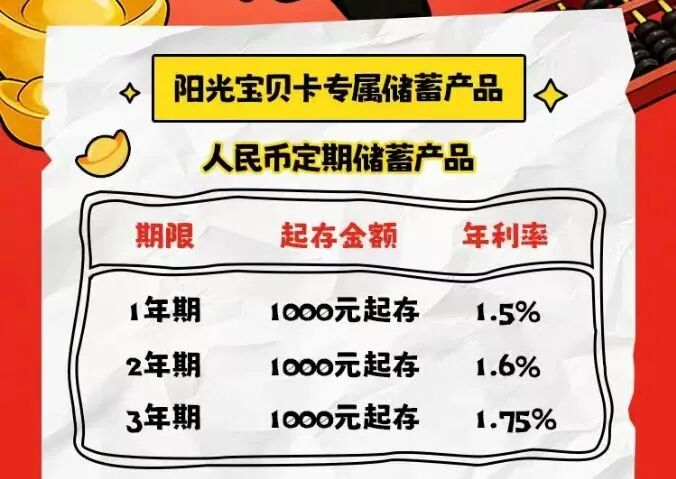
Core Insights - The article discusses the emerging trend of banks offering higher interest rates on children's savings accounts compared to traditional adult deposit products, indicating a strategic shift in the banking sector towards targeting the youth market [1][2][3]. Group 1: Interest Rate Dynamics - Beijing Rural Commercial Bank's "Sunshine Baby Card" offers a three-year interest rate of 1.75%, surpassing both the bank's standard fixed deposit rates and high-value time deposit rates [1][2]. - This "interest rate inversion" phenomenon, where children's small deposits yield higher rates than adult large deposits, is becoming a common strategy among banks to attract young customers [2][3]. Group 2: Strategic Implications - Industry experts suggest that this trend represents a long-term investment in customer lifetime value, as banks aim to establish emotional connections with young clients who will have a financial lifecycle of 50 to 60 years [3][7]. - The strategy allows banks to optimize their liability structure and manage liquidity more effectively, as children's savings typically have long retention periods and lower transaction frequencies [3][7]. Group 3: Product Offerings and Market Segmentation - Different types of banks are creating tailored product matrices to capture the significant market of "lucky money" from the Chinese New Year, focusing on specialized accounts, unique deposits, and parent-child co-management [4][5][6]. - State-owned banks leverage their comprehensive financial services to create one-stop solutions for financial management and education, while joint-stock banks emphasize differentiated account features and service experiences [4][5]. Group 4: Long-term Relationship Building - The shift towards children's financial products is seen as a transition from merely attracting deposits to building long-term relationships with families, allowing banks to access a broader range of financial needs within households [7][8]. - Successful examples include banks like China Merchants Bank and Beijing Bank, which have reported significant growth in their child account customer bases, indicating the effectiveness of this strategy in establishing family financial connections [8]. Group 5: Future Directions - Analysts recommend that banks expand their children's financial services within compliance frameworks, enhancing product offerings and integrating financial literacy education to create a comprehensive service ecosystem [9]. - The focus should be on transforming "lucky money" into a child's first financial asset, emphasizing the importance of financial education and responsible management of funds [9].





密集推出专属金融产品与服务,多家银行争抢“小客户”!
Jin Rong Shi Bao· 2026-02-24 13:09
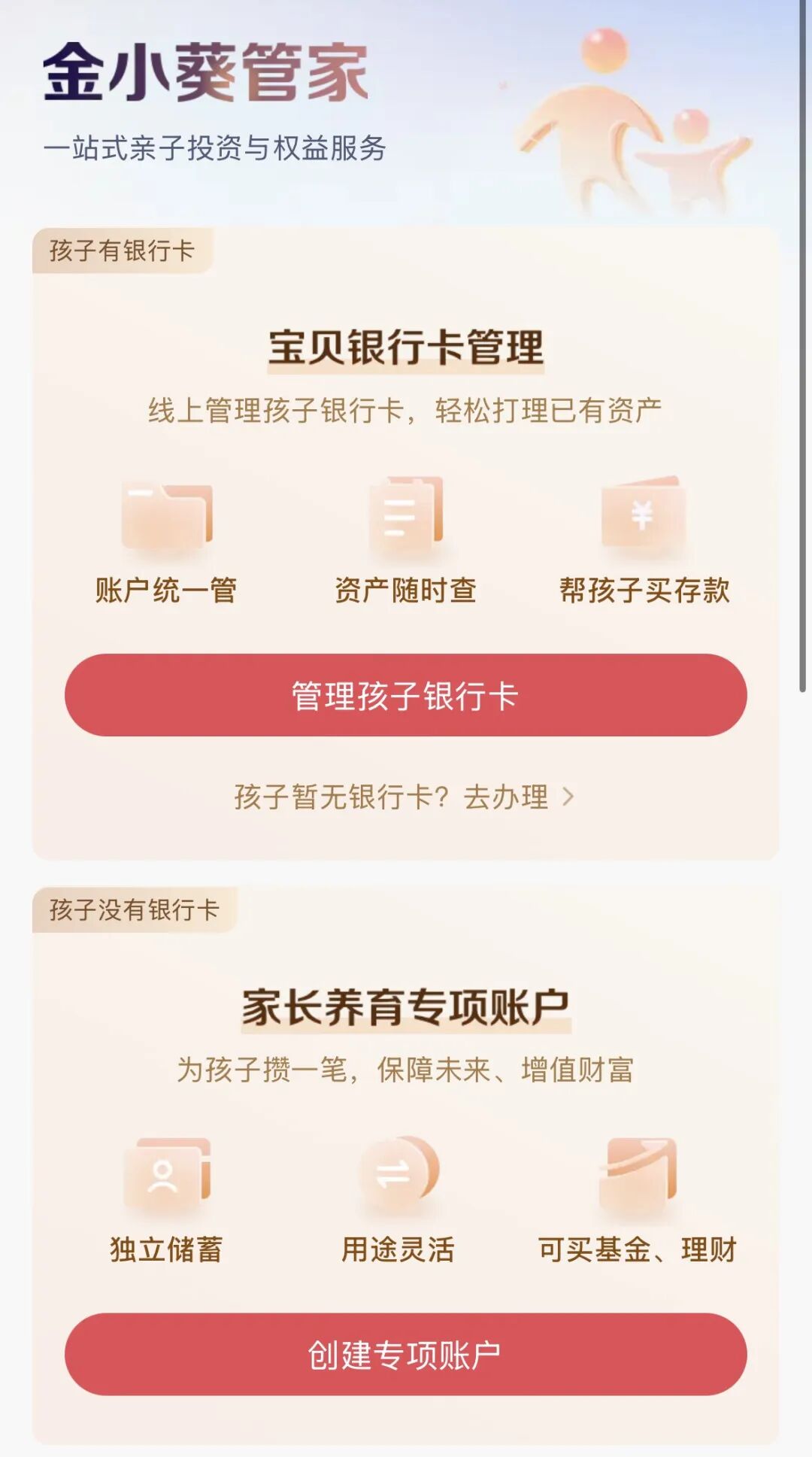
Group 1 - Several banks have launched children's exclusive financial products and services, offering higher interest rates and unique benefits to attract young customers [1][2] - For example, China Merchants Bank offers a one-year deposit rate of 1.3% and a two-year rate of 1.4%, both higher than its standard rates [1] - Beijing Bank's "Little Jing Ya Sui Bao" offers deposit rates of 1.60% and 1.75% for two and three-year terms, respectively, which are above its regular rates [1] Group 2 - Beijing Rural Commercial Bank introduced the "Sunshine Baby Card" with competitive rates of 1.5%, 1.6%, and 1.75% for one, two, and three-year terms, significantly higher than standard rates [2] - Various banks are also providing a range of children's financial products, including customized bank cards and special savings accounts, to engage both children and their parents [2][3] - The children's financial market is expanding, with banks taking on the role of educating financial literacy among children, thus creating a new growth area in retail banking [7] Group 3 - Banks are increasingly offering "managed" financial solutions that link children's savings to parental accounts, allowing for better asset management [3] - China Merchants Bank's "Golden Little Aui Manager" service includes features for managing children's bank cards and educational accounts [3] - The focus on children's financial services is expected to deepen, with banks needing to design targeted products that meet the diverse needs of families [7]
存1000元比存20万元利率高,银行用“吃奶劲”抢压岁钱
Hua Xia Shi Bao· 2026-02-22 13:17
Core Insights - The article highlights the increasing focus of banks on children's financial education and the competition for the "lucky money" market during the Spring Festival, indicating a shift from merely attracting deposits to building long-term customer relationships [2][5]. Group 1: Market Trends - In 2026, commercial banks are launching specialized financial products centered around "lucky money" and "children's accounts," utilizing strategies like interest rate increases and unique benefits to convert this seasonal funding into a vital link with family customers [2][5]. - Major banks such as China Merchants Bank, Guangfa Bank, and Huaxia Bank are introducing dedicated financial products for children's lucky money, with offerings that include savings, investment, and insurance [5]. Group 2: Product Offerings - Beijing Rural Commercial Bank's "Sunshine Baby Card" offers a minimum deposit of 1,000 yuan with interest rates of 1.5%, 1.6%, and 1.75% for 1-year, 2-year, and 3-year terms, respectively, which are higher than standard rates [5]. - Other banks like Beijing Bank and Mengshang Bank are also providing competitive interest rates for children's savings accounts, with some rates exceeding those of regular fixed deposits [6]. Group 3: Customer Engagement Strategies - Banks are enhancing customer attraction through various promotional activities, such as prize draws and gifts for children who open accounts, thereby creating a more engaging experience [7]. - The introduction of "parent-child co-managed accounts" and financial education services signifies a shift towards comprehensive family financial services, moving beyond traditional deposit competition [10]. Group 4: Long-term Strategy - The strategy of offering high-interest rates on children's accounts is aimed at capturing long-term family value, as these accounts can lead to future banking relationships in areas like education loans and investments [9][11]. - By establishing early connections with young customers, banks can position themselves as integral to family wealth management, enhancing customer loyalty over decades [11].

多家银行密集出手,盯上孩子“压岁钱”
Xin Lang Cai Jing· 2026-02-21 13:08
Core Viewpoint - The competition among banks to attract children's "lucky money" during the Spring Festival has intensified, with various financial products and services being launched to convert this influx of funds into long-term customer assets [1][5]. Group 1: Product Offerings - Banks are focusing on three main types of products related to "lucky money": exclusive savings or card accounts for minors, short-term fixed deposits with enhanced interest rates or incentives, and "managed" funds linked to parent accounts for comprehensive family asset management [1][3]. - Examples include Guangfa Bank's "Free Card" which allows for independent accounts for children, and China Merchants Bank's "Golden Little Aui Housekeeper Service" that includes features for managing children's bank cards and educational accounts [1][2]. Group 2: Interest Rates and Terms - China Merchants Bank offers a one-year deposit annualized interest rate of 1.3% and a two-year rate of 1.4%, both higher than standard rates. Beijing Rural Commercial Bank's "Sunshine Baby Card" has rates of 1.5%, 1.6%, and 1.75% for one, two, and three-year terms, respectively [2]. - Zhejiang Jiaxing Pinghu Rural Commercial Bank's "Children's Savings Book" requires a minimum deposit of 10,000 yuan, with one-year and three-year rates at 1.5% and 1.65% [2]. Group 3: Strategic Focus - Banks emphasize that these products are not merely aimed at short-term deposit growth but are part of a strategy to engage with customers over their lifecycle, fostering savings habits and financial literacy among children [3]. - The influx of "lucky money" is seen as a low-cost funding source and a way to attract young families, with potential for cross-selling in areas like education funds and insurance [3][5]. Group 4: Regulatory Considerations - The design of products targeting "lucky money" must balance compliance with long-term value, as regulations govern account management, risk warnings, and fund usage permissions for minors [4]. - Banks must ensure that marketing does not undermine trust in their professionalism, maintaining a balance between helping parents manage money and establishing rules for children [4]. Group 5: Market Trends - The focus on "lucky money" reflects a broader trend in retail finance from simply "grabbing deposits" to "grabbing relationships" and "long-term customers," indicating a shift in the industry [5].
单笔金额不高的压岁钱,银行为何纷纷开“抢”?
Xin Lang Cai Jing· 2026-02-21 11:53
Core Viewpoint - The competition among banks to attract children's "lucky money" during the Spring Festival has intensified, with various financial products and services being launched to convert this influx of funds into long-term customer assets [1][5]. Group 1: Product Offerings - Banks are focusing on three main types of products related to "lucky money": exclusive savings or card accounts for minors, short-term fixed deposits with enhanced interest rates or incentives, and "managed" funds linked to parent accounts for comprehensive family asset management [1][3]. - Examples include Guangfa Bank's "Free Card" which allows for independent accounts for children, and China Merchants Bank's "Golden Little Aui Housekeeper Service" that includes features for managing children's bank cards and educational accounts [1][2]. Group 2: Interest Rates and Terms - China Merchants Bank offers a one-year deposit annualized interest rate of 1.3% and a two-year rate of 1.4%, both higher than standard rates. Beijing Rural Commercial Bank's "Sunshine Baby Card" has rates of 1.5%, 1.6%, and 1.75% for one, two, and three-year terms, respectively [2]. - Zhejiang Jiaxing Pinghu Rural Commercial Bank's "Children's Savings Book" requires a minimum deposit of 10,000 yuan, with one-year and three-year rates of 1.5% and 1.65% [2]. Group 3: Strategic Focus - Banks emphasize that these products are not just about short-term deposit growth but aim to cultivate savings habits and financial literacy among children, positioning themselves as integral to family financial planning [3][5]. - The influx of "lucky money" is seen as a low-cost funding source and a gateway to acquiring young family customers, with potential for cross-selling in education funds, insurance, and consumer finance [3]. Group 4: Regulatory Considerations - The design of products targeting "lucky money" must balance compliance with long-term value, as regulations govern account management, risk warnings, and fund usage for minors [4]. - Banks must ensure that marketing does not undermine trust in their professionalism, maintaining a balance between helping parents manage money and establishing rules for children [4]. Group 5: Market Trends - The focus on "lucky money" reflects a broader trend in retail finance from "competing for deposits" to "competing for relationships" and "long-term customers," indicating growth potential in this niche market as family financial needs evolve [5].