小京压岁宝

Search documents
各大银行盯上了压岁钱:孩子存1000元,比你存20万利息高
Mei Ri Jing Ji Xin Wen· 2026-02-27 00:26
Core Insights - The article discusses the emerging trend of banks offering higher interest rates on children's savings accounts compared to traditional adult deposit products, indicating a strategic shift in the banking sector towards targeting the youth market [1][2][3]. Group 1: Interest Rate Dynamics - Beijing Rural Commercial Bank's "Sunshine Baby Card" offers a three-year interest rate of 1.75%, surpassing both the bank's standard fixed deposit rates and high-value time deposit rates [1][2]. - This "interest rate inversion" phenomenon, where children's small deposits yield higher rates than adult large deposits, is becoming a common strategy among banks to attract young customers [2][3]. Group 2: Strategic Implications - Industry experts suggest that this trend represents a long-term investment in customer lifetime value, as banks aim to establish emotional connections with young clients who will have a financial lifecycle of 50 to 60 years [3][7]. - The strategy allows banks to optimize their liability structure and manage liquidity more effectively, as children's savings typically have long retention periods and lower transaction frequencies [3][7]. Group 3: Product Offerings and Market Segmentation - Different types of banks are creating tailored product matrices to capture the significant market of "lucky money" from the Chinese New Year, focusing on specialized accounts, unique deposits, and parent-child co-management [4][5][6]. - State-owned banks leverage their comprehensive financial services to create one-stop solutions for financial management and education, while joint-stock banks emphasize differentiated account features and service experiences [4][5]. Group 4: Long-term Relationship Building - The shift towards children's financial products is seen as a transition from merely attracting deposits to building long-term relationships with families, allowing banks to access a broader range of financial needs within households [7][8]. - Successful examples include banks like China Merchants Bank and Beijing Bank, which have reported significant growth in their child account customer bases, indicating the effectiveness of this strategy in establishing family financial connections [8]. Group 5: Future Directions - Analysts recommend that banks expand their children's financial services within compliance frameworks, enhancing product offerings and integrating financial literacy education to create a comprehensive service ecosystem [9]. - The focus should be on transforming "lucky money" into a child's first financial asset, emphasizing the importance of financial education and responsible management of funds [9].





银行存款利率延续下行趋势:一年期 1.1% ,活期利率 0.05%
Shen Zhen Shang Bao· 2026-02-26 11:41
Group 1 - The A-share banking sector did not experience a "good start" at the beginning of the year, with overall fluctuations and significant differentiation in individual stock performance, indicating market expectations for the long-term growth of bank stocks but short-term profit-taking by investors [1] - The deposit interest rates continued to decline, while the yields on wealth management products showed a steady decrease, reflecting a structural characteristic of "differentiated deposit rates, recovering demand for wealth management, and highlights in children's exclusive products" [1] - Major state-owned banks maintained their three-year fixed deposit rates at around 1.55%, with one-year rates at 1.1% and savings rates at 0.05%, while some joint-stock banks and local banks offered higher rates for children's exclusive deposits [1] Group 2 - Several banks launched "children's exclusive deposits" with three-year rates generally reaching between 1.55% and 1.88%, with some products exceeding the rates of large-denomination certificates of deposit [2] - Banks are willing to offer higher interest rates for small amounts of "lucky money" compared to large-denomination deposits, which is based on precise calculations of customer lifetime value and funding costs, rather than a "rate inversion" [2] - Children's deposits are characterized by "long-term" and "low liquidity," allowing banks to use them as a low-cost, stable source of medium to long-term liabilities, which is more controllable compared to high-interest deposits or interbank liabilities [2] Group 3 - This strategy is a key measure for banks to optimize their liability structure, seek incremental customers, and enhance customer loyalty amid a continuously narrowing net interest margin [3] - Children's financial products create a topic effect through a combination of "low thresholds + high interest rates + exclusive rights," enhancing brand recognition among young families [3] - Some banks view children's accounts as an entry point for "lifecycle customer management," facilitating a long-term transition from "savings" to "comprehensive financial services" [3]
银行竞相布局儿童金融“新蓝海”
Jin Rong Shi Bao· 2026-02-26 02:44
Core Viewpoint - The article highlights the increasing importance of children's financial education, with banks actively targeting the management of "lucky money" (red envelope money) during the Chinese New Year, transforming it into a tool for wealth growth rather than mere spending [1][3]. Group 1: Bank Strategies - Banks are launching a variety of child-specific financial products, including dedicated bank cards, special savings accounts, and parent-child accounts, to attract young customers and their parents [3][4]. - Notable offerings include Guangfa Bank's "Freedom Card" and Henan Rural Commercial Bank's "Lucky Money Appreciation Plan," which incentivize saving through unique promotions and features [3][4]. - Major state-owned banks like ICBC and China Merchants Bank are also introducing specialized accounts that allow parents to manage their children's finances while providing investment planning tools [4][5]. Group 2: Interest Rate Competitiveness - Many banks are offering higher interest rates on children's savings accounts compared to standard rates, with examples such as a 1.75% rate for a three-year deposit at Huaxia Bank [6][7]. - Beijing Bank's "Little Jing Lucky Money Treasure" offers competitive rates of 1.60% and 1.75% for two and three-year deposits, respectively, showcasing the trend of banks enhancing their offerings to attract families [6][7]. Group 3: Long-term Market Potential - The children's financial market is seen as a new growth area for retail banking, with banks positioning themselves as educators in financial literacy for children [8][9]. - Historical initiatives, such as ICBC's early issuance of children's bank cards, demonstrate a long-term commitment to developing a comprehensive financial service system for young clients [8]. - Industry experts suggest that focusing on children's financial needs can also enhance overall family banking relationships, as children's accounts often correlate with broader family financial services [9].
部分压岁钱产品利率反超大额存单
2 1 Shi Ji Jing Ji Bao Dao· 2026-02-25 08:35
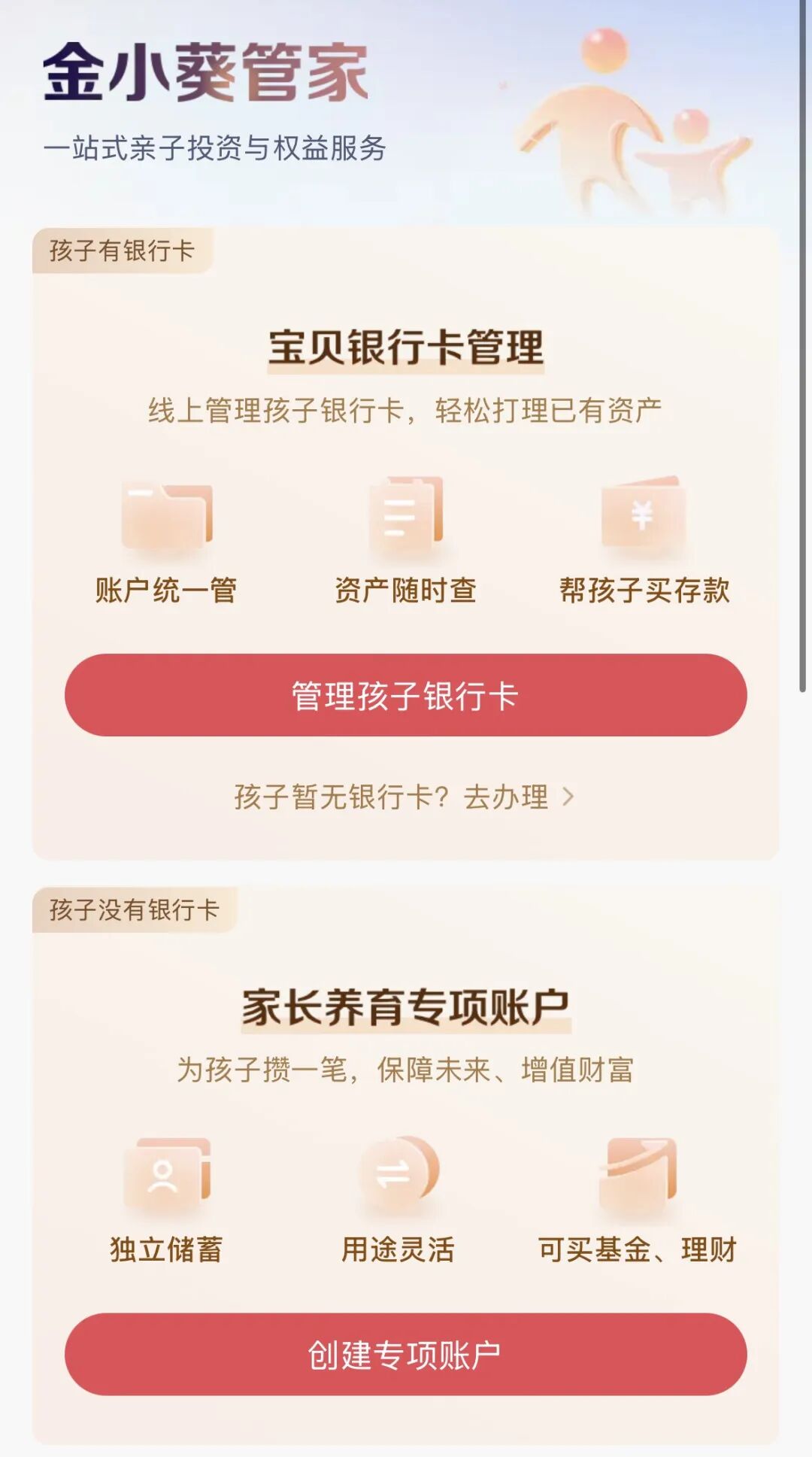
Core Viewpoint - The competition among financial institutions for managing children's "lucky money" has intensified, with banks offering attractive savings products specifically designed for minors, often featuring higher interest rates than traditional large-denomination deposits [1][4]. Group 1: Product Offerings - Many banks have introduced children's savings accounts with low minimum deposit requirements and waived card issuance fees, making them accessible to families [2]. - Specific products include the "伴宝贝成长" module from Industrial and Commercial Bank of China, which allows parents to add children's bank cards to family accounts, and the "金小葵" parent-child account from China Merchants Bank, which offers a variety of investment options [2]. - Interest rates for these children's savings products are competitive, with some banks offering rates higher than those for standard fixed-term deposits, such as Hangzhou Bank's 1.9% for a three-year term [3][4]. Group 2: Marketing Strategies - Banks are employing creative marketing strategies to attract both children and their parents, including colorful card designs featuring popular characters and customizable savings products that commemorate children's milestones [5]. - The design of children's bank cards has shifted to vibrant colors and fun patterns, with some banks offering limited edition cards that appeal to young customers [5]. - The introduction of themed savings products, such as the "压岁钱定制存单" from Dongnong Commercial Bank, reflects a trend of linking financial products to personal growth and family values [5]. Group 3: Changing Attitudes - There is a noticeable shift in how parents manage their children's "lucky money," moving from a model of parental control to a more collaborative approach where children are involved in financial decisions [6]. - Parents are increasingly viewing the management of "lucky money" as an opportunity for financial education, encouraging children to make informed choices about saving and investing [6].


银行竞逐宝贝经济:压岁钱产品利率“反超”20万大额存单
2 1 Shi Ji Jing Ji Bao Dao· 2026-02-25 08:34
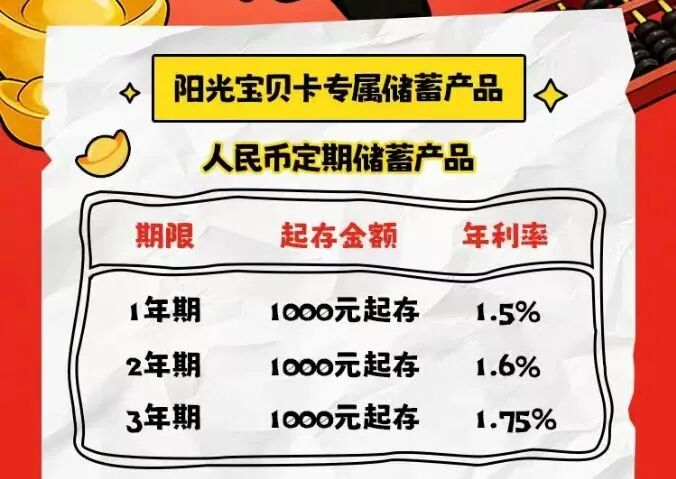
Core Viewpoint - Financial institutions are engaging in a "red envelope money competition" targeting minors, with banks offering attractive interest rates on children's savings products that surpass those of large-denomination time deposits [1][4]. Group 1: Product Offerings - Many banks have introduced children's savings accounts with low minimum deposit requirements and no account opening fees, making them accessible [1][3]. - For example, Beijing Bank's "Little Jing Red Envelope Treasure" offers interest rates of 1.5% for one year, 1.6% for two years, and 1.75% for three years, all starting from a minimum deposit of 1,000 yuan [3]. - Agricultural commercial banks are also launching tailored products, such as the "Sunshine Baby Card" with interest rates of 1.5%, 1.6%, and 1.75% for one, two, and three years, respectively [3]. Group 2: Marketing Strategies - Banks are employing creative marketing strategies, including vibrant card designs featuring popular characters and customizable options for children's savings accounts [5]. - Unique savings products, such as the "certainly above 985" themed deposit, are designed to resonate with parents' aspirations for their children [5]. - The marketing approach has shifted from traditional methods to more engaging and playful designs, appealing to both children and parents [5]. Group 3: Industry Trends - The trend of offering high interest rates on small deposits is driven by banks' need to secure low-cost, stable liabilities amid narrowing interest margins [6]. - The focus on children's savings accounts allows banks to establish long-term relationships with families, paving the way for future financial services such as education funds and insurance [6]. - Parents are increasingly viewing the management of red envelope money as part of financial education for their children, shifting from a model of parental control to shared management [7].
从高息存款到财富管理闭环,银行打响压岁钱“保卫战”
Hua Er Jie Jian Wen· 2026-02-25 07:13
Group 1 - The core idea of the article highlights the competitive landscape of children's financial products among banks, particularly during the Chinese New Year, leveraging the tradition of "lucky money" as a marketing tool to attract family asset allocation [2] - Banks are moving beyond mere marketing to establish systematic operational models, as evidenced by Beijing Bank's launch of the "Xiao Jing Card" and the "Xiao Jing Lucky Money" product, which offers a three-year fixed deposit rate of 1.75% with a low entry threshold of 1,000 yuan [2][3] - The industry consensus is shifting towards high-yield, low-threshold savings products for "lucky money," with examples including Guangxi Beibu Gulf Bank's "Dream Savings No. 1" at 1.9% for a minimum deposit of 50 yuan, and Jilin Bank's "Xiao Ji Savings" at 1.8% with a 10,000 yuan threshold [2] Group 2 - China Merchants Bank focuses on an ecological and scenario-based approach in wealth management, exemplified by the "Jin Xiao Kui" section in its mobile banking app, allowing parents to create dedicated accounts for their children [4] - The wealth management platform of China Merchants Bank promotes a variety of financial products based on the child's account activity, including a special fixed-income product with an annualized return of 2.84% [5] - The strategy of targeting children's "lucky money" accounts serves as a low-cost customer acquisition channel, potentially linking to parents' and even grandparents' accounts, indicating that children's finance is becoming a long-term focus for banks beyond seasonal marketing [5]
银行力推压岁钱专属存款产品
Zheng Quan Ri Bao· 2026-02-24 15:42
Core Viewpoint - Multiple banks are launching specialized deposit products for children's New Year money, such as "压岁宝" and "儿童存单," to attract market attention amid narrowing net interest margins and intensified deposit competition [1][2]. Group 1: Product Offerings - Banks are introducing children's deposit products with low minimum deposit amounts, some starting as low as 50 yuan, and interest rates generally higher than standard fixed-term deposits [1]. - For instance, 鄞州银行 offers a 3-year "儿童存单" with a maximum interest rate of 1.88% for new customers, while 北京银行's "小京压岁宝" has a 3-year annualized rate of 1.75% with a minimum deposit of 1,000 yuan [1]. - Other banks like 蒙商银行 and 北京农商行 are also providing competitive rates, with 北京农商行's rates for 1-year, 2-year, and 3-year terms being significantly higher than their standard rates [1]. Group 2: Financial Education and Services - In addition to deposit products, banks are launching account services tailored to children's financial education, such as 招商银行's "金小葵" for exclusive management of New Year money and 北京银行's "小京卡" for joint parent-child accounts [2]. - The focus on children's financial services indicates a strategic move by banks to cultivate customer loyalty from an early age and to create a comprehensive financial service ecosystem [2]. Group 3: Market Trends and Insights - The push into the children's financial market reflects the increasing competition in the financial sector, with banks aiming to establish a foundational customer base and secure a foothold in family financial services [2]. - As the demand for children's financial literacy continues to grow, banks are expected to enhance their product offerings and transition from seasonal marketing to regular services, including education fund planning and parent-child financial management [2].
密集推出专属金融产品与服务,多家银行争抢“小客户”!
Jin Rong Shi Bao· 2026-02-24 13:09
Group 1 - Several banks have launched children's exclusive financial products and services, offering higher interest rates and unique benefits to attract young customers [1][2] - For example, China Merchants Bank offers a one-year deposit rate of 1.3% and a two-year rate of 1.4%, both higher than its standard rates [1] - Beijing Bank's "Little Jing Ya Sui Bao" offers deposit rates of 1.60% and 1.75% for two and three-year terms, respectively, which are above its regular rates [1] Group 2 - Beijing Rural Commercial Bank introduced the "Sunshine Baby Card" with competitive rates of 1.5%, 1.6%, and 1.75% for one, two, and three-year terms, significantly higher than standard rates [2] - Various banks are also providing a range of children's financial products, including customized bank cards and special savings accounts, to engage both children and their parents [2][3] - The children's financial market is expanding, with banks taking on the role of educating financial literacy among children, thus creating a new growth area in retail banking [7] Group 3 - Banks are increasingly offering "managed" financial solutions that link children's savings to parental accounts, allowing for better asset management [3] - China Merchants Bank's "Golden Little Aui Manager" service includes features for managing children's bank cards and educational accounts [3] - The focus on children's financial services is expected to deepen, with banks needing to design targeted products that meet the diverse needs of families [7]
马年春节刚过完,聪明的家长悄悄将闲钱转入儿童银行账户
Jing Ji Guan Cha Wang· 2026-02-24 09:00
Core Insights - The article discusses the increasing trend of banks offering specialized savings products for children, particularly during the Chinese New Year, to attract young customers and their families [2][3][5]. Group 1: Children's Savings Products - Banks are launching exclusive savings products for children with higher interest rates compared to standard savings accounts. For instance, Beijing Bank's "Xiao Jing Card" offers a 3-year fixed deposit rate of 1.75%, while the standard rate is only 1.30% [2][3]. - Other banks, such as Beijing Rural Commercial Bank and Guangxi Beibu Gulf Bank, have also introduced similar products with competitive rates, indicating a market trend towards catering to children's savings [3]. Group 2: Financial Education and Services - Many banks are combining savings products with financial education initiatives, such as Minsheng Bank's "Financial Literacy Training Camp" and Ping An Bank's "Orange Baby Club," which provide age-appropriate financial courses [5]. - Banks are also creating parent-child zones that offer a range of services, including insurance, funds, and educational payments, enhancing the overall customer experience [4]. Group 3: Strategic Marketing and Customer Retention - Financial institutions view children's savings accounts as a long-term investment in customer relationships, aiming to establish emotional connections with young clients that can lead to higher conversion rates for future financial products [5]. - The strategy includes leveraging festive occasions like the Chinese New Year for proactive marketing, which helps banks secure stable deposits and enhance customer loyalty among affluent families [5].

存1000元比存20万元利率高,银行用“吃奶劲”抢压岁钱
Hua Xia Shi Bao· 2026-02-22 13:17
Core Insights - The article highlights the increasing focus of banks on children's financial education and the competition for the "lucky money" market during the Spring Festival, indicating a shift from merely attracting deposits to building long-term customer relationships [2][5]. Group 1: Market Trends - In 2026, commercial banks are launching specialized financial products centered around "lucky money" and "children's accounts," utilizing strategies like interest rate increases and unique benefits to convert this seasonal funding into a vital link with family customers [2][5]. - Major banks such as China Merchants Bank, Guangfa Bank, and Huaxia Bank are introducing dedicated financial products for children's lucky money, with offerings that include savings, investment, and insurance [5]. Group 2: Product Offerings - Beijing Rural Commercial Bank's "Sunshine Baby Card" offers a minimum deposit of 1,000 yuan with interest rates of 1.5%, 1.6%, and 1.75% for 1-year, 2-year, and 3-year terms, respectively, which are higher than standard rates [5]. - Other banks like Beijing Bank and Mengshang Bank are also providing competitive interest rates for children's savings accounts, with some rates exceeding those of regular fixed deposits [6]. Group 3: Customer Engagement Strategies - Banks are enhancing customer attraction through various promotional activities, such as prize draws and gifts for children who open accounts, thereby creating a more engaging experience [7]. - The introduction of "parent-child co-managed accounts" and financial education services signifies a shift towards comprehensive family financial services, moving beyond traditional deposit competition [10]. Group 4: Long-term Strategy - The strategy of offering high-interest rates on children's accounts is aimed at capturing long-term family value, as these accounts can lead to future banking relationships in areas like education loans and investments [9][11]. - By establishing early connections with young customers, banks can position themselves as integral to family wealth management, enhancing customer loyalty over decades [11].