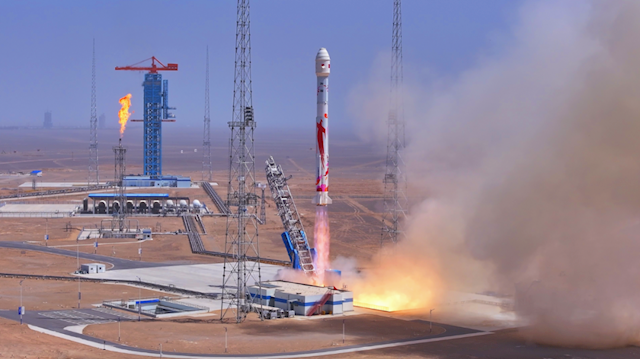
双曲线系列火箭

Search documents
北京火箭大街竣工
第一财经· 2026-01-19 15:24
Core Viewpoint - The article highlights the completion of the Beijing Rocket Street project, which will serve as China's first common research and production base for commercial aerospace, aiming to enhance innovation and ecological development in the industry [2][3]. Group 1: Project Overview - The Beijing Rocket Street project has a total construction area of 145,000 square meters and includes four main functional areas: common technology platform, innovation R&D center, high-end manufacturing center, and display and operation control center [2]. - The project will provide over ten shared services for satellite and rocket development, including various testing services and support for research and production [2]. Group 2: Industry Goals and Policies - Beijing Yizhuang aims to establish a 50 billion yuan commercial aerospace industry cluster by 2028, with a long-term goal of achieving "thousand enterprises linked, thousand stars launched, and thousand billion revenue" [3]. - The development of the commercial aerospace sector is supported by national strategies and local policies, with a focus on innovation and collaboration among various regions [3]. Group 3: Current Industry Status - In 2025, the "Yizhuang Arrow" is expected to successfully launch 24 times, delivering over 160 satellites, with the aerospace industry generating over 30 billion yuan in revenue [4]. - The industry faces challenges such as insufficient rocket capacity, low total supply, and high launch costs, with costs for Chinese commercial launches ranging from 50,000 to 150,000 yuan per kilogram compared to SpaceX's Falcon 9 at approximately 2,940 USD per kilogram [4]. Group 4: Collaborative Development - The industry has historically struggled with a "single-point breakthrough" approach, leading to inefficiencies and high costs [5]. - The completion of the Rocket Street project is expected to enhance the efficiency of the entire industry chain by providing accessible public service support for key testing and production processes [5].

北京火箭大街竣工,商业航天集群目标千星入轨、千亿营收
Di Yi Cai Jing· 2026-01-19 13:31
Group 1 - The Beijing Rocket Street project has completed construction and is now entering the delivery phase, becoming the first commercial aerospace common research and production base in China [1] - The total construction area of Beijing Rocket Street is 145,000 square meters, featuring four functional areas: common technology platform, innovation R&D center, high-end manufacturing center, and display and operation control center [1] - The project aims to provide over ten shared services, including various testing services and research production support services like 3D printing and reliable component supply [1] Group 2 - Beijing Yizhuang has gathered over 180 related enterprises in the commercial aerospace sector, with commercial rocket companies accounting for 75% of the national total [2] - The goal for the commercial aerospace industry in Yizhuang is to form a 50 billion-level industry cluster by 2028, progressing towards a target of "thousand enterprises linked, thousand stars in orbit, and thousand billion revenue" [2] - The development of the commercial aerospace sector is supported by national strategic guidance and local policy collaboration, with multiple provinces and cities implementing special support policies [2] Group 3 - In 2025, "Yizhuang Arrow" successfully launched 24 times, delivering over 160 satellites, with the aerospace industry generating over 30 billion yuan in revenue [3] - Challenges such as insufficient rocket capacity, low total supply, and high launch costs continue to hinder industry development, with launch costs in China ranging from 50,000 to 150,000 yuan per kilogram compared to SpaceX's Falcon 9 cost of approximately 2,940 USD per kilogram [3] - The report highlights the lack of collaboration and supporting facilities in the commercial aerospace industry chain, which leads to high costs across various segments [3] Group 4 - The root of the industry's challenges lies in a past development model characterized by "multiple single-point breakthroughs and insufficient collaboration" [4] - Under conditions of mass production, the launch cost of the "Tianlong-3" rocket is approaching that of the Falcon 9, and costs are expected to decrease further with the maturity of reuse technology [4] - The completion of Rocket Street provides essential public service support for key industry chain segments, allowing commercial aerospace companies to focus more on product iteration and improving overall industry efficiency [4]
朱雀腾空“箭”指苍穹 恒友汇解码中国商业航天崛起大势
Cai Fu Zai Xian· 2025-05-19 08:25
Core Insights - The successful launch of the Zhuque-2 rocket marks a significant milestone for Blue Arrow Aerospace and highlights the rapid development and maturation of China's commercial space industry [1][4] - The growth of China's commercial space sector is driven by a combination of government policy support, market demand, and technological innovation, indicating a strong upward trajectory [2][8] Industry Development - China's commercial space industry is seen as a key driver for high-quality economic development and technological advancement, with policies encouraging private investment in space infrastructure since 2014 [2][8] - The market demand for satellite internet, earth observation, and other emerging applications is surging, leading to explosive growth in the need for cost-effective and reliable commercial launch services [2][3] Market Potential - The global space economy is projected to exceed $1 trillion by 2030, with significant demand for low Earth orbit communication satellites driving the need for launch vehicles [3] - China's commercial space industry is expected to grow from a value of 1 trillion yuan in 2020 to approximately 2.3 trillion yuan by 2024, with a compound annual growth rate of 22.9% [3] Company Achievements - Blue Arrow Aerospace has established itself as a leader in commercial launch services, successfully completing multiple launches and enhancing its rocket technology, including the Zhuque-2's improved thrust and payload compatibility [5][9] - The number of commercial space companies in China has surpassed 500, covering the entire industry chain from rocket launch to satellite manufacturing [6] Investment Landscape - Investment in China's commercial space sector reached 18.1 billion yuan in 2024, with significant funding directed towards satellite internet and rocket launch services [7] - The emergence of unicorn companies in the sector reflects the growing confidence of investors in the long-term value of commercial space ventures [7][9] Future Outlook - The successful operation of the Zhuque-2 rocket and plans for the Zhuque-3, which aims to achieve reusable rocket technology, position Blue Arrow Aerospace as a potential leader in the global space market [9] - The commercial space industry in China is entering a phase of positive feedback loops driven by policy support, technological breakthroughs, and financial collaboration, suggesting a bright future for the sector [9]