
叮咚谷雨

Search documents
美团收购后,叮咚买菜管理层大调整
盐财经· 2026-03-10 10:14
Core Viewpoint - The article discusses significant management changes at the fresh e-commerce platform Dingdong Maicai, including the resignation of founder Liang Changlin as CEO and the appointment of former CFO Wang Song as the new CEO, following Meituan's acquisition of the company [2][5]. Group 1: Management Changes - Founder Liang Changlin resigns as CEO but will continue as Chairman of the Board, focusing on company strategy and governance [2]. - Wang Song, with nearly 20 years of experience in the consumer retail industry, takes over as CEO and has a strong background in financial management and supply chain integration [5]. - The CTO Jiang Xu will leave the company at the end of March, with responsibilities redistributed among the existing team [2]. Group 2: Acquisition and Financial Performance - Meituan announced a $717 million acquisition of Dingdong Maicai, which will become a wholly-owned subsidiary, with its financial results incorporated into Meituan's financial statements [5]. - Dingdong Maicai achieved a record quarterly revenue of 6.66 billion yuan in Q3 2025, marking a 1.9% year-over-year increase, and reported a non-GAAP net profit of 101.3 million yuan, with a net profit margin of 1.5% [5]. - Despite achieving profitability, Dingdong Maicai's net profit margin remains low at 1.2%-1.5%, facing competition from rivals like Meituan's Xiaoxiang Supermarket and Hema [6]. Group 3: Strategic Outlook - Liang Changlin emphasized that the acquisition does not weaken Dingdong Maicai's core capabilities but rather enhances its potential within a larger platform, improving product strength, service delivery, and supply chain efficiency [7]. - The company reassured stakeholders that operations and team structure would remain stable post-acquisition, maintaining its commitment to quality standards in product selection and delivery [7].


零售商新老势力混战“自有品牌” 谁能更胜一筹?
Mei Ri Jing Ji Xin Wen· 2025-12-09 14:53
Core Viewpoint - Walmart is intensifying its focus on private label brands, particularly "Wojixian," as a strategic response to competition from e-commerce and emerging retailers, while also addressing the declining image of its Sam's Club brand [1][2][4]. Group 1: Walmart's Strategy - Walmart's private label "Wojixian" has been upgraded to cover essential categories like fresh produce, food, and beverages, emphasizing low prices and health attributes [2][4]. - The company is facing challenges as traditional retail formats struggle against e-commerce platforms, prompting a shift towards private labels to enhance competitiveness [1][4]. - The strategy of launching private labels is seen as a "last resort" to revitalize the hypermarket format amid increasing competition [1][4]. Group 2: Market Competition - Other traditional retailers, such as RT-Mart, are also focusing on private labels, with a similar emphasis on low prices and health trends [2][4]. - New players like Hema and Dingdong Maicai have established private labels as core competitive advantages, highlighting the shift in market dynamics [6][9]. - The competition for quality suppliers is intensifying as both established and emerging retailers seek to enhance their private label offerings [7][8]. Group 3: Financial Performance - RT-Mart's parent company, Gao Xin Retail, reported a revenue decline of 12.1% year-on-year, indicating the financial pressures faced by traditional retailers [5]. - Walmart's performance in China is primarily driven by Sam's Club, while its hypermarket segment has been experiencing store closures [5]. Group 4: Private Label Development - The private label penetration varies significantly among retailers, with Aldi achieving a 90% share in China, while Hema's community stores have nearly 60% [7]. - Successful private label strategies require strong brand value and supply chain management to maintain competitive pricing and quality [7][8]. - Walmart's approach involves stringent supplier selection, with only a small percentage of potential suppliers making it through the rigorous evaluation process [8].

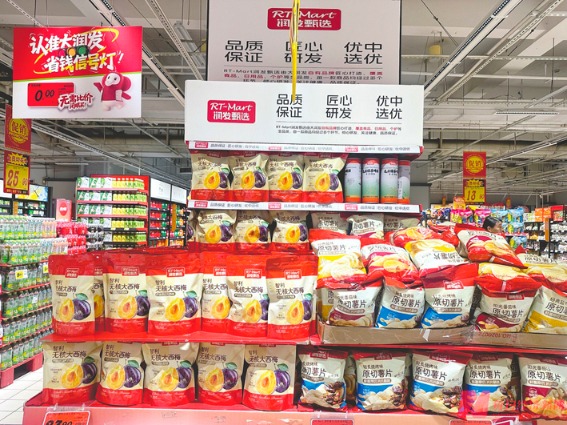
零售商新老势力混战“自有品牌”,谁能更胜一筹?
Mei Ri Jing Ji Xin Wen· 2025-12-09 14:43
Core Insights - Walmart is developing its private label "Wojixian" as a response to the declining image of its high-end membership store Sam's Club, indicating a strategic shift in its retail approach [1][2] - The competition in the retail market is intensifying, with traditional retailers like Walmart and RT-Mart facing pressure from e-commerce and emerging players [1][4] Group 1: Walmart's Strategy - Walmart's "Wojixian" brand focuses on affordability and health, with products prominently displayed at low price points [2][3] - The company is adopting a strategy similar to RT-Mart, which is also enhancing its private label offerings, emphasizing low prices and health attributes [2][3] - The shift towards private labels is seen as a necessary response to market competition and performance pressures, as evidenced by declining revenues and profits reported by RT-Mart's parent company [3][4] Group 2: Market Competition - New retail players like Hema and Dingdong Maicai have established their private labels as core competitive advantages, launching various products since 2017 [4][5] - The self-owned brand strategy is crucial for retailers to attract customers and improve profit margins by defining product standards and reducing intermediary costs [4][5] - The competition for quality suppliers is intensifying as traditional retailers ramp up their private label initiatives, with companies like Dingdong Maicai investing in direct sourcing and partnerships [5][6] Group 3: Supply Chain and Brand Development - The success of private labels relies heavily on effective supply chain management and the ability to create strong brand value [5][6] - Walmart is currently focusing on supplier selection and has a rigorous evaluation process for potential suppliers, which limits the number of partnerships [6] - The retail landscape is evolving, with established players like Walmart actively learning from newer competitors to enhance their product offerings and market positioning [6]